As three countries move to quit UK, a Brexit reversal might be its only hope
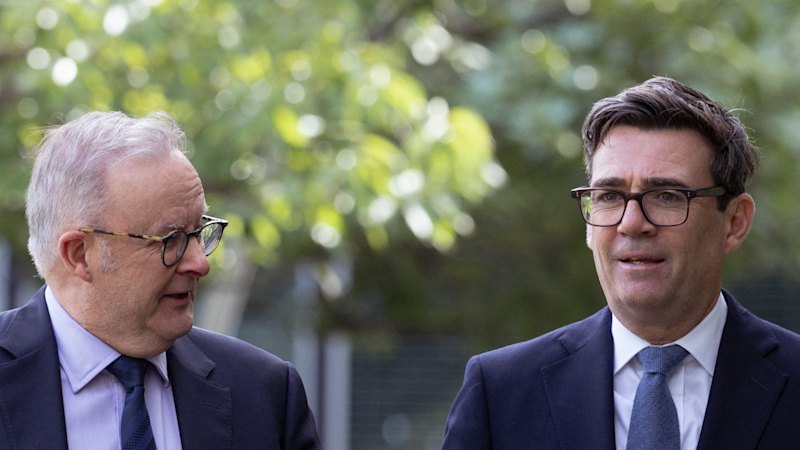
Among the many heads of government Anthony Albanese met during his successful visit to “Leaders Week” at the United Nations was Andy Burnham, the new prime minister of Great Britain. Such has been the turmoil in British politics over recent years that Burnham is the fifth UK prime minister during Albanese’s term – and the seventh since 2016. That was the year Britons voted to leave the European Union, thereby destroying the government of David Cameron – the last tenant of 10 Downing Street to serve a respectably long term in office (six years and two election wins).
That instability is all the more remarkable when one considers that of Britain’s three elections in the past decade, two were won by landslides – the Tories in 2019 and Labour in 2024. Yet both victorious leaders, Boris Johnson and Keir Starmer, were soon shown the door by their parties, despite what had initially seemed likely to be long incumbencies.
Although there has been a modest honeymoon for Burnham, just 10 weeks into the job the new prime minister is struggling to get to grips with the same issues that thwarted his ill-starred predecessor. According to the biggest opinion poll since Burnham’s accession, published last Thursday, Labour would now lose 171 of the 412 seats it won at the election. Neither Labour nor the aggregate of the two main right-wing parties (Conservative and Reform) would come anywhere close to the 326 seats needed for a majority in the House of Commons.
Almost three years remain in the current parliamentary term; things are only likely to get worse for Labour, while there are no signs of consolidation on the right.
There is an obvious similarity with the decade and a half of instability in Australian politics between the Ruddslide of 2007 and Albanese’s victory in 2022, just as there is a likeness between the current fragmentation on the right, with the rise of the populist radicals Nigel Farage and Pauline Hanson. Unlike Australia, however, the Balkanisation of British politics arises from factors deeper than mere frustration with the party system. The much overused word “existential” seems, for once, to be more than journalistic hype.
The acute stresses to the body politic of Britain have been manifested within the past fortnight in two different but related ways.
On September 14, the leaders of the provincial governments of Scotland, Wales and Northern Ireland met to sign “the Cardiff Declaration”, demanding self-determination for their respective territories. (The constitutional status of the three is rather confusing for those of us who are accustomed to regarding sub-national governments as states in a federation. Britain is not a federation. Scotland is a kingdom, Wales is a principality and Northern Ireland is a province. All have their own regional assemblies and governments, though subject ultimately to Westminster. All are united with England under the Crown.)
For the first time, following elections in May, the governments of all three countries – sometimes patronisingly called “the Celtic fringe” – are led by parties whose principal platform is separation from the United Kingdom. The Cardiff Declaration is a mutual commitment to hold referendums to do so.
In Wales, where separatism is the weakest of the three, there has never been an independence referendum. An independence referendum was held in 2014 in Scotland, which failed relatively narrowly (55-45); in the years since, the Scottish National Party has relentlessly campaigned for another. In Northern Ireland, the position is more complicated. There, separation from the UK means union with the Republic of Ireland, which is favoured by all of the major parties south of the border, and which the Good Friday Agreement of 1998 (which ended “the Troubles”) conditionally allows for as a possible long-term outcome.
It may well be that after the next UK general election, the only way Labour could form a government would be with the support of the Scottish National Party, which would undoubtedly demand a second referendum as its price. (The SNP would never support a Tory or a Reform government.) There is an interesting historical parallel: after the 1885 election, the Liberal titan William Gladstone could only form a government relying on Irish nationalists, who demanded Home Rule as the condition of their support.
Nationalists in Scotland and Wales see their future as independent nations within the European Union. They are not too small: 10 of the 27 EU member states have populations smaller than Scotland and seven are smaller than Wales. Ireland has long been an enthusiastic member of the bloc.
Ten years on, the UK continues to be vexed by Brexit. While Starmer took Labour to the last election refusing to entertain the issue of Britain rejoining the EU, last week Burnham deliberately reopened the question by refusing to rule out Labour taking a policy for a second referendum to the next election. The following day, former Labour PM Tony Blair jumped on board, arguing that Labour should commit to Britain resuming membership within a decade. Meanwhile, the European Commission president Ursula von der Leyen welcomed the possibility, in the interim, of Britain becoming an “associate member”, as Canada has just done.
Come the next election, Burnham may well calculate that the promise of a second referendum on EU membership might save Labour seats in Scotland and Wales – and, potentially, save not just his government, but the Union itself. Until then, he will continue to hide behind Brexit as a convenient excuse for his government’s failure to deal with Britain’s crippling economic woes.
The next chapter of British politics will be significantly defined by the interplay between the centrifugal force of Celtic nationalism and the gravitational attraction of European internationalism.
George Brandis is a former high commissioner to the UK, and a former Liberal senator and federal attorney-general. He is now a professor at the ANU’s National Security College.
Get a weekly wrap of views that will challenge, champion and inform your own. Sign up for our Opinion newsletter.
KioskNews shows a cleaned-up reading view extracted from the publisher’s page — the original always lives on their site, not ours.