Why food prices may rise and stay elevated
June, the opening month of the season, witnesses an average of three low-pressure systems (LPS) that cover a 24-hour period of about 11 days. This time, not a single LPS — which brings rain as warm, moist air near the ground rises into the atmosphere, where it cools and condenses into clouds — was formed. Rainfall over India as a whole was, then, 38% below the normal long-period average (LPA) for the month.
July, by contrast, saw four LPSs, close to the climatological average for the month. Since each of these systems persisted for relatively longer durations, the total LPS days, at 24, were higher than the average of 13.56 days for the month. These led to good rainfall, which was 1% above the overall LPA for the country in July.
August was when the effects of El Niño started showing up. Six LPSs were formed during the month, against the climatological average of 5.38. The number of LPS days, at 26, also exceeded the normal of 16.3 days for August. Yet, the month registered an all-India rainfall deficit of 16.3% over the LPA. The formation of LPSs wasn’t enough, because the weakening of the easterly trade winds (blowing from east to west) due to El Niño reduced the transport of moisture-laden air towards the Indian subcontinent.
In all, then, this hasn’t been a great monsoon. All-India rainfall for the four-month season has cumulatively been 14.7% below the LPA as on September 13. Moreover, as many as 24 out of the country’s 36 meteorological subdivisions have recorded deficiency in excess of 10%. The southern states, together with the adjoining Marathwada and Vidarbha regions of Maharashtra, have been the worst-affected.
Impact of the deficient monsoon
According to the Agriculture Ministry, the total area sown under kharif (monsoon season) crops, at 1,086.3 lakh hectares (lh) as of September 4, is only 1.6% below the 1,104 lh for the same period of 2025.
But acreage shortfall alone may not give the real picture. A better indicator is fertiliser sales, the latest data for which is available till July.
Story continues below this ad
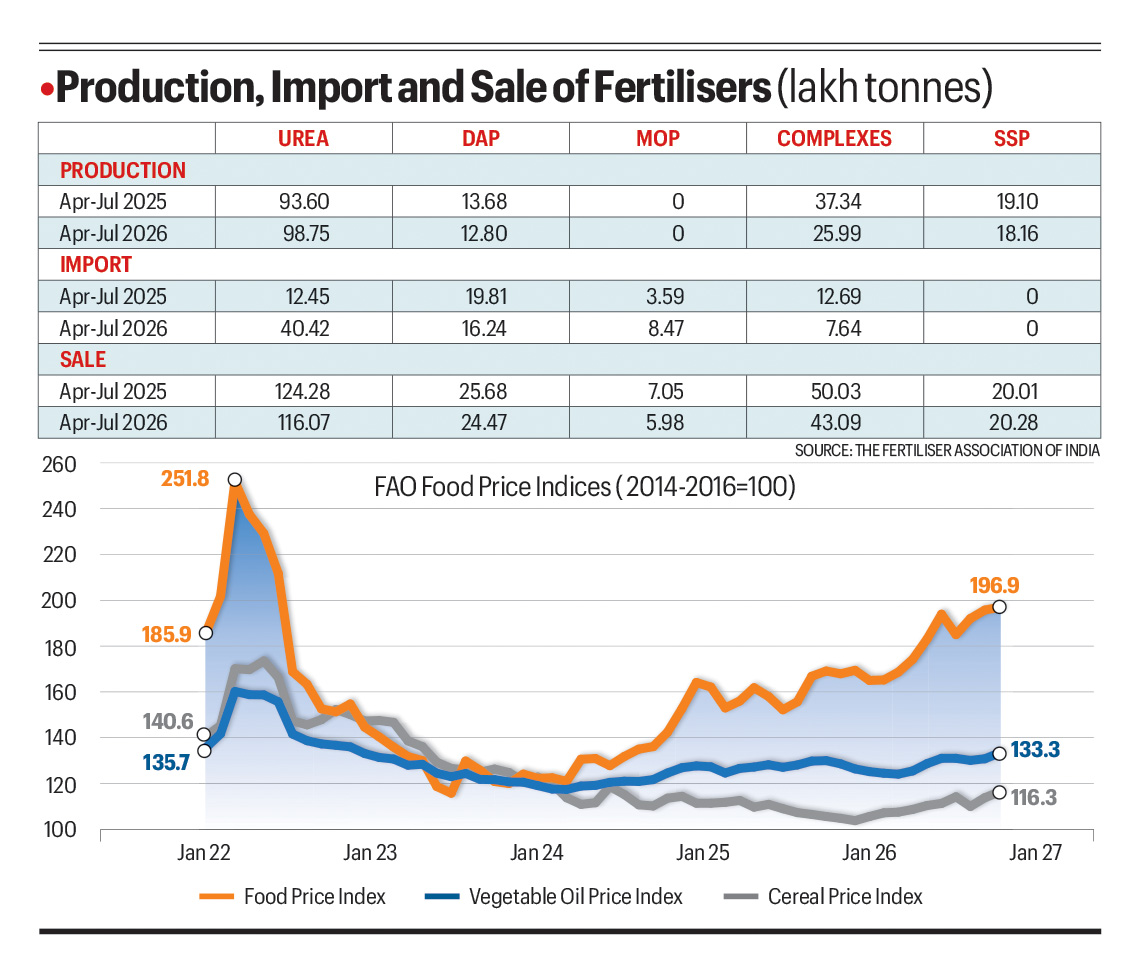
The accompanying table shows sales of di-ammonium phosphate, muriate of potash and complex fertilisers (containing nitrogen, phosphorous, potassium and sulphur in different combinations) to be significantly lower in April-July 2026 over April-July 2025. Only single super phosphate sales are marginally higher. Interestingly, even urea has posted a 6.6% sales decline, despite the government’s policy interventions to ensure adequate availability of natural gas for domestic production and also imports, amid the West Asia-induced supply shocks.
Even better an indicator is prices. Maize is currently selling in Madhya Pradesh’s Chhindwara wholesale market at around Rs 2,625 per quintal, up from Rs 2,165 last year at this time. The same goes for arhar (pigeon pea) in Maharashtra’s Akola (Rs 8,600 versus Rs 6,280/quintal) and for soyabean in MP’s Dewas (Rs 6,150 versus Rs 4,300/quintals) markets.
The higher prices are a reflection of sentiment and expectations of crop size among traders and other market participants – bullish for now. The United States Department of Agriculture has already forecast India’s rice and maize production to fall to 147 million tonnes (mt) and 50 mt respectively, from the previous year’s all-time-highs of 154 mt and 55.1 mt.
Simply put, El Niño’s impact has not been small. While the headline kharif sowing acreage gap may not seem much, the uneven temporal (extended dry spells interspersed with heavy downpours) and spatial distribution of rainfall (largely confined to Odisha, Chhattisgarh, eastern MP, Gangetic West Bengal, Jharkhand and Uttar Pradesh) is likely to translate into lower yields and harvested produce.
Looking ahead
Story continues below this ad
El Niño is now in a “strong” state, with average sea surface temperatures (SST) in the equatorial Pacific Ocean off the coasts of Ecuador and Peru roughly 1.8 degrees Celsius higher than normal.
The US National Oceanic and Atmospheric Administration has projected a 90%-plus chance of a “very strong” (SSTs more than 2ºC above normal) El Niño event developing and lasting from September through January. El Niño will remain “strong” (SSTs more than 1.5ºC above normal) till March and “weak-to-moderate” (0.5ºC to 1.5ºC above normal) till May.
El Niño is known to not only suppress rainfall, but also raise temperatures in India. If it were to turn very strong over the next 4-5 months, the result could be a relatively short and warm winter. The crops grown in the upcoming rabi (winter-spring) season — from wheat, rapeseed-mustard, chana (chickpea), masoor (red lentil) and matar (green peas) to potato, onion, garlic, jeera (cumin), saunf (fennel) and dhaniya (coriander) — may the ones that would bear the brunt.
Equally important is world prices. The conflict in West Asia hasn’t led to any dramatic spike in global food prices, unlike at the time of Russia’s invasion of Ukraine in 2022. The reason: ample stocks from back-to-back bumper crops in 2024-25 and 2025-26, with record output of wheat, rice, maize/corn, sugar and even soyabean, rapeseed and palm oil.
That scenario is changing.
Story continues below this ad
The UN Food and Agriculture Organization’s (FAO) food price index in August, at 133.3 points, was the highest since November 2022. The index — a weighted average of world prices of a basket of food commodities over a base period value (taken at 100 for 2014-16) — is well below the all-time-high of 160.2 points scaled in March 2022.
But with a running down of stocks, disrupted trade logistics from escalating geopolitical tensions both in West Asia and Russa-Ukraine, and a strengthening El Niño, the direction of global prices could be further northward. The FAO index for vegetable oils in August was the highest since June 2022, with even that for cereals edging up to a 27-month high (see chart).
The inflation pressures are at present mainly in vegetable oils. Landed prices of imported crude palm, soyabean and sunflower oil in Mumbai, at $1,285, $1,300 and $1,450 per tonne respectively, are above their September 2025 average levels of $1,164, $1,182 and $1,293, as per data from the Solvent Extractors’ Association of India.
There’s a tightening happening in cereal markets too. Export prices of wheat from Argentina have firmed up from $228 to $262 per tonne in the last one year, while even more for grain from European Union ($226 to $290), Australia ($251 to $319) and the US ($235 to $354). Corn from Argentina and Brazil are similarly being exported at $219 and $238 per tonne, against $200 and $210 a year ago.
Story continues below this ad
All this points to food inflation making a return and staying elevated going ahead.
KioskNews shows a cleaned-up reading view extracted from the publisher’s page — the original always lives on their site, not ours.