Donovan’s Deep Dives: Taiwan’s election machinery faces a test
As the nine-in-one vote approaches, complex logistics and controversies at the Central Election Commission put the mechanics of democracy under scrutiny
By Courtney Donovan Smith 石東文 / Staff columnist


Some consider how Taiwan conducts elections a model other countries should emulate. There are good reasons to do so, considering the messy outcomes in some other countries, such as the current seemingly endless wait for the final US midterm results. However, Taiwan’s system does have some aspects that are controversial, including the lack of absentee ballots.
Election logistics are crucial in ensuring fair, democratic results. Considering its fundamental role in ensuring the health and basic functioning of a democracy, it should get more attention and scrutiny than it does.
Unfortunately, the public rarely gives it much thought until something goes wrong or the race is very tight. How complex the voting in the Nov. 28 nine-in-one elections is depends on where one lives. As the name indicates, nine categories of local public office are on the ballot, but not all apply to all voters. There is also one referendum item on the ballot on nuclear power, a perennial favorite.
The plaque of the Central Election Commission in Taipei is pictured in an undated photograph.
Photo: Taipei Times
In the big six special municipalities — Taipei, New Taipei City, Taoyuan, Taichung, Tainan and Kaohsiung — voters will choose their mayor and city councillors for their district. They will also vote on their local neighborhood borough chief, which is a hyper-local position that serves as a liaison between the local community and the city government.
Unlike elections for ordinary single-member legislative constituencies, most local council constituencies elect multiple members. This creates a very complicated strategic problem for parties because if too many of their supporters vote for one of their candidates, their other candidates could lose. To maximize support for their entire slate, parties will encourage their supporters to spread their votes. One example is to instruct voters to pick which candidate to vote for by birth month, so if you are born between January and March, vote for candidate A, but for April and June, vote for candidate B, and so on.
Outside of the big six cities, there are 13 counties and three cities. Under the county governments are city, township and village governments. So, for example, Changhua and Yuanlin cities have their own governments under the Changhua County government.
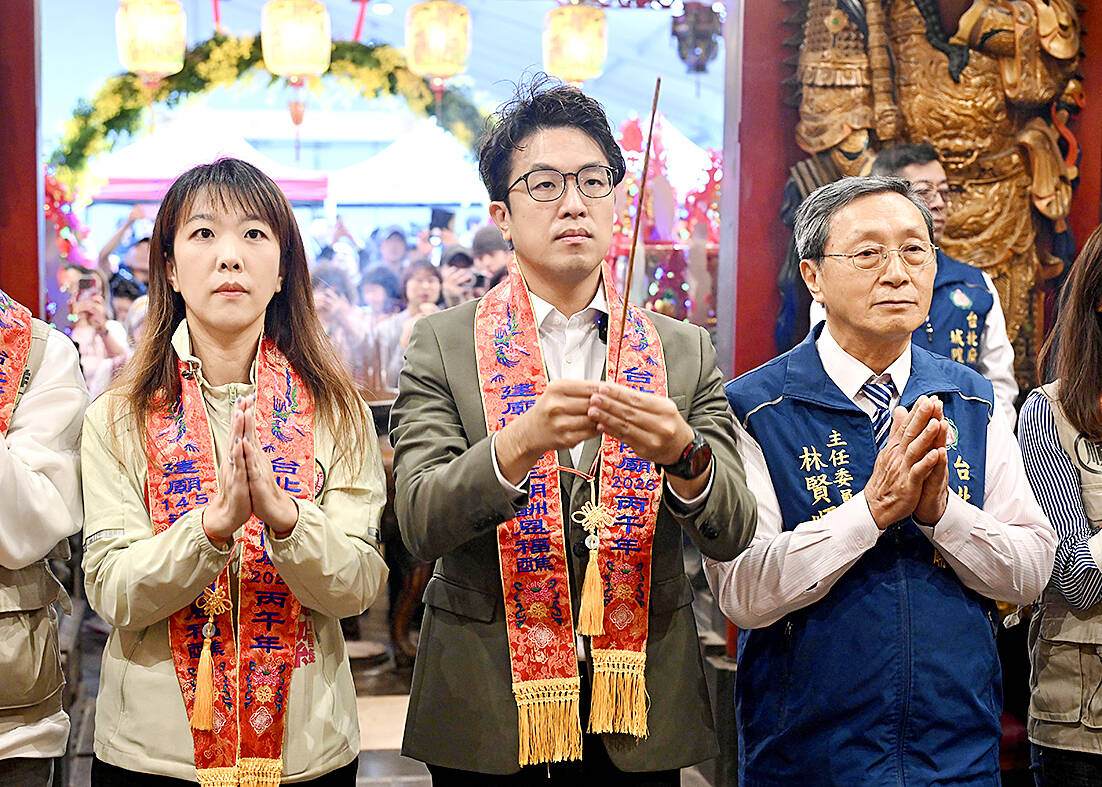
Democratic Progressive Party Taipei mayoral candidate Puma Shen on Sunday attends the City God Cultural Festival in Taipei. Some pundits say that voters shouldn’t be allowed to wear Puma-branded sports apparel when voting because it constitutes a violation of campaign rules.
Photo: Peter Lo, Taipei Times
If the indigenous population in a locale passes a certain threshold, council seats are set aside for indigenous voters.
Typically, elections are remarkably smooth and efficient. To avoid the potential for fraud or overseas interference, voters are required to show up in person in the district where their household registration is. Though effective for reducing potential fraud, this creates an added hurdle for voters living, working and studying in another city. Younger voters, especially students, often balk at the financial costs and time required to travel home to vote.
Taiwan’s dark history of electoral fraud and its unique national security risks of Chinese pressure on voters based overseas make introducing absentee voting controversial. It is inconvenient for some, but it does make it much more costly for China’s united front to interfere with Taiwan’s elections. They offer discounted airfare to Taiwanese based in China on the theory they are more likely to vote for candidates they prefer, which may be true, but is enormously expensive.
On voting day, polls open at 8am and close at 4pm. There are rules against filming, intimidation, campaigning and so forth near the polls. Local news has been running interviews with lawyers’ opinions on whether Taipei voters can wear Puma-branded sports apparel when voting, or if it constitutes a violation of campaigning rules because of Democratic Progressive Party (DPP) mayoral candidate Puma Shen’s (沈伯洋) English name.
This year, there will be an estimated 19.65 million people eligible to cast ballots for 11,051 local public officials chosen across 8,906 electoral districts and 18,244 polling stations. To handle all this, over a quarter of a million election workers will be on hand, which is more than one percent of the entire population.
After polls close, vote counting begins. It is open for the public to witness. For every vote cast, a worker calls out in a sing-song voice the result, and another worker tallies it on a large board.
Typically, the results are known by roughly 8pm or 9pm, though a few areas may take a little longer. An exception was the 2018 election, which faced the messy logistical challenge of also having 10 referendum questions on the ballot.
THE CONTROVERSIAL CEC AND YOU
The entire process is overseen by the Central Election Commission (CEC), which has been at the center of some controversies this year.
The CEC is mandated to have nine to 11 commissioners, but currently only has eight. In March, the opposition-controlled legislature rejected three of the seven nominees put forth by the Executive Yuan, and again in July shot down three more. Fortunately, unlike when the legislature shot down nominees for the Constitutional Court and National Communications Commission and rendered them inoperable, the CEC only requires five commissioners to form a quorum, so they are still able to function.
The one nominee the legislature approved in March for the CEC was the controversial Michael You (游盈隆). His academic credentials for the job are suitable, but he is famous for being the former chair of the polling outfit Taiwanese Public Opinion Foundation (TPOF). In my 2024 Weighted Poll of Polls, I ranked TPOF as “low reliability” due to erratic results from month to month, but to their credit, they often asked interesting poll questions.
You was previously active in DPP politics, but quit the party in 2019 and grew increasingly critical of his former party, which made him acceptable to the opposition parties. He has fortunately shown some backbone as CEC chair and made decisions offending people across party lines.
He rejected two of the three referendum items approved by the legislature, both for solid reasons. One was to affirm the death penalty, but You correctly pointed out it legally remains on the books, so it was unnecessary.
You said the other, which intended to introduce caning as a criminal punishment, did not require a referendum because it could be passed by the legislature. This was an important decision. It put the onus on introducing caning firmly in the opposition caucus’ laps, which they have so far declined to do. Passing a caning law would draw international condemnation, and by depriving the opposition of the excuse of “but the people want it,” they know that condemnation would fall squarely on their heads.
In June, the legislature lifted restrictions on candidates with a deferred sentence or who are eligible to commute their term to community service to participate in elections. This controversially opened the door for opposition-backed independent Hsinchu Mayor Ann Kao (高虹安) to run for re-election.
The CEC dutifully followed the new law, but opposition parties were less happy about it enforcing the laws on eligibility for China-born nationals being required to prove they cancelled their household registration there at least 10 years ago. The outcry was relatively muted, however, as the candidates disqualified were mostly not members of the main opposition parties, or were running for minor offices.
More seriously, You had to apologize after it was discovered by the Taiwan Go Go alliance of four smaller parties that the national ID numbers of more than 1,500 candidates running for office, including those of top politicians, were reportedly exposed on the CEC Web site for 11 days. At a news conference, You blamed the lapse on “negligent” handling by a third-party contractor, but said, “This kind of thing should not have happened.” No kidding.
Ultimately, despite the controversies, You’s final test will be election day. Hopefully, it runs smoothly.
Donovan’s Deep Dives is a regular column by Courtney Donovan Smith (石東文) who writes in-depth analysis on everything about Taiwan’s political scene and geopolitics. Donovan is also the central Taiwan correspondent at ICRT FM100 Radio News, co-publisher of Compass Magazine, co-founder Taiwan Report (report.tw) and former chair of the Taichung American Chamber of Commerce. Follow him on X: @donovan_smith.
KioskNews shows a cleaned-up reading view extracted from the publisher’s page — the original always lives on their site, not ours.