Turning invitations into arrests is making citizens reluctant to assist police – Twumasi Ankrah
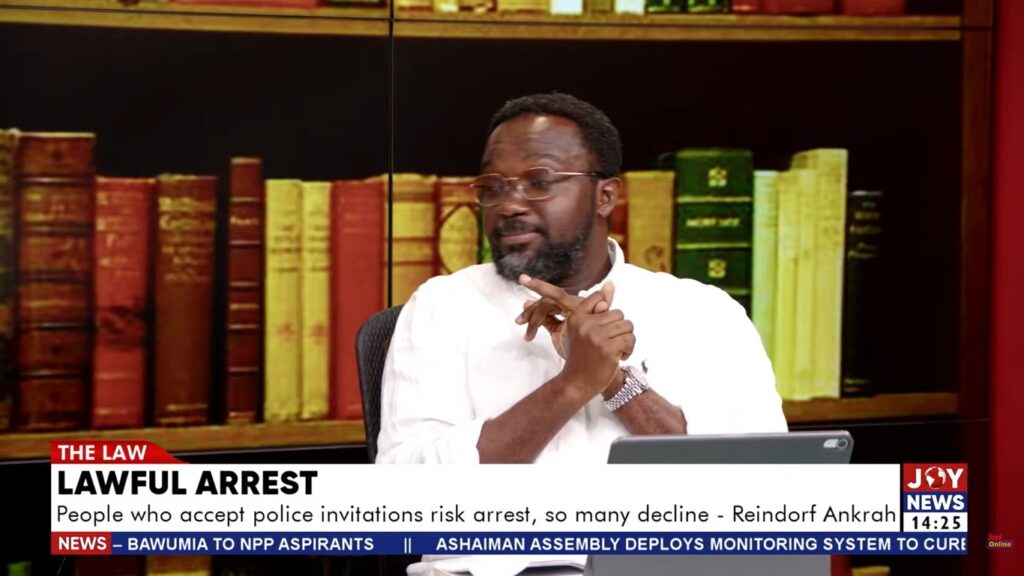
Private legal practitioner Reindorf Twumasi Ankrah has warned that the practice of arresting people after inviting them to assist investigations is making citizens increasingly reluctant to cooperate with the police.
Mr Twumasi Ankrah, who is the acting Chief Executive Officer of the Ghana Integrated Aluminium Development Corporation (GIADEC), said the uncertainty surrounding such invitations had created fear among people willing to provide information to investigators.
Speaking to Samson Lardy on The Law on JoyNews on Sunday, October 4, 2026, he argued that law enforcement agencies must address the apprehension their practices had generated.
“The practice has shown over the years that when people willingly submit themselves or attend to an invitation extended to them by the police or any other institution with the power to effect arrest, they end up being arrested,” he said.
According to him, some citizens now prefer to wait for a formal arrest rather than voluntarily honour an invitation that could result in unexpected detention.
“So, with the benefit of that practice, people now have also taken a position not to honour such invitations and to say to them that you come and now exercise your powers of arrest; then they know that properly they are a suspect,” he explained.
Mr Twumasi Ankrah acknowledged that invitations were a legitimate and prudent means of obtaining information, particularly when investigators had not established whether an individual should be considered a suspect.
An invitation, he explained, could simply require someone to supply documents or clarify facts relevant to a case involving another person.
However, he said the repeated use of invitations that subsequently led to arrests had undermined citizens’ confidence in the process.
“They have so often created, turned an invitation into an arrest that the people have now become apprehensive,” he stated.
He said this had left citizens balancing their willingness to help investigators establish the truth against concerns about their personal liberty.
“There is this genuine fear as to whether it is imminent or remote, that when they go, there is a likelihood they won’t come back home. So, the police also have some work to do in that regard,” he said.
Mr Twumasi Ankrah advised individuals to seek legal representation when attending an invitation, given the possibility that their role in an investigation could change.
“You go with your lawyer to pre-empt anything that may happen which was not within your contemplation,” he said.
He further argued that once officers prevented an individual from leaving, they had to recognise the change from voluntary attendance to detention and safeguard the person’s constitutional rights.
DISCLAIMER: The Views, Comments, Opinions, Contributions and Statements made by Readers and Contributors on this platform do not necessarily represent the views or policy of Multimedia Group Limited.
Tags:
DISCLAIMER: The Views, Comments, Opinions, Contributions and Statements made by Readers and Contributors on this platform do not necessarily represent the views or policy of Multimedia Group Limited.
KioskNews shows a cleaned-up reading view extracted from the publisher’s page — the original always lives on their site, not ours.