4.48 Psychosis review – a dazzling, harrowing opera worthy of Sarah Kane’s furious writing

Sarah Kane revolutionised British theatre with five provocative plays written between 1995 and 1999. Her final work, 4.48 Psychosis, was her most personal, confronting the clinical depression she struggled with for years. The play was first performed posthumously in 2000, after she died by suicide in 1999.
The Royal Opera and Guildhall School of Music and Drama commissioned Philip Venables to adapt the play as an opera, which debuted in 2016. The composer, also known for a certain “in-yer-face” approach, set Kane’s original text almost entirely, realising its 24 disjointed sections in a raw, imaginative score teeming with minimalist licks, prickly synth-pop and consoling nods to the baroque. The libretto shifts between poetic abstraction and scathing exchanges between a patient and a psychologist. An ensemble of six female singers navigates themes of depression, isolation and the agonising choices surrounding medication.
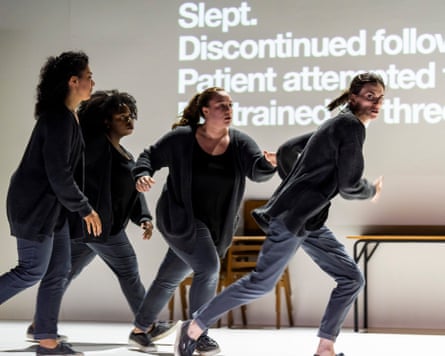
Venables’ adaptation successfully leverages the unique capabilities of music, tapping into Kane’s non-linear prosody and use of verbal repetition. His dazzling score overlaps vocal lines, introducing a structural complexity that traditional theatre cannot easily replicate. The sprawling narrative is anchored by a single spoken voice over a loudspeaker, evoking Kane’s authorial presence.
Where matters occasionally falter is in the music’s tendency to prescribe the emotional temperature by tying it to the six-part polyphonic chorus. Tightly controlled, it tethers the freedom of interpretation inherent in Kane’s furious text. Although Venables retains the spoken voice in places, and the opera is an extremely harrowing experience, it tempers the play’s potential to shock.
Ted Huffman’s 10-year-old production is successfully revived here with a subtly revised ending. Astute and economical direction ensures the action remains fluid yet focused within Hannah Clark’s institutional white box set. DM Wood’s stark lighting is laser-focused while the amplified sound design lends a kick up the backside to Venable’s most brutal musical onslaughts.
London-based collective Chroma forms the 14-piece chamber orchestra perched above the action. The anarchic orchestrations, which feature a trio of saxophones, piano synthesiser and accordion, hiss with a fierce violence contrasting with moments of hushed beauty and the unsettling sounds of distant waiting-room muzak. Projected text is paired with duelling percussion instruments (including bass drums, carpenter’s saw and shop-counter bell) to punctuate the patient-doctor dialogues bringing brief moments of levity. Catherine Ring and Delia Stevens attack their instruments with sticks and hands, dramatic intent writ large on their faces.
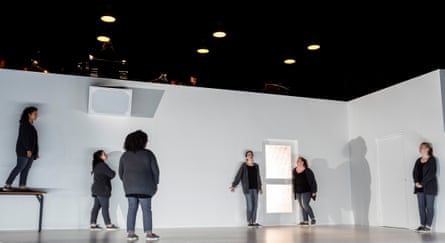
Conductor Naomi Woo brings an arresting immediacy to Venables’ complex score while the six fearless singers – Jacquelyn Stucker, Hannah Edmunds, Sophia Burgos, Veena Akama-Makia, Lauren Young and Marta Fontanals-Simmons – perform with preternatural accuracy. Costumed identically, Huffman suggests – as Kane does – that they may all be fragments of the one fractured personality. Nevertheless, Stucker stands out as the deeply troubled protagonist in a searingly honest and frequently heart-rending performance.
KioskNews shows a cleaned-up reading view extracted from the publisher’s page — the original always lives on their site, not ours.