King Lear review – David Threlfall makes a moving Lear, but why is he playing the Fool too?
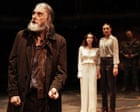
The TV series Succession was partly modelled on King Lear, the family name Roy derived from the monarchic French roi. Returning the compliment, Matthew Dunster’s production centralises dynastic dynamics among the young as they plot around a splintering figurehead.
The reading is supported by a modern setting – jeans, car keys and handguns for hessian, horses and swords – on an Anna Fleischle set of spangly strings variously dividing the stage into a nightclub, England and France, dungeons and, in the storm scene, serving as shower curtains to keep theatregoers dry.
In a play notable for repeated words, versions of Lear are revealed through verbal italicisation. Titas Halder’s recent Sheffield staging with Ian McDiarmid stressed nothing and other nihilisms, emphasising the end days of a man and society. Dunster underlines references to parenting and siblings – Jonathan Slinger’s unusually unpleasant Gloucester seems to have brought up Edmund and Edgar using Lear’s childcare manual – and, more conventionally, to senility, David Threlfall’s King feeling neurologically forensic.
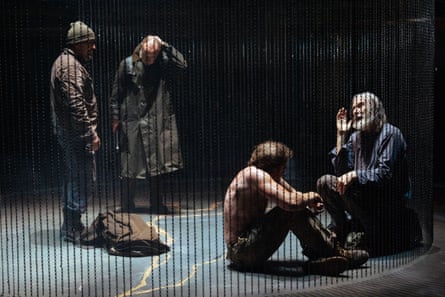
Otherwise, Dunster is notably disruptive. Starting with Threlfall alone on stage delivering a speech from act III, he gives the younger generation introductory erotic dumb shows. The Mercury prize-nominated musician Nadine Shah becomes surely the first Goneril or composer for a staging of King Lear to mime sex to her own pulsing compositions. This accentuation of seduction as a power tactic and the implied significance of procreation to inheritance fits the brutal triangle of the final act – Paddy Stafford’s Edmund lasciviously tasting two glasses of wine as he juggles Lear’s daughters – but can feel like Succession becoming Game of Thrones.
The most seismic rewrite removes a great Shakespearean character. Threlfall doubles as monarch and his Fool, doing both halves of their duologues like a ventriloquist whose mouth moves. When Jonathan Pryce’s Hamlet also played King Hamlet’s ghost, almost vomiting the lines, there was a sense of demonic possession. In this case, speaking to the unseen can be a dementia symptom but the change means we lose the one candid truth-teller to Lear. This could be an editorial point about the absolute insularity that destroys the powerful, but the casting-off adds another hole to a play that already bears one in the title character’s long act IV absence and makes the wonky trial scene even odder.

Within this gimmickry, Threlfall delivers a fairly classic Lear, deeply affecting in the deathbed scenes but, having established the character’s nationalism, winning a big laugh with the usually nothing line, “Am I in France?” Isobel Akuwudike intriguingly suggests Cordelia may have inherited her dad’s wilful anger.
King Lear’s word reverberations include more than 40 uses of “letters” or “note”, and Dunster makes this unusually tangible: some correspondence generally only spoken of is delivered and opened; the kingdom of this Lear boasts an impressive Royal Mail. The director, you suspect, will get a lot of missives about the spectre jester. Lear without Fool is, in two senses, not funny.
KioskNews shows a cleaned-up reading view extracted from the publisher’s page — the original always lives on their site, not ours.