Europe is a blast – but more a curse than a blessing if you are not a Premier League super-club I Jonathan Wilson

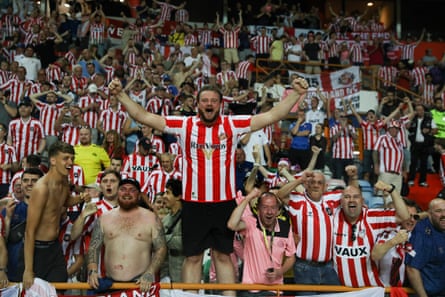
The sun shone. The temperature was in the high 20s. There was a mood of great conviviality. If you were struggling with the official allocation, it turned out you could just email the president of Torreense and he’d sort you out. Were these “Nuno-tickets” real? It turned out they were. Not only that, but you could sit anywhere you wanted in a stadium too big for the game and, if you happened to have gravitated to the comfortable hospitality seating at the back of the lower tier, the beer was inexplicably free.
Locals in Leiria seemed bewildered but could hardly have been more accommodating. A beer pump had been installed outside a patisserie on the Praça Francisco Rodrigues Lobo, whose owner soon found fans happy to help stack empty barrels if that facilitated the free flow of Sagres. “There was a meeting at the town hall to explain these are not hooligans,” said the owner of a radical leftist flammkuchen restaurant between the square and the cathedral. “They told us the club comes from the labour movement and I found that very interesting.” And how had she found the fans? “Noisy, but with a quirky sense of humour.”
This was everything Sunderland fans could have wished for from their first European away game in 53 years and more. They had seen other fans experience these things, and now they could tick off the checklist: complicated travel to a pretty foreign town they would otherwise never visit, a fussy Albanian referee and a great sense of togetherness and community. There was even an injury-time winner from, miracle of miracles, Noah Sadiki.
Ask any of the 5,000 or so Wearsiders who made the trip to Portugal if the Europa League was worth it and the answer would be unanimous. Bournemouth, Crystal Palace and Brighton fans would surely say something similar: European football, especially for clubs who are unfamiliar with it, is a joy and an adventure. It generates experiences that will be remembered for ever, and if the cost is that the risk of relegation goes up, that’s a price worth paying. Others at those clubs may see things differently.
The four Premier League clubs involved in the lesser two European competitions play each other on Sunday. Brighton are thriving; the other three are not. Palace were 12th before the weekend fixtures but not playing well. Bournemouth against Sunderland is a battle of third- and fourth-bottom. Whether the Europa League football can yet be blamed is debatable. Brighton surely can’t be bucking the trend just because of the lesser demands of the Conference League. Thursday’s was only the second round of Europa League league games, and the clubs involved bypassed a round of the Carabao Cup; fatigue may come but it shouldn’t be an issue yet.
There are other factors at play. Sunderland have already played Manchester City, Arsenal, Brighton and Brentford, the top four going into this weekend. They could easily have been a couple of goals up by half-time at Brentford. They missed a penalty to go ahead against Arsenal. They registered an xG of 2.72 in losing 5-3 at Manchester City. Only in the defeat to Brighton last weekend have they really disappointed. In the equivalent six games last season (substituting Ipswich for Burnley), Sunderland took only one point; in that sense, they are actually three points better off this campaign.
But that can’t alter the fact that four points from six games leaves them beginning to fret. There is pressure on this next run of fixtures: after Bournemouth, they are home to Leeds, then away to Coventry. Sunderland’s transfer business left a major question on the right of the forward line that has yet to be resolved. A lack of depth in certain areas has been exposed by injuries to Brian Brobbey and Habib Diarra, although both players were on the bench on Thursday.
Bournemouth have also lost key players to injury. Eli Junior Kroupi, who scored 13 league goals last season, has not played this campaign. Neither has Amine Adli, although he came off the bench on Thursday, as did Justin Kluivert, who had been out for a month. Most damagingly of all, perhaps, after impressing for England against Croatia, Alex Scott has been ruled out with a thigh injury.
The transition away from Andoni Iraola was always likely to be disruptive and, while Saturday’s 5-1 defeat at Chelsea was a jolt, their other losses this season were to Manchester City and Liverpool. There has been a sense of margins going against them, of draws that might have been wins. The concern, as with Sunderland, comes if that affects morale, and decent displays that have yielded disappointing results curdle into disappointing performances.
after newsletter promotion
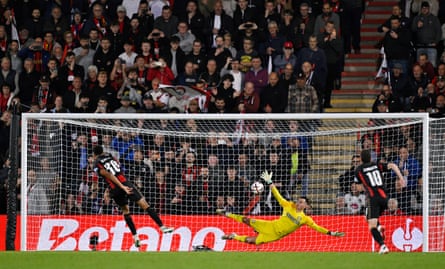
Palace are in a slightly different position. Other than City, their fixture list has been relatively kind. Seven points from six games would constitute comfortable survival if extrapolated over the season as a whole, but Opta’s expected points table, which has Bournemouth ninth and Sunderland 10th, has them 18th. A new manager is settling in, Maxence Lacroix and Daniel Múñoz were sold over the summer, while Jean-Philippe Mateta hasn’t played since the opening weekend.
For none of those three sides can unsettled starts be blamed entirely or even primarily on Europe. That said, the evidence is clear: over the past five years, teams who did not play in Europe the previous season see their league position fall when they do play in Europe: Palace dropped from 12th to 15th, Nottingham Forest from seventh to 16th, Newcastle from fifth to 12th, Brighton from sixth to 11th, West Ham from sixth to seventh. Of those examples, only Forest even came vaguely close to relegation, but the fear nags away.
Although winning the Europa League would bring the vast rewards of Champions League football, losing in the final would probably bring in not much more than £20m for a Premier League club, plus gate receipts and whatever intangible benefits there might be from increased exposure. To put that in context, that’s roughly the difference between finishing ninth and 14th in the Premier League.
Which is to say that while fans revel in trips to Milan, Prague or Lyon, for club executives a few nice mini-breaks do not balance out the potential financial headaches.
KioskNews shows a cleaned-up reading view extracted from the publisher’s page — the original always lives on their site, not ours.