Hong Kong arts group urges balance in funding criteria as attendance falls

A major Hong Kong performing arts group has urged the government to give greater weight to qualitative measures when setting funding criteria for local organisations, arguing that changing social trends have contributed to falling attendance.
Celina Chin Man-wah, executive director of the Hong Kong Chinese Orchestra, also warned on Thursday that the group might have to scale back its community work to devote more resources to income-generating or sponsored activities.
Her comments followed the announcement on Wednesday of further details of a government overhaul of funding for major performing arts groups, linking subsidies more closely to performance and artistic merit.
“It’s appropriate to measure performance in both quantitative and qualitative standards, but we have to pay attention to the split of how much each takes. It’s a topic that requires discussion and looking into,” Chin said on a radio programme.
“We’ve always said it’s very important to use the right metrics to measure [the achievements of] an arts group. If we used the wrong yardstick, it’d be very dangerous.”
Under the new funding mechanism, each group’s annual allocation will comprise a “baseline subvention” and a “performance-based subvention”. The baseline component will gradually fall from about 77 per cent of the total to 50 per cent.
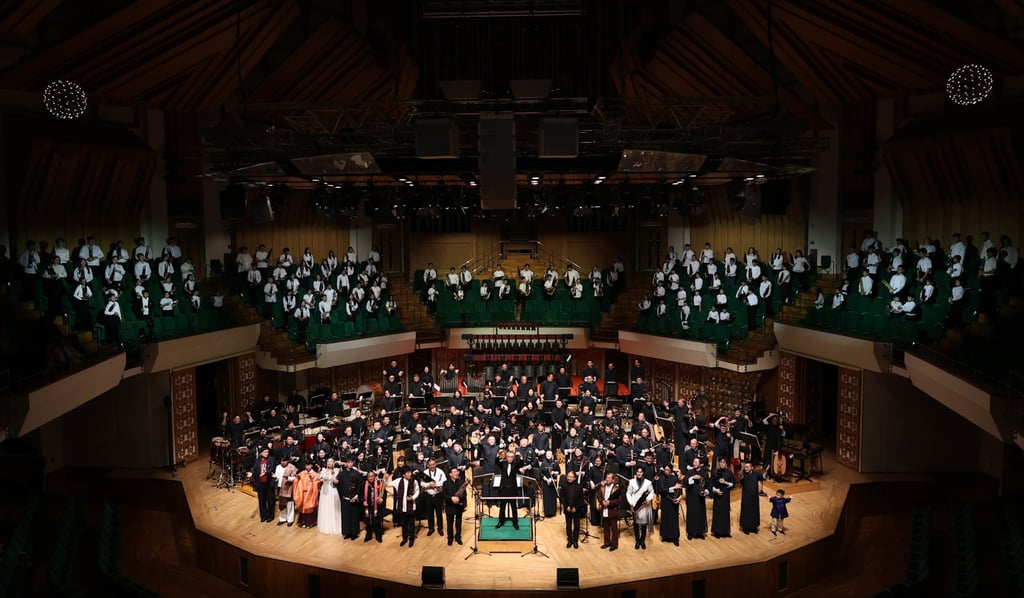
The performance-based component will take into account each group’s non-government revenue, including box-office takings, other operating income, donations and sponsorship, as well as its achievement of key performance indicators.
The mechanism applies only to designated “major performing arts groups”.
Nine currently hold that status, the Hong Kong Philharmonic Orchestra, Hong Kong Chinese Orchestra, Hong Kong Sinfonietta, Hong Kong Ballet, Hong Kong Dance Company, City Contemporary Dance Company, Hong Kong Repertory Theatre, Chung Ying Theatre Company and Zuni Icosahedron.
Under the reforms, groups with exceptional performance may receive more funding, while those that underperform will face cuts. Groups that consistently fail to meet the required standards will lose their “major” status.
Authorities said the groups would have a five-year transition period, with the reforms fully implemented from 2032–33.
The government said the changes aimed to encourage major groups to innovate continuously, while allowing capable medium-sized groups with consistently outstanding performance to gain major status and the associated funding.
Over the past two decades, annual government funding for the nine major groups has risen from about HK$220 million to about HK$450 million (US$57.3 million), an increase of more than 104 per cent.
Over the same period, however, the government said total paid attendance at the groups’ performances had fallen from 360,000 to 310,000, while the overall attendance rate had dropped from about 77 per cent to 69 per cent.

Chin attributed part of the decline to broader changes in Hong Kong beyond the arts and cultural sector, including falling birth rates, residents’ growing preference for spending across the border and a post-pandemic shift towards staying out less late.
With less baseline funding, she said, the orchestra might have to devote more resources to attracting audiences. That could mean scaling back unsponsored community activities, such as visits and classes for people undergoing rehabilitation.
Chin stressed that artistic work often needed time to gain recognition. Some compositions that were ahead of their time might initially be poorly received by audiences and performers, she said, only to become staples of the repertoire years later.
“We’d be worried, as we have to balance our books and we might not be able to recoup our costs in a short time frame. I can’t say it would stifle creative development, but it’s a message that we’d have to pass on to the artists,” she said.
But lawmaker Chris Ip Ngo-tung said the reforms would support the sector’s healthy development and provide a “funding ladder” for small and medium-sized groups seeking major status.
Asked how long a group’s performance should be deemed “consistently unsatisfactory” before it lost that status, Ip suggested about three years. He said there should be a gradual transition rather than an abrupt funding cut.
KioskNews shows a cleaned-up reading view extracted from the publisher’s page — the original always lives on their site, not ours.