Chinese desalination plant cuts 60% energy use, turns waste brine into industrial salt
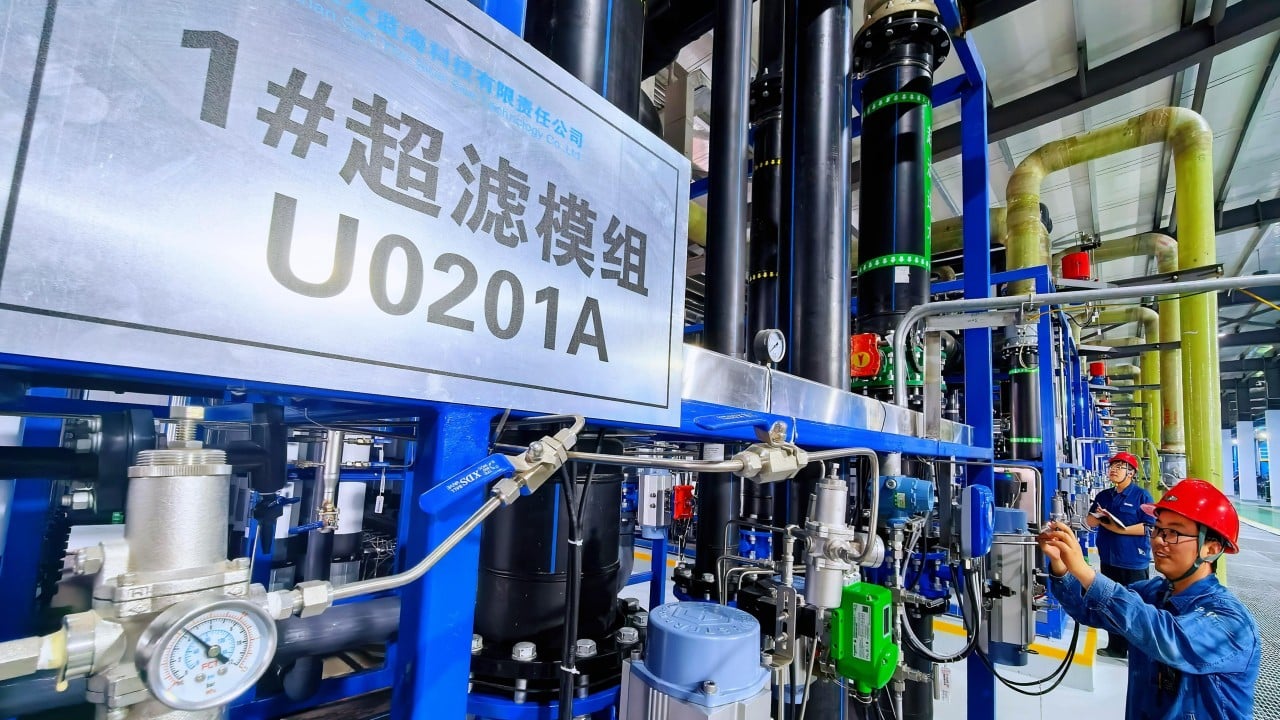
A large desalination plant on Bohai Bay has achieved an energy efficiency breakthrough, slashing electricity consumption by more than half while converting millions of tonnes of toxic waste brine into high-value chemical salt.
Situated in the Caofeidian industrial zone of Tangshan, Hebei province, the facility recently entered its trial production stage, the state-run Science and Technology Daily reported last month.
This technology provides a viable pathway to solving the global challenge of discharging concentrated seawater into the sea, according to the report.
The facility processes waste brine at a three-to-one ratio, yielding 1 tonne of refined concentrated seawater – with a salinity of 120 grams per litre – alongside 2 tonnes of fresh water.
The refined brine is then piped directly to a chemical plant 50km (31 miles) away to produce soda ash, a fundamental raw material used extensively across the glass, metallurgical, papermaking, textile-dyeing and food industries.
According to Zhao Lin, head of research and development at Tangshan Sanyou Group, the firm behind the innovation, the project boasts the largest scale and lowest energy consumption globally among comparable technologies.
“For every 10,000 yuan (US$1,490) of value produced, the plant uses 60 per cent less electricity than conventional desalination methods,” Zhao told Science and Technology Daily.
In the same report, Liu Lan, a senior engineer at the Ocean University of China in Shandong, described the large-scale resource utilisation of concentrated seawater as “unprecedented”.
“This technology has completed the circular industrial chain linking seawater desalination, refined concentrated seawater and the salt chemical industry,” Liu said.
The plant is the culmination of several years of collaborative research between universities and business.
Within the pre-treatment facilities, insoluble impurities are first filtered from brine before the primary technical challenge begins: separating out divalent ions such as calcium, magnesium and sulphate.
05:00
A ‘super’ El Nino is forming: what is it, and what’s coming?
During high-ratio concentration, these ions precipitate rapidly, much like limescale in a kettle. This blocks pipes and damages membrane equipment, proving notoriously difficult to clear.
Furthermore, the production line must retain the salt within the brine – an even steeper hurdle for both technical and economic viability. Following hundreds of trials, the research team successfully identified and resolved this critical bottleneck, according to the report.
In September 2023, the Tangshan-based company officially launched its pilot plant.
Operating five production lines simultaneously, the facility precisely intercepted calcium and magnesium ions – the minerals responsible for stubborn scaling – while successfully retaining a high-purity solution of sodium chloride, or common salt.
The subsequent challenge was to increase the concentration, or salinity, of the waste brine from 40 to 45 grams per litre to 120 grams per litre.
Traditional methods of forcing water molecules from a brine of such high concentration require immense physical pressure. According to the research team, this extreme pressure is not only highly energy-intensive but also threatens to warp or completely crush the fragile membranes used in the filtration process.
To circumvent this, the team devised an innovative solution by dividing the concentration process into four distinct stages. They matched different membrane components to the specific characteristics of each stage and determined the optimum sequence for their connection.
Yet, even with a theoretical framework established, scaling it for the production line presented a host of practical challenges, chief among them being the selection of ideal membrane components.
Lead researcher Zhao Lin explained that the team rigorously tested products from mainstream domestic and international manufacturers. They conducted repeated comparisons and cross-verifications before ultimately selecting a domestic brand.
In June this year, the entire production line was successfully integrated and the first phase of the project officially entered its commissioning stage.
According to an official from the industrial zone where the facility is based, once the third phase is completed, the plant is expected to process nearly 100 million tonnes of concentrated waste seawater annually, substantially relieving the Bohai Bay of a heavy ecological burden.
KioskNews shows a cleaned-up reading view extracted from the publisher’s page — the original always lives on their site, not ours.