Israel braces for rainy Election Day, but can bad weather affect voter turnout?

Election day in Israel is expected to bring cooler temperatures and rain in southern and eastern Israel, raising the question: Will Dreary weather keep Israelis away from the polls?
The expected rain will intensify at midday, mainly in the south and east, with thunderstorms, gusty winds, and hail. Significant flash flooding is also possible in the Negev and Arava streambeds, and in the Dead Sea area.
Is there any real basis for this fear? The data show the answer is an unequivocal no.
Looking back, Israel has no proven link between rain and voter turnout. In fact, the all-time turnout record of 87% was set in the First Knesset elections in January 1949, on an especially stormy winter day. By contrast, the Second Knesset elections were held on an ordinary summer day in July 1951 and recorded just 75%, lower than any election held in the country until 2003.
The all-time low was recorded in the 2006 elections (the 17th Knesset), when only 63.5% of Israelis voted. That election was held on March 28, a spring day, but clouds and rain covered parts of the country. The media at the time rushed to blame the weather, but an in-depth review by the Israel Meteorological Service showed that rain has no real connection to voter participation; political and social factors drive it.
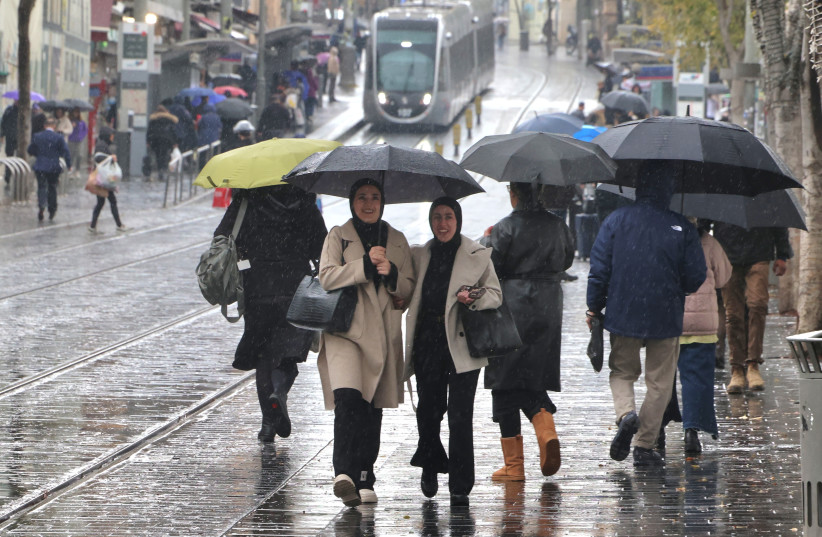
The paradox is simple: rain supposedly keeps people at home under the covers, while pleasant sunshine sends them to the beach, parks, and malls, supposed “enemies of the ballot box.” In practice, polling stations stay open for a full 15 hours, rain in Israel mostly falls in short bursts, and no outing lasts all day.
First Israeli election on schedule in three decades
Israel’s lawmakers actually considered the weather in advance. A 1959 amendment to Basic Law: The Knesset set the Hebrew month of Cheshvan as the fixed election date, and 2006 documents from the Knesset Constitution Committee explain that it is a comfortable month, falling right after the Tishrei holidays and before the peak of winter. The assumption was that mild weather would make it easy to get to the polls, and that early sunsets, especially in winter, like the switch that took effect this week, would send day-trippers from the beaches straight to the polling stations well before closing.
But political reality in Israel rarely goes by the book. Since 1988, every election has been moved up (though the November 2022 election was held in Cheshvan because the Knesset dissolved itself). If the election on Tuesday, October 27, goes ahead as planned, it will be the first time Israelis vote on the original date set by law in 38 years.
A statistical look at the 25 elections held since the state's founding, along with this week’s election for the 26th Knesset, shows an almost even seasonal spread: seven in winter, seven in summer, six in spring, and six in fall. Most elections, 14 of them, were in fact held in the “hard” seasons (winter and summer), and 12 in the “comfortable” ones (fall and spring).
The bottom line: turnout shows no real difference between summer and winter, partly because the July–August elections took place long before Israelis began flying abroad en masse for vacation.
But what about the rest of the world?
How weather impacts elections worldwide
An American study of 14 presidential elections found that roughly 25 mm (about an inch) of rain lowered turnout by about one percentage point. In the Netherlands (13 elections between 1971 and 2010), researchers found a similar result: pleasant sunshine encourages people to go out and vote. In Sweden, by contrast, researchers found no significant effect of rain.
Rather than settling on a single country, researchers at the University of Copenhagen combined data from 34 studies worldwide, published in the journal Electoral Studies.
The conclusion: every centimeter of rain lowers turnout by about 0.95%, with young people and undecided voters six times more sensitive to the weather than others. Even so, applying this to Israel is hard; here, Election Day is a public holiday, unlike in many countries where people vote on a regular workday.

An International IDEA institute report this past April, together with King’s College and Griffith University, found that between 2006 and 2025 at least 94 elections and referendums in 52 countries were disrupted by natural disasters (in 26 of those cases the vote was postponed; in 2024 alone, 23 elections in 18 countries were disrupted).
But don't worry, that study focuses on typhoons, hurricanes, massive wildfires, and devastating floods that paralyze infrastructure, events irrelevant to Israel's climate.
A local autumn shower may mean grabbing an umbrella on the way to the polls, but Israeli history shows it won't stop voters from having their say.
KioskNews shows a cleaned-up reading view extracted from the publisher’s page — the original always lives on their site, not ours.