How might the proposed undersea tunnels linking mainland Singapore to Pulau Tekong be built?
SINGAPORE – Completed in 2013, the Marina Coastal Expressway (MCE) marked a new first for Singapore, becoming the first highway in the Republic to have a segment running undersea.
Now, the Government is studying the feasibility of building more undersea tunnels – this time, to link mainland Singapore to Pulau Tekong, Singapore’s largest outlying island.
Engineers told The Straits Times that the planned tunnels are likely to be constructed differently from the MCE’s undersea stretch, and unpacked the possible considerations before the project can be green lit.
How was Singapore’s other undersea tunnel constructed?
The MCE has a 420m section that lies 14m under the seabed of Marina Bay, or about 20m below the mean sea level.
A “cut and cover” method was used for the undersea section, which involved creating a dry dam for the tunnel to be built in, before constructing the tunnel and then covering the worksite.
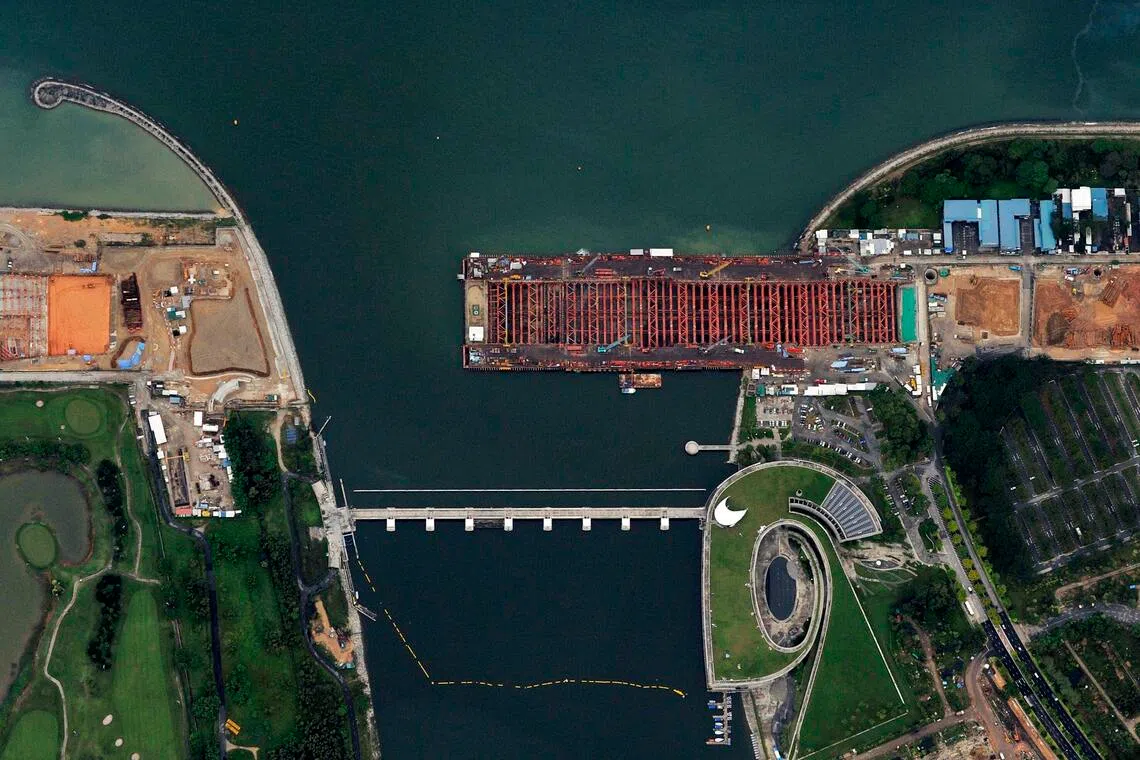
Aerial photograph of the Marina Barrage (bottom) and the construction progress of the Marina Coastal Expressway (top), taken on July 14, 2012.
PHOTO: ST FILE
After the tunnel was completed, surrounding water was released and allowed to flow over it.
Chew Soon Hoe, deputy head of the Department of Civil and Environmental Engineering at NUS’ College of Design and Engineering, said that the undersea stretch of the MCE could be constructed at a relatively shallow depth as there is no vessel traffic passing over it.
He added that the seabed at the MCE site has a more uniform soil profile than the channel between Changi and Tekong, which made “cut and cover” the optimal solution, as it could be carried out after the seabed was strengthened by deep cement mixing – a process that involves mixing cement with on-site soil.
This “cut and cover” solution, he said, is unlikely to be used for the mainland-Tekong tunnels as they will need to be longer and constructed deeper below the seabed, and as vessel movement will be impacted during the construction phase.
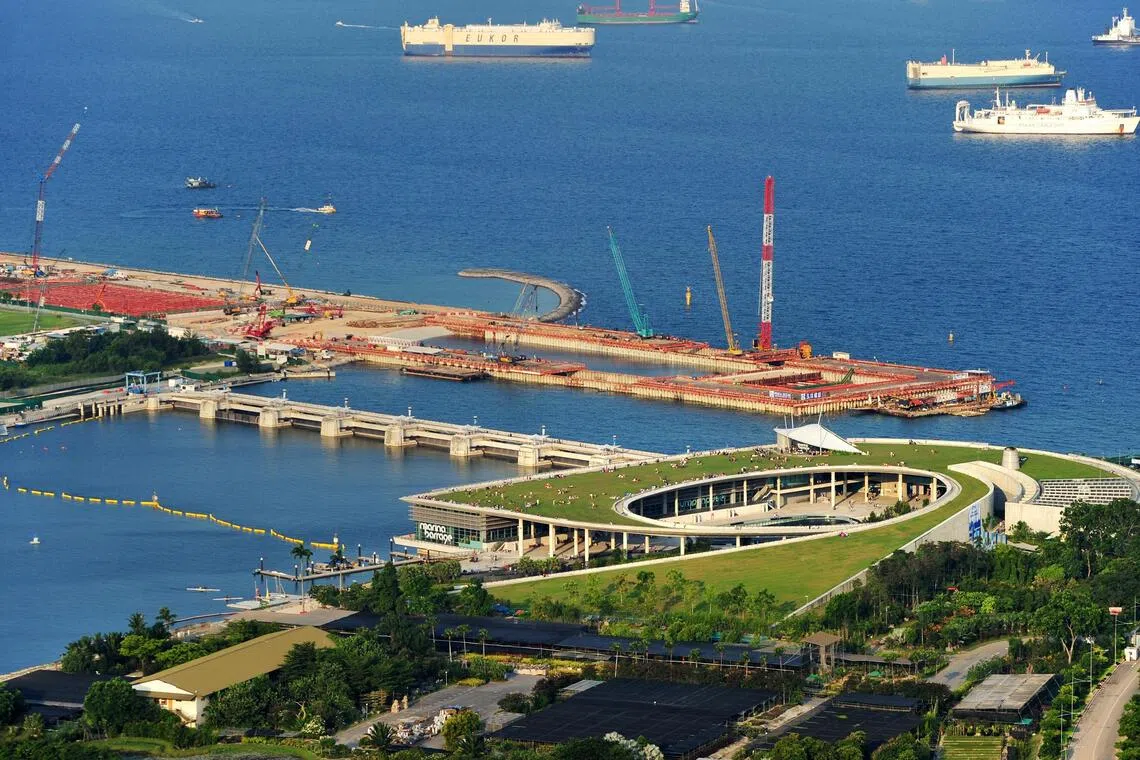
A “cut and cover” method was used to construct the undersea portion of the Marina Coastal Expressway.
PHOTO: ST FILE
Chew added that soil conditions in the Changi-Tekong area are more complex than at the MCE site, which makes deep cement mixing to stabilise the worksite more challenging.
Based on satellite images, the sea between Changi and Pulau Tekong spans at least about 1.5km.
How will might the tunnels be constructed?
Engineers said that broadly, two construction methods can be used – tunnel boring or an immersed tunnel.
David Ng, chairman of the Civil and Structural Engineering Technical Committee at the Institution of Engineers, Singapore, said tunnel boring involves launching a machine from a shaft on land, which will bore through rock or stiff clay roughly 15 to 30m beneath the sea floor.
For the immersed tunnel process, he said concrete tunnel elements will be constructed on dry land, before being brought out to sea to be connected.
These precast tunnels will be placed in a trench that will have to be dredged on the seabed. After the tunnels are in place, they will be covered with rock and sand.
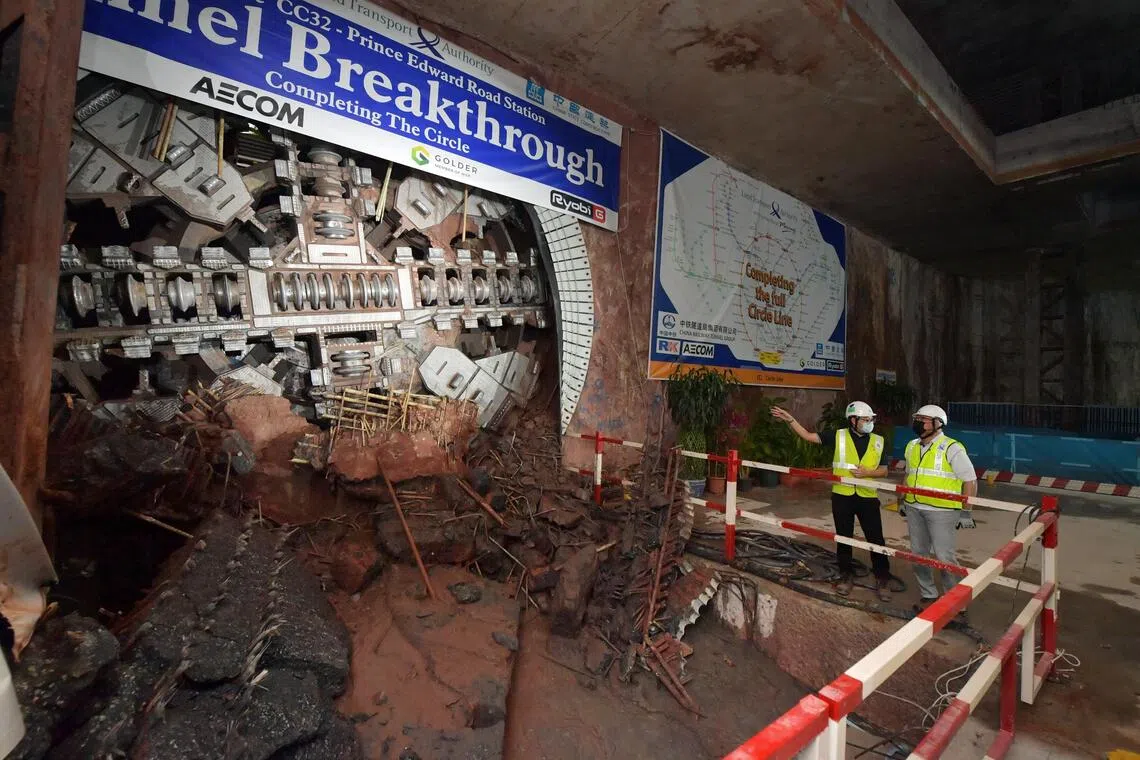
The Circle Line tunnel breakthrough by a tunnel boring machine in January 2022.
ST PHOTO: ALPHONSUS CHERN
Ng noted that while tunnel boring will allow shipping lanes in the Johor Strait to remain open, it is generally more expensive, and runs the risk of the boring machine getting stuck. The immersed tunnel method will at least partially block sea traffic in the Johor Strait while the tunnels are being installed.
Chew added that the dredging required for the immersed tunnel process will have an environmental impact – something that is minimised with tunnel boring.
He said that while tunnel boring causes vibrations, these can be absorbed by the soft clay in the seabed, which helps to reduce effects on the surroundings.
What are the challenges of building tunnels under the sea?
A critical consideration for engineers is high hydrostatic pressure, said Audrey Tee, senior vice-president of civil and structural engineering at CPG Consultants.
This refers to the significant weight or force that is exerted on the body of seawater above the tunnels.
Tee said hydrostatic pressure affects tunnelling works, waterproofing, tunnel joints, cross passages between tunnels, as well as the connections between the tunnel and shafts.
She added that the tunnels cannot be too close to the seabed, as sufficient ground cover is needed to manage stability, hydrostatic pressure and the risk of the seabed shifting.
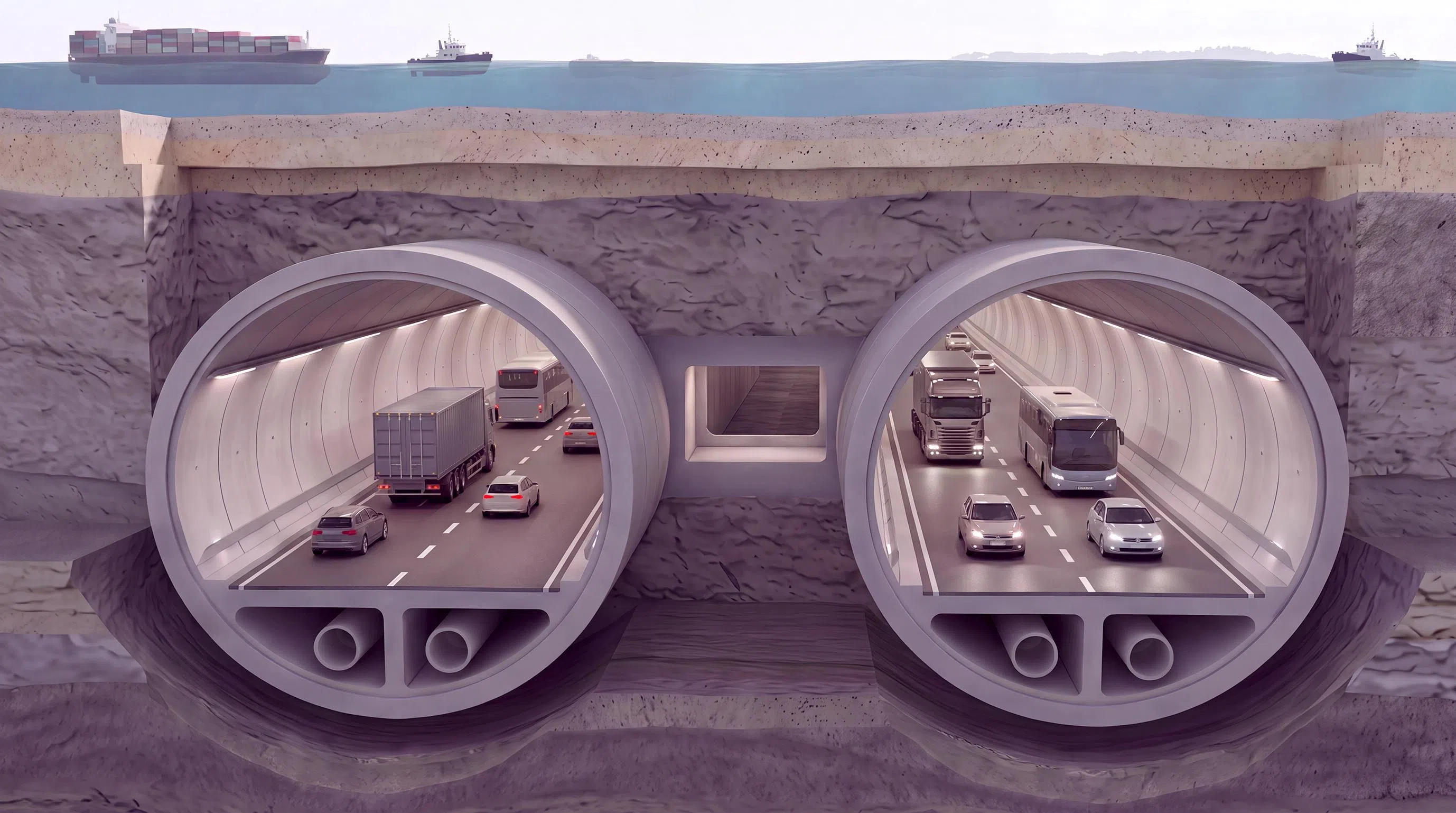
An AI-generated artist’s Impression of undersea tunnels.
PHOTO: URBAN REDEVELOPMENT AUTHORITY
Chew said geological conditions in the ground between Changi and Pulau Tekong are another key consideration.
“The soil below the seabed is soft to start with, so that’s a concern,” said Chew.
“If we were to tunnel through rock, that would be relatively straightforward, but Changi to Tekong is different – the geological conditions are interesting. Beneath the seawater is a thick layer of soft clay and sediment, and then old alluvium that has the consistency of densely compacted sand, followed by granite.”
Chew said an added challenge is that interspersed in the layer of soft clay and sediment are pockets of paleochannel, or old streams that no longer carry water and have been buried by other sediments.
The old streams are likely more abundant near the mouth of a river where more deposits are found, said Chew, who added that they have a different consistency from the soft clay that surrounds them, which means engineers must navigate a drastic change in pressure if tunnelling works take place in this layer of the seabed.
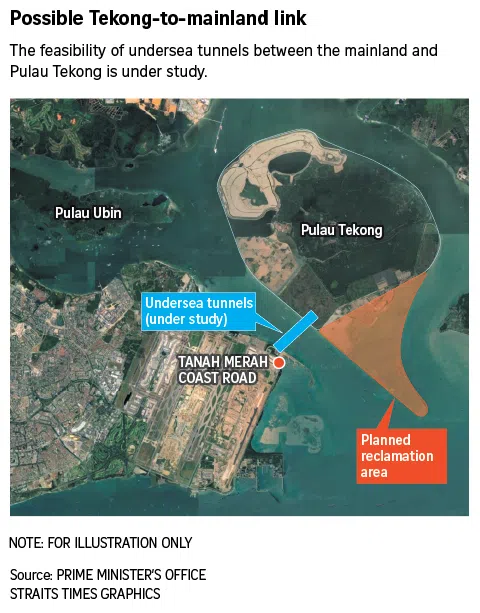
The area where the tunnels are likely to be built is on the south-western end of Pulau Tekong, while the mouth of the Johor River is towards the island’s north.
“When you’re digging through soft clay, suddenly you will hit loose sand that shifts easily and the pressure faced will be very different. Clay is sticky but water will not flow too quickly around it. But when moving from clay into a paleochannel that will cause problems,” Chew said.
Ng added that the long-term durability of undersea structure and future maintenance will have to be factored in, while Tee said other considerations include ventilation and fire safety, water proofing, flooding risk, as well as emergency escapes and evacuation routes.
Joanne Wong, a senior consultant for civil and structural engineering at CPG Consultants, said the planning and design for the tunnel will also have to factor in the effects of climate change.
“This includes accounting for projected sea-level rise and tidal surges, as well as coordinating the tunnel design with any associated coastal protection structures,” said Wong.
How have undersea tunnels been constructed overseas?
Chu Jian, President’s Chair in Civil Engineering at Nanyang Technological University said several projects that are on a larger scale than the mainland-Tekong tunnels have been completed abroad using immersed tunnels, such as a 5.6km section of the Hong Kong-Zhuhai-Macau Bridge and about 5km of the Shenzhen-Zhongshan Link.
Chu added that Singapore’s project will likely be less complex, as the tunnels will be shorter, the waters here are shallower, and the seas are calmer.
Chew added that elsewhere, the Tuen Mun-Chek Lap Kok Link in Hong Kong has a 5km tunnel constructed by boring. He said the method was, notably, chosen over immersed tunnels owing to environmental concerns.
Also built using tunnel boring machines was the Channel Tunnel, a 50.45km-long connection between the United Kingdom and continental Europe.
How long is construction expected to take?
Based on Singapore’s experience with major tunnel projects, said Tee, construction could take about eight to 10 years.
“The actual duration would depend on the selected tunnelling method, geological and marine conditions, construction logistics, approvals and the overall project scope,” she said.
KioskNews shows a cleaned-up reading view extracted from the publisher’s page — the original always lives on their site, not ours.