Opinion: Opinion | 'Lies, Damned Lies, Statistics': On The Controversy Around India's GDP Growth Figures
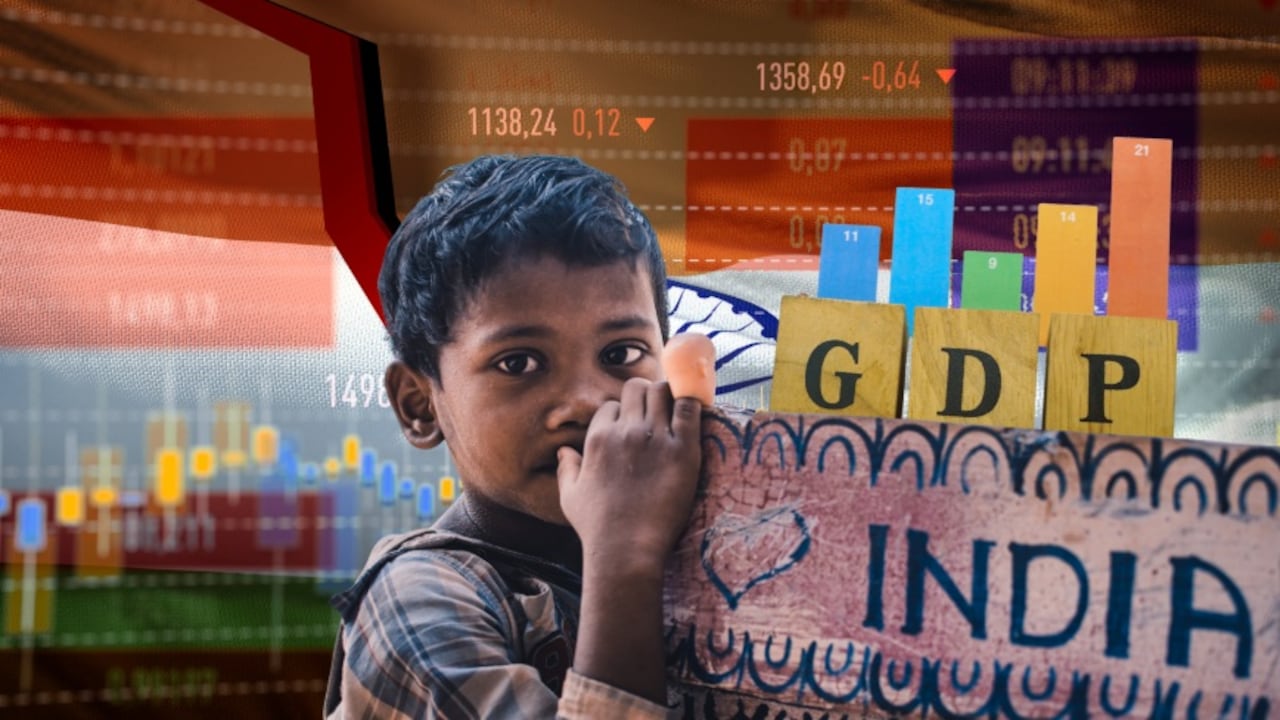
I am not an economist, so it was with some bemusement that I watched the debate surrounding India's economic growth figures spilling into the public square. When the government announced a headline-grabbing 7.8% real GDP growth rate for the first quarter (Q1) of 2026, the figure was met not with universal celebration, but with deep suspicion among independent economists, global financial institutions, and everyday citizens. It's clear that the debate is less about a single figure than about a decade-long erosion of trust in official statistics, and the stark mismatch between high-growth figures and the lived economic realities of ordinary Indians.
While the Q1 2026 data provided the spark, the underlying kindling has been dry for nearly ten years. Scepticism regarding India's official growth metrics is not a recent phenomenon. It can be traced back at least to the aftermath of the 2016 demonetisation policy and the subsequent rollout of the Goods and Services Tax (GST), then to the controversy over the Covid fatality numbers, the resignation of senior government statisticians, and now the eruption over GDP growth.
Advertisement - Scroll to continue
Over the past decade, eminent independent thinkers, including two who have worked with the BJP government, former Chief Economic Adviser Arvind Subramanian and former RBI Governor Raghuram Rajan, have repeatedly raised red flags regarding how output is measured. Global bodies such as the International Monetary Fund (IMF) have similarly downgraded the credibility quotient of Indian data. This trust deficit was further deepened in 2024 when the government abruptly dissolved its advisory body of statisticians and academics, leaving official releases without the crucial stamp of independent oversight.
Changing Benchmarks
At the core of the current controversy lies a major recalculation: the transition from an older benchmark data series (base year 2011–12) to a new series (base year 2022–23). On the surface, shifting to a more recent base year is standard statistical practice designed to capture structural changes in an evolving economy. However, critics say that the manner in which this transition was executed created a statistical optical illusion. To calculate growth percentages, statisticians compare current economic output against the output of the same period in the previous year. In releasing the Q1 2026 numbers, the government retroactively slashed its estimate for the previous year's baseline (2024–25 GDP) by roughly ₹12.7 trillion.
Advertisement - Scroll to continue
By shrinking the previous year's denominator, the jump to this year's numerator looks artificially large. Using the reduced baseline, nominal growth appeared to be an impressive 10.3%, yielding a real GDP growth figure of 7.8%. Had the baseline not been retroactively revised downward, the critics argue that nominal growth for Q1 2026 would have stood at a modest 2.6%. However, official statistics apply the revised baseline across both periods to maintain methodology consistency, resulting in a nominal growth rate of 10.3% and a real GDP growth figure of 7.8%. Whether viewed as a necessary statistical re-benchmarking or an advantageous base effect, the downward revision of the prior year's denominator significantly aided the headline growth numbers.
To measure real economic growth, economists must subtract inflation using a tool called the GDP deflator (to convert nominal growth into real, inflation-adjusted growth). Calculating an accurate deflator requires a Producer Price Index (PPI), which measures the wholesale prices manufacturers actually charge and pay for inputs. India, however, has lacked a functional PPI for two decades. When adjusted using the official GDP deflator, actual economic expansion would have been close to zero. But it's actually worse: Without robust input and output price data, the government's estimated GDP deflator of 2.5% appears implausibly low, especially when wholesale inflation has hovered significantly higher. A deflator that underestimates inflation naturally overstates real economic growth. So, by repeatedly revising past figures downward, current performance automatically appears stronger, a pattern that allows the government to project a narrative of rapid growth while quietly erasing past overestimations.
Whenever official statistics began to murmur unpleasant truths, the shutters were promptly pulled down. The 2017-18 Labour Survey, which laid bare a devastating 45-year peak in national unemployment, was quietly kept under lock and key until the 2019 general election had comfortably passed. Soon after, the 2017 Consumer Expenditure Survey, which revealed the sobering reality of declining real consumption, was suppressed altogether, erased from public view rather than acknowledged. Even the National Crime Records Bureau's stark tallies of farmer suicides found themselves subject to deliberate delays and administrative procrastination, ensuring that numbers capable of disturbing the official narrative were kept safely out of sight.
Missing The Other Story
Beyond the base-year mathematics, technical flaws in how data is collected systematically inflate India's economic performance. The informal economy, comprising unregistered businesses (from chaiwallahs to mochis) , small kirana shops, and cash-reliant micro-enterprises, accounts for roughly 45% of India's overall economy. Because tracking millions of small enterprises in real time is difficult, government statisticians make the flawed assumption that the informal sector grows at the exact same rate as large, publicly listed formal corporations. Disruptions such as demonetisation, the initial GST implementation, and COVID-19 lockdowns hit informal, cash-dependent businesses much harder than well-capitalised corporations. By using formal corporate growth as a proxy for the entire economy, official statistics mask the deep, ongoing distress in the informal sector.
The strongest argument for the likes of me (and again I must stress I am not an economist, let alone a statistician) comes from real-world economic indicators. If the economy is truly growing at nearly 8% a year, key economic engines should be humming. Instead, they show clear signs of stagnation. Educated youth face severe structural unemployment. The gap between economic growth and job creation has fuelled widespread public frustration, visible in the youth-led demonstrations we have witnessed across major urban centres. Private Investment is still sluggish; domestic industrialists remain hesitant to commit fresh capital to new factories or expansion, signalling a lack of confidence in consumer demand. And much-vaunted Foreign Direct Investment (FDI) inflow has not matched the high headline growth numbers, reflecting caution among global investors regarding data clarity and demand-sustainability before they will commit long-term foreign capital.
India is currently in the midst of a historic "demographic dividend" - a multi-decade window where the working-age population significantly outnumbers dependents. Historically, emerging economies have leveraged this window to transform into high-income nations. However, India's performance during this crucial window compares unfavourably with its Asian peers during their respective growth surges. In their peak demographic windows, China, Japan, and South Korea all grew by 8.7 to 9.4% consistently, while India's has averaged growth rate of 5.4% over recent years. We risk growing old before we grow rich, squandering a once-in-a-generation demographic advantage.
Rebuilding credibility requires adhering to established international statistical standards. When transitioning between economic base series, standard practice dictates that statistical agencies run both the old and new methodologies side-by-side in parallel for a transition period. Publishing both datasets simultaneously allows independent researchers, market analysts, and the public to verify calculations, understand methodology changes, and trust the final numbers. For India's economic leadership, restoring complete transparency in national accounting is not merely a technical task; it is an urgent prerequisite for sound policymaking and public trust.
Mark Twain famously attributed to Benjamin Disraeli the words, "There are three kinds of lies: lies, damned lies, and statistics." India, it seems, is a victim of the third kind.
(Shashi Tharoor has been a Member of Parliament from Thiruvananthapuram, Kerala, since 2009. He is a celebrated author and a former diplomat)
KioskNews shows a cleaned-up reading view extracted from the publisher’s page — the original always lives on their site, not ours.