On Vallabhbhai Patel’s birth anniversary, a historian explains how he became ‘Sardar’
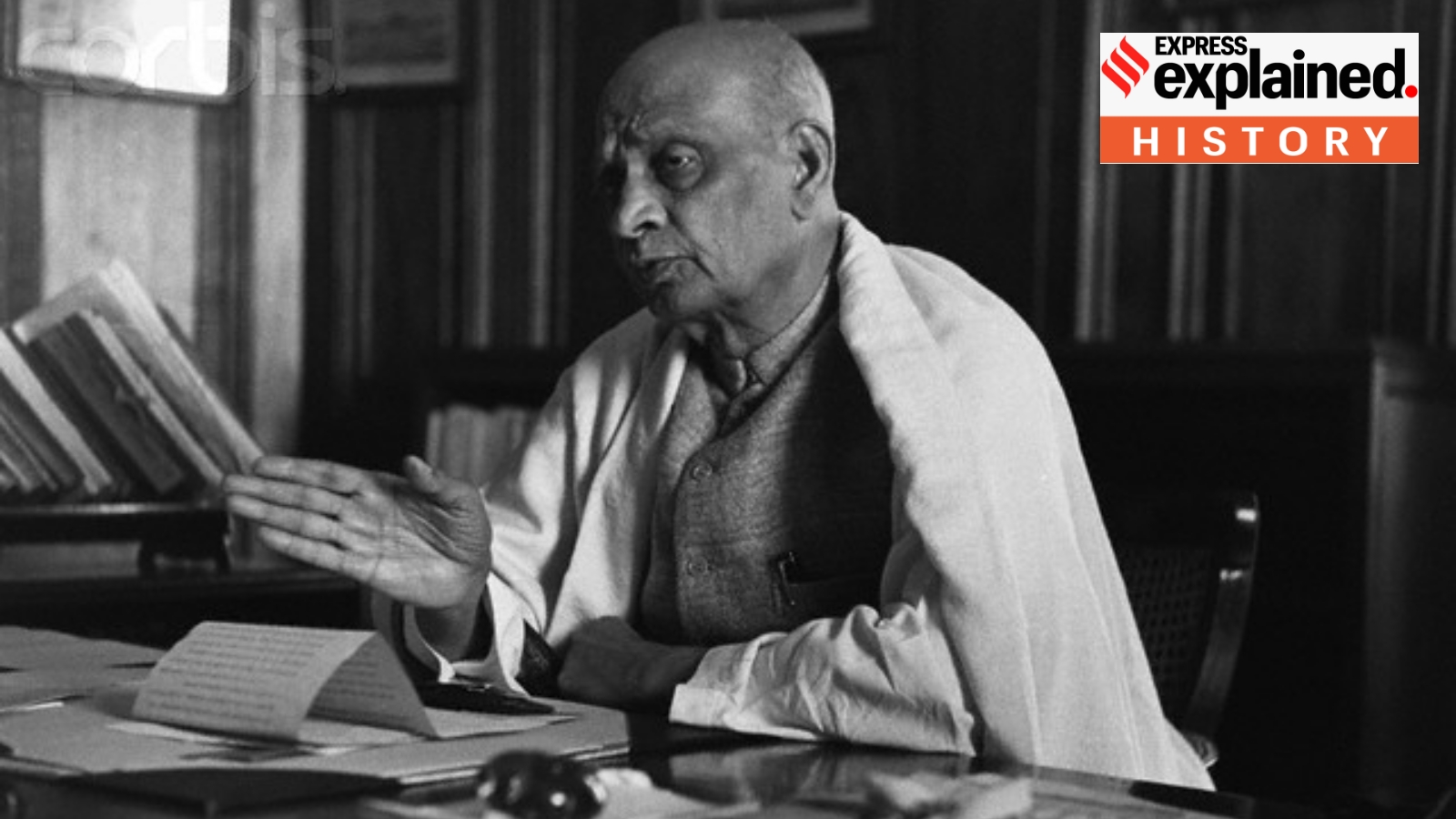
It was at Sardar Vallabhbhai Patel’s residence in Lal Darwaza, Ahmedabad, that most meetings for the 1918 Kheda Satyagraha were held. When Mahatma Gandhi first announced the launch of the movement for the rights of peasants, Patel, without a second thought about his public life or career as a lawyer, declared he would join as a ‘Satyagrahi’.
Eventually, the Satyagrahis secured a partial victory when the poorer peasants were allowed concessions in revenue assessment by the administration owing to crop failure. Gandhi said that it would not have been possible without an up-senapati like Vallabhbhai, crediting his exceptional management skills: “The more I came to know him, the more I realised that I must secure his help… If it were not for his assistance, I must admit that this campaign would not have been carried through so successfully.” This was the country’s — and Gandhi’s — first mass movement, and would mark a crucial moment in Patel’s ascent as a national leader.
How Sardar Vallabhbhai Patel rose within Gujarat
After becoming the deputy commander-in-chief during the Kheda Satyagraha, Patel’s voice began to resonate widely. During the Non-Cooperation Movement of 1920, which started after the Jallianwala Bagh massacre, Patel provided new political leadership to what is today the state of Gujarat.
In the 1920 session of the Congress in Nagpur, it was decided that provincial committees should be formed to work at lower levels more efficiently. Patel was provisionally elected as the first president of the new Gujarat Provincial Committee and, following his unopposed election, became its president. He was no longer limited to being a local leader at the municipal level.
Patel then chaired the Reception Committee of the Fourth Gujarat Political Conference, where Gandhi moved the resolution on non-cooperation. It was the teamwork of Patel and his colleagues at this conference that laid the groundwork to successfully host the next Congress session at Ahmedabad. Such a session was last held there in 1902. The meeting was held while the Non-Cooperation Movement was underway, resulting in the establishment of a temporary tent city called ‘Khadi Nagar’, made using lakhs of metres of khadi cloth.
As the chairman, Patel sat alongside national leaders and addressed the meeting in a completely indigenous style, in Hindi. This was Sardar’s first national-level address.
Story continues below this ad
The success of the meeting and the growing popularity of the NCM, however, came as a setback to the British government. In response, it dismissed the municipalities of Ahmedabad and Surat. A claim was filed in the Ahmedabad District Court to recover public money on the groundless allegation of misappropriation of funds. At the end of the case, which lasted for almost a year, the District Judge dismissed the government’s claim and said that neither the British government nor its lawyers could prove that Sardar Vallabhbhai Patel and his associates had misappropriated even one paisa.
The government even appealed to the Bombay High Court against the District Court’s order, but was defeated there as well.
Leading the fight in Gandhi’s absence
In March 1922, Gandhi was sentenced to six years of imprisonment by a special court formed at the Circuit House. It came as a result of his articles criticising the colonial government, and led the State to charge him with sedition. It was the first time that Sardar was left without his guru. While Gandhi was on trial, Sardar had the sole responsibility of leading the fight against the British. In Gandhi’s absence, Sardar also readily accepted the responsibility of the Gujarat Vidyapith and presided over its first convocation ceremony as its acting vice-chancellor.
On March 18, 1923, a procession was taken out in Nagpur under the leadership of Pandit Sunderlal, marking one year of Gandhi’s imprisonment. About 10 people carrying the national flag were arrested during the march. The next day, all of them were released, but Nagpur became the centre of the struggle when the flag was not returned to the protestors under colonial laws that barred such displays of nationalism.
Story continues below this ad
Sardar, however, successfully carried out the Flag Satyagraha, proving his mettle as a leader beyond his state. On September 6, 1923, Sardar and other Satyagrahis were given a grand welcome in Ahmedabad. Immediately afterwards, he launched a determined struggle against taxation in Borsad that forced the British government to retreat.
A few years down the line, another town in Gujarat saw a successful, Patel-led Satyagraha. The people of Bardoli, who had been fighting against unfair taxes since 1922, launched the Satyagraha in 1928. This leadership role, or ‘Sardari’, was entrusted to him not owing to his posts within the Congress party or in local government, but as a son of the soil who had won the trust of the farmers. He played a pivotal role in instilling a fiery sense of patriotism within them.
It was at the first meeting of the Bardoli Satyagraha that the title of ‘Sardar’ became associated with him, as the people chose him to lead the movement. Though he had earlier been called the farmers’ Sardar when he fought for their rights, archival records, newspapers, journals and magazines clearly show that it was not one person who gave him the title, but rather the people as a collective.
Even before he received the popular title of ‘Sardar’ in Bardoli, Gandhi had recognised his strengths and bestowed upon him the title of ‘Sinhpurush’, lauding his fearlessness, in 1924. This sense of courage was on full display when, in the early 1920s, Sardar fought to place the statue of Lokmanya Tilak in Ahmedabad’s Victoria Gardens, established to celebrate the Diamond Jubilee of the Queen. Eventually, the statue was allowed to be placed.
Story continues below this ad
In 1931, Patel became the chairman of the Karachi session of the Congress, where a Bardoli Sardar became the country’s Sardar. Four years later, he furthered the spread of his organisational work across the country, which helped build his stature as a formidable leader of the Independence Movement.
The author is a historian of the Indian freedom struggle, biographer of Sardar Vallabhbhai Patel and a professor.
KioskNews shows a cleaned-up reading view extracted from the publisher’s page — the original always lives on their site, not ours.