9 Coolest Swords In Fantasy Books
Legendary blades have been a staple of fantasy since long before the genre had a name, from Excalibur in Arthurian legend to Nægling and Hrunting in Beowulf. There is something intrinsically epic about a grand hero wielding a cool sword. It’s no surprise that fantasy fiction is overflowing with memorable broadswords, sabers, cutlasses, rapiers, claymores, and countless other variations, and some even become as recognizable as the characters carrying them.
The coolest swords in fantasy books are not necessarily the most powerful, although plenty certainly rank among the genre's most dangerous magical artifacts. Many have become iconic not through raw power but through complex histories, unique designs, unusual abilities, or simply being the blade responsible for a particularly sinister dark lord's downfall. Fantasy fiction is flush with interesting weapons, but few swords stand out quite as much as these swords.
The Sword Of Martin The Warrior From The Redwall Series By Brian Jacques (1986-2011)
Martin's Sword Turns A Simple Weapon Into The Ultimate Symbol Of Redwall

Unlike many legendary fantasy weapons, Martin the Warrior's sword, known also as Ratdeath, does not need magical powers to become an object of almost religious significance. The blade passes through a surprisingly complicated history throughout Brian Jacques' Redwall books. Originally belonging to Martin's father, Luke, it is broken by the villainous wildcat Tsarmina Greeneyes before being reforged at Salamandastron from a piece of a fallen star. From there, it becomes inseparable from the legendary mouse warrior who carries it.
The sword eventually becomes much bigger than Martin himself. Following his death, it is preserved at Redwall Abbey and repeatedly wielded by later champions, effectively turning it into Redwall’s answer to Excalibur. It's a cool fantasy sword because of the power of what it represents rather than anything it physically does. Every new wielder is effectively taking up Martin's legacy and accepting responsibility for defending Redwall. Its meteorite-derived blade and impressive history certainly help, but the sword's reputation is what truly makes it formidable.
Purchase the first Redwall novel here.
Ice From The A Song Of Ice And Fire Series By George R.R. Martin (1996-Present)
A Greatsword So Enormous That Ned Stark Barely Uses It In Combat

House Stark's ancestral greatsword in George R.R. Martin’s A Song Of Ice And Fire novels makes an unforgettable impression precisely because it’s not treated like a conventional fantasy hero's weapon. Ice is a colossal Valyrian steel blade, wider than a man's hand and over 6ft in length, with a dark, smoky appearance characteristic of the mysterious metal. Ned Stark primarily uses it for executions rather than battle, immediately establishing the sword as an instrument of authority as much as warfare.
After Ned Stark's death, Tywin Lannister has the ancient weapon symbolically melted down and reforged into two smaller swords, Widow's Wail and Oathkeeper. That fate, and the fact that the weapon was so symbolic to the people of the North that the Lannister's couldn’t abide by it still existing, only makes Ice cooler. Valyrian steel is already interesting, but with Ice it’s combined with phenomenal physical scale and centuries of Stark history to create a truly iconic weapon. Few fantasy swords command quite so much attention without actually needing to be swung.
Purchase the first A Song Of Ice And Fire novel here.
Terminus Est From The Book Of The New Sun Series By Gene Wolfe (1980-1987)
An Executioner's Sword With A Design As Grim As Its Purpose

Some of the coolest swords in fantasy are iconic not because of magical powers, but because of their physical design, and that’s definitely the case with Terminus Est. Carried by Severian throughout much of Gene Wolfe's The Book of the New Sun, it is an executioner's sword with no pointed tip. More unusually, the blade contains a hollow channel filled with liquid mercury, which shifts as Terminus Est is swung and alters its balance to add extra weight on the downswing, making weapon engineering itself feel fantastical.
What’s more, Terminus Est is about as grimdark as it’s possible for a fantasy sword to be. Its two edges are also designed for different purposes: one for beheading men, the other women. Terminus Est's name translates roughly as "this is the end," which could hardly be more appropriate. The sword perfectly embodies The Book of the New Sun's strange combination of medieval imagery, distant-future technology, and dying-world mystery. It feels simultaneously archaic and impossibly sophisticated, making Terminus Est one of fantasy's most distinctive blades without requiring any kind of magical enhancement.
Purchase the first The Book of the New Sun novel here.
The Possible Sword From The Bas-Lag Series By China Miéville (2000-2004)
A Sword That Strikes With Every Possible Version Of Itself At Once

Author China Miéville apparently looked at the concept of magical sword and decided that merely making one sharper or hit harder wasn’t strange enough. The Possible Sword appears in The Scar, the second novel in the Bas-Lag series of steampunk fantasy books, and is wielded by Uther Doul, bodyguard to the rulers of the floating pirate city of Armada. The power of the white ceramic longsword is built around possibility itself: when activated, the weapon effectively makes every potential strike the wielder could choose actually happen, allowing multiple theoretical blows to become real at once.
That ability makes sword fighting into something approaching weaponized probability. An opponent is not simply dealing with the attack Doul chooses to make, but all the potentially successful attacks that he could have made. The concept fits perfectly into Bas-Lag, where Miéville combines fantasy, steampunk, and bizarre speculative ideas with little concern for conventional norms of any genre. However, even among that setting's strangest creations, the Possible Sword stands out. Plenty of cool fantasy weapons can cut through armor or unleash magical energy; considerably fewer turn the abstract concept of quantum possibility into a combat technique.
Purchase the first Bas-Lag novel here.
Stormbringer From The Elric Saga By Michael Moorcock (1970-2022)
A Soul-Eating Demon That Happens To Look Like A Sword

Calling Stormbringer a mere sword undersells just how dangerous Michael Moorcock's most famous creation from the highly infleuntial The Elric Saga actually is. The enormous black runesword wielded by the sickly and doomed emperor of Melniboné, Elric, isn’t only sentient and malevolent, but also devours the souls of those it kills. Those stolen energies strengthen Elric, whose physical frailty otherwise needs drugs and magical assistance to treat. Their relationship is far from healthy though, and Elric tries to get rid of Stormbringer more than once, only for it to find its way back to him.
The fact that Stormbringer simultaneously empowers its master and makes him increasingly dependent upon it gives the weapon a unique identity compared to other fantasy swords. It has its own desires, repeatedly causes tragedy for Elric, and ultimately reveals itself as far more than an enchanted piece of steel. While soul-stealing swords are a recurring fantasy archetype in their own right, Stormbringer arguably represents the concept at its coolest. Its visual simplicity, terrifying abilities, demonic nature, and toxic relationship with Elric make it feel less like equipment and more like a character in its own right.
Purchase the first Elric Saga novel here.
Dragnipur From The Malazan Book Of The Fallen Series By Steven Erikson (1999-2011)
A Fantasy Sword Imprisons Its Victims Inside A Nightmarish World

Most swords, magical or otherwise, work by killing their victims. Dragnipur, on the other hand, makes death look like the preferable alternative. Wielded most famously by Anomander Rake, the terrifying weapon traps the souls of those it kills within its own Warren. There, the dead are chained to an enormous wagon and forced to drag it eternally through and endless darkness. Even by the wild standards of author Steven Erikson’s highly ambitious Malazan Book of the Fallen series, it’s an extraordinarily unique, and grim, concept.
Dragnipur looks appropriately intimidating, appearing as a bastard sword with a completely jet black blade and an aura of otherworldly power (complete with the sounds of screams and whip cracks whenever it's drawn). However, Erikson turning the sword into a magical prison system is why it's among literary fantasy's coolest. The blade contains countless souls, including enormously powerful beings, while the wagon they pull carries the Gate of Darkness (a literal portal to the realm Chaos) itself. Dragnipur isn’t merely a dangerous sword. It’s a pocket dimension and horrific punishment device disguised as a blade.
Purchase the first Malazan novel here.
Andúril From The Lord Of The Rings By J.R.R. Tolkien (1954-1955)
A Legendary Broken Sword Reforged For Middle-earth's Returning King

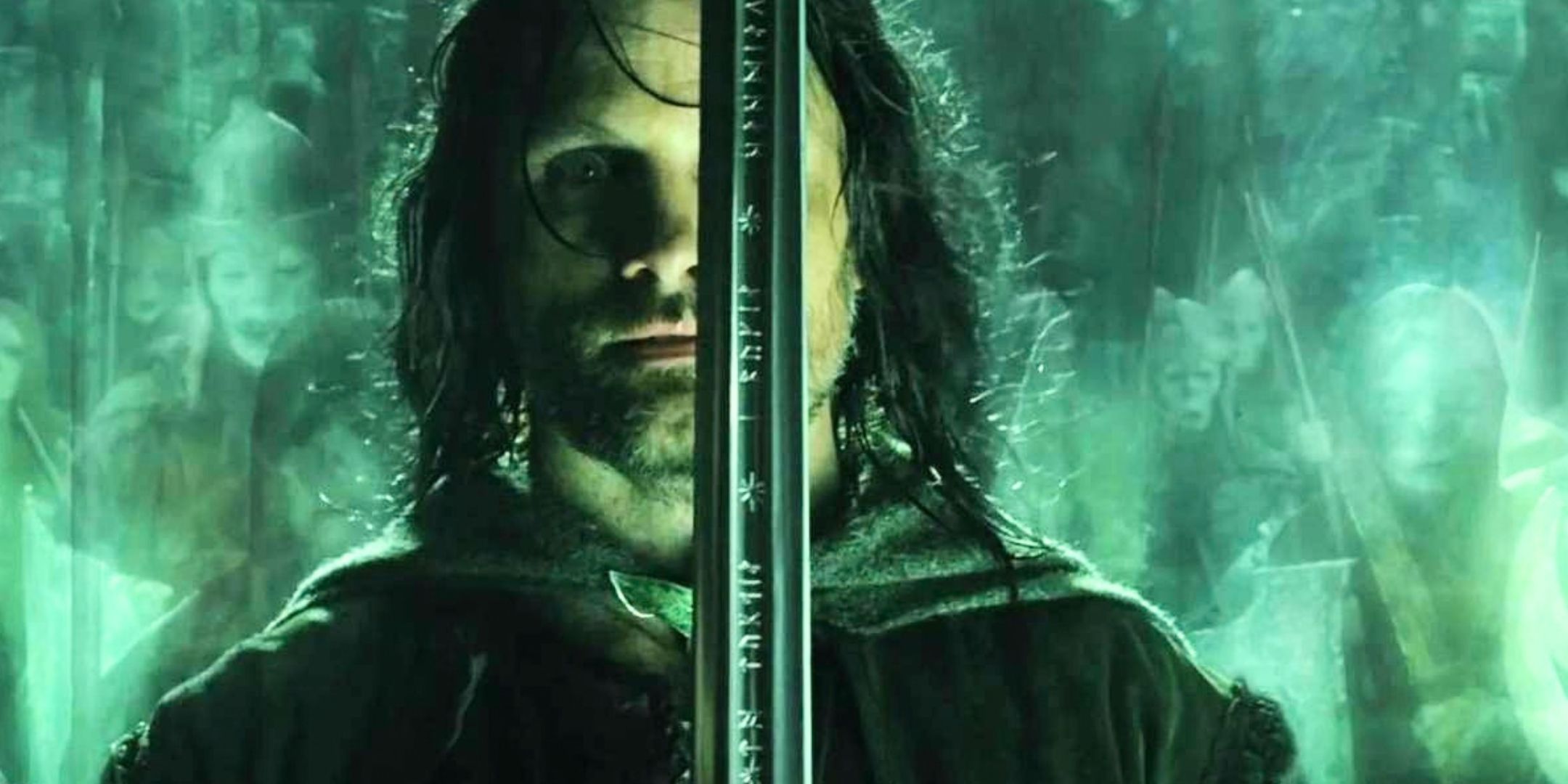
Few fantasy weapons have a place in pop culture like Andúril, known also as the Flame of the West and the Sword that was Broken. Aragorn’s iconic sword in The Lord of the Rings is reforged from the fragments of Narsil, the blade wielded by Elendil during the War of the Last Alliance. After Elendil falls, Isildur uses its broken blade to cut the One Ring from Sauron's hand. Thousands of years later, those same shards are reforged into Andúril for Elendil's heir.
That history would make Andúril iconic even before J.R.R. Tolkien describes its newly forged blade being inscribed with complex iconography and runes. It’s essentially Aragorn’s claim to the throne of Gondor given physical form, and no object in LotR besides the One Ring itself has as much symbolic significance. Andúril nails almost every requirement for a legendary fantasy sword: a dramatic and ancient history, a striking name, an iconic appearance, and a direct connection to the defeat of one of fantasy literature's definitive dark lords. It may not be the most powerful fantasy sword out there, but its status as one of the coolest is inarguable.
Purchase the first The Lord of the Rings novel here.
Nightblood From The Cosmere Series By Brandon Sanderson (2005-Present)
A Cheerful Talking Sword With A Terrifying Definition Of Evil

"Destroy evil" sounds like a reasonably straightforward command until that instruction is given to a sentient sword with absolutely no understanding of what evil means. This is exactly the case with Nightblood, one of the strangest and most dangerous weapons in Brandon Sanderson’s Cosmere universe. First introduced in 2009’s Warbreaker, the black-bladed longsword constantly encourages its wielder to draw it and destroy evil, displaying an almost childlike personality that contrasts spectacularly with its destructive capabilities.
Once unsheathed, Nightblood becomes horrifyingly powerful. It consumes Investiture (magical energy) at an alarming rate, making merely holding the weapon potentially fatal to someone unable to supply its hunger. What’s more, it can destroy minds and spirits as well as their physical bodies. The reason it’s one of the coolest swords to grace the pages of a fantasy novel isn’t its power, though, but the inherent contrast in its concept. A ridiculously dangerous black sword with an innocent personality and catastrophically simplistic moral reasoning makes Nightblood impossible to mistake for any other fantasy weapon, and one of the most interesting to read about too.
Purchase Warbreaker here.
Callandor From The Wheel Of Time Series By Robert Jordan (1990-2013)
A Crystal Sword That’s A Magical Superweapon

The Wheel of Time’s Callandor is technically not even a sword in the conventional sense, which only makes it cooler. The crystal blade cannot cut like steel because it is actually a powerful sa'angreal, an artifact that dramatically amplifies a channeler's ability to use the One Power. Known as the Sword That Is Not a Sword, Callandor waits within the Stone of Tear until the prophesized Dragon Reborn can claim it, making possession of the weapon one of the great prophetic milestones of Robert Jordan’s The Wheel of Time narrative. It is, in no uncertain terms, the fantasy equivalent of a weapon of mass destruction.
Its translucent appearance already gives Callandor an unmistakable visual identity compared to other fantasy swords, but its immense magical potential makes it genuinely frightening. Using the weapon would allow the wielder to level whole cities, control the weather, and wipe out entire armies basically on a whim. However, while the sword massively increases the amount of the One Power that can be channeled, doing so would be fatal to almost anyone who tries (or, at the very least, would drive them to madness). It may look like an ornamental crystal blade, but few, if any, fantasy swords have the destructive power or narrative weight of Callandor.
KioskNews shows a cleaned-up reading view extracted from the publisher’s page — the original always lives on their site, not ours.