Trump-Xi meeting: US policy clues to come after meeting: academics
US President Donald Trump’s meeting with Chinese President Xi Jinping (習近平) produced few surprises, but its implications for Taiwan will become clearer from Washington’s actions after the summit, Taiwanese academics said yesterday.
Chang Wu-ueh (張五岳), a senior advisor at the Institute for National Policy Research, told a forum in Taipei hosted by the institute that the outcome of the Trump-Xi meeting was “unsurprising.”
The meeting helped manage differences, but was unlikely to produce any major agreement on Taiwan, Chang said.
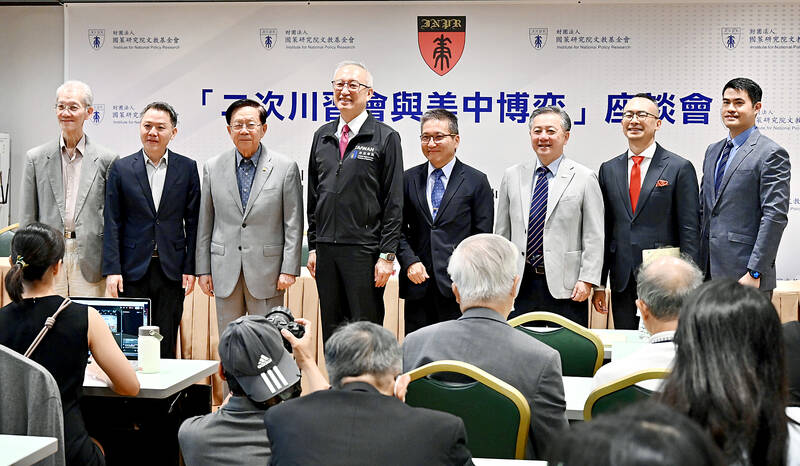
Panelists post for a photograph at a forum hosted by the Institute for National Policy Research in Taipei yesterday.
Photo: George Tsorng, Taipei Times
“There is no possibility of Taiwan becoming a bargaining chip in a grand US-China negotiation or deal,” he said.
The more telling signs would come afterward: whether Washington proceeds with arms sales to Taiwan, permits stopovers by Taiwanese presidents, sends senior officials to Taiwan or advances measures supporting it, he said.
According to China’s account, Xi during the meeting at the White House on Thursday urged Washington to handle the Taiwan issue prudently and oppose Taiwan independence.
White House accounts described progress on economic and other issues, but did not mention Taiwan.
A US fact sheet said each leader intended to attend a summit hosted by the other country — APEC in China and the G20 in the US.
Ming Chu-cheng (明居正), a professor emeritus of political science at National Taiwan University, said that the elaborate welcome for Xi in the US should not be mistaken for progress on the countries’ underlying disputes.
The reception served both leaders’ political interests: Trump faces US midterm elections, while Xi is seeking to strengthen his position ahead of the next Chinese Communist Party congress, Ming said.
“Don’t assume re-election is guaranteed for an authoritarian leader,” he said, referring to Xi’s political future.
Ming also challenged the view in some international media coverage that Trump needed Xi more than Xi needed Trump.
Given China’s economic difficulties and what Ming described as political pressure on Xi, the Chinese leader might need Trump more, he said.
Institute vice president Kuo Yu-jen (郭育仁) said that two B-1B warplanes that flew over Joint Base Andrews as Xi arrived was a warning amid Trump’s elaborate welcome.
“Trump also intended to put Xi on notice,” Kuo said.
B-1s were among the aircraft used in the US operation that captured deposed Venezuelan president Nicolas Maduro in January.
KioskNews shows a cleaned-up reading view extracted from the publisher’s page — the original always lives on their site, not ours.