With one last magic moment, DCE shows he’ll be a Hull of a big loss for the NRL
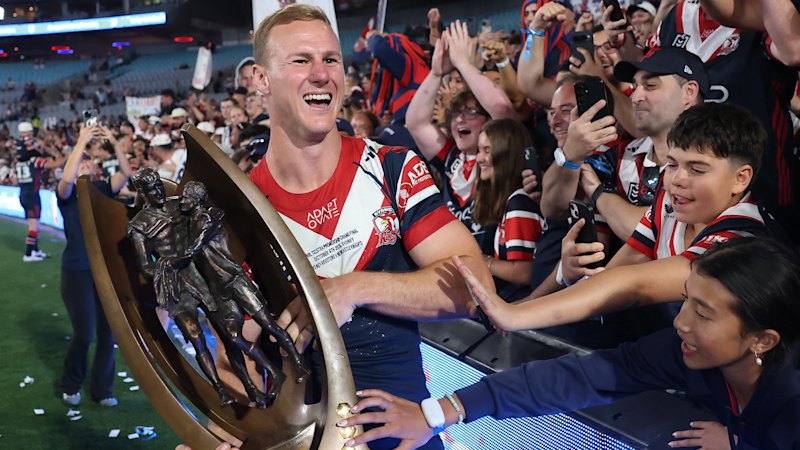
Daly Cherry-Evans kicked 28 field goals in 352 games for Manly, many of them match-winners. To see him do it in a grand final for the Roosters would have evoked mixed feelings for the Sea Eagles, but seriously?
He gave so much to Manly, keeping them competitive year after year and week after week, often single-handedly (and double-footedly with those drop-kicks off his left or right), that it’s a bit amnesic to begrudge him the joy of going out a winner.
His recruitment, like Cooper Cronk’s in 2018, proved the difference for the Roosters in 2026. Fifteen years apart, Cherry-Evans owned two grand final nights. Hull have got a good one.
Are all clubs created equal?
The Roosters will just have to live with the fact that most of the rugby league community don’t believe they, already premiership contenders, were able to recruit Cherry-Evans and Reece Robson and remain under the salary cap.
I don’t think they’ll struggle with it. Another premiership trophy offers pretty warm comfort and a high hill to crow from. But in these polarising times, it’s difficult to imagine a grand final with two more divergent potential narratives.
Newcastle win, from last to first, and it gives every club heart. The Roosters win, and it suggests that the salary cap is not stopping wealthy clubs from hoarding talent. The Roosters’ counter-argument is that Naufahu Whyte, Rob Toia, Sam Walker and many more of its representative stars are one-club players; by which logic, Penrith wouldn’t have had to let go Stephen Crichton, Matt Burton, Jarome Luai, James Fisher-Harris and Viliame Kikau ...
The margin might have only been one point in Sunday’s grand final, but the broader fan sentiment is very black and white. Not since David Gallop was chief executive has the NRL responded seriously to concerns about the failure of the cap to help equalise the talent pool.
It’s a bit tough to swallow any “fans first” rhetoric while some clubs remain, like George Orwell’s animals, more equal than others.
Bring back the entertainment
It’s a rule of every sporting event that there has to be a “random Souths guy”, and on Sunday night, that role fell to Jai Arrow.
In all the debate about how appropriate it was to have a sad and sombre moment as pre-grand final “entertainment”, and the inevitable last squeeze of shared sentiment to take it across the line into sentimentality, there wasn’t much about the Souths-ness of the situation.
A 100-game Rabbitoh was the centre of attention on the Roosters’ big night. In terms of tribalism, I’m not sure who was more put off: Souths, for having their man headline a Roosters game, or the Roosters, for having their grand final thunder stolen by someone from their enemy.
Of course, Arrow’s diagnosis with motor neurone disease has transcended tribalism and brought rugby league together. But tribalism is more resilient and permanent than individuals, and the best that can be said about Arrow’s lap of honour, accompanied by Nathan Charles (a former rugby player with the same horrible disease), is that the league was making the best of a bad situation. With any luck, it will be a one-off, and the NRL will get its act together sooner about what it organises for its big night.
Brigginshaw will always be game’s first champion
Ali Brigginshaw, after nine seasons for the Broncos, four premierships, 13 Origins for
Queensland and 29 Tests for Australia, retired after the NRLW grand final with a legacy as the foundation stone of women’s rugby league in this country.
She is to the sport what Betty Wilson was to women’s cricket and Fanny Durack was to women’s swimming. As that first great champion, she can never be superseded.
Brigginshaw’s final act as a player was to get whacked in the head as she completed a tough offload, still on the attack, looking for points even after Brisbane were well beaten.
What a career. The game will always owe her.
Great Dane was a Kiwi all along
Having watched Dane Gagai torment NSW in 23 Origin matches for a decade, I’m sure I’m not the only one who thought he was a Queenslander. Seven Kangaroos Test appearances confirmed he was Australian. But it turns out he’s a New Zealander.
In a convoluted judgment wrapped up in the cover-all “special circumstances”, Gagai has been granted his request to represent the Kiwis in the upcoming World Cup.
At 35, he is following his Newcastle teammate Kalyn Ponga in dissolving the old rule that players could not switch their representation between “tier one” nations. Now, we all know that international rugby league has been turned into a thing by the steady decanting of what would previously have been Australian players through other nations.
It’s smart business and is going to make the World Cup as credible as it can possibly be. That said, New Zealand don’t need Australian defectors – they are good enough to win on their own.
In the Indian summer that Gagai’s career is enjoying, it would surprise no one to see him emerge next month with a winner’s medal in black and white.

KioskNews shows a cleaned-up reading view extracted from the publisher’s page — the original always lives on their site, not ours.