The reason your face looks wrong in photos

If you’re anything like me, you’ve had this experience: You see a photo of yourself—maybe on a day you actually felt relatively put-together before leaving the house—and you suddenly feel betrayed by your own face.
For me, it’s usually some combination of the following: one eye squinting against the sun, a smile that somehow always turns into a tortured rictus, my chin multiplying despite my best “strategic selfie” angle.
That can’t be me, I think.
But it is. So, if the relatively inoffensive face I saw in the mirror is me, and the deeply unfortunate JPEG is also me, which do I believe? Which is real? Why do we look so different in photos than we do in the mirror—and which version is actually closer to the truth?
“We tend to like things that are familiar,” Dr. Nicholas Epley, a behavioral scientist at the University of Chicago Booth School of Business, tells Popular Science. “And so if you are routinely seeing yourself as a mirror image, over time you’re going to come to like that image of yourself.”
The face you know isn’t the face people see
Part of the answer lies in simple physics. A mirror shows you a reversed image of your face, and a photo doesn’t. Nearly everyone’s face has some subtle asymmetry: one eye slightly higher, one side of the mouth that curves a little differently. Actors will sometimes talk about having a “good side,” and there’s likely some truth to that. When you look in the mirror, you’re seeing that asymmetry flipped, day after day, thousands of times over.
But why would a reversed image start to feel more “correct” than the real one? Psychologists call it the “mere exposure effect.” It’s the idea that the more we’re exposed to something, the more we tend to like it, simply because it becomes familiar.
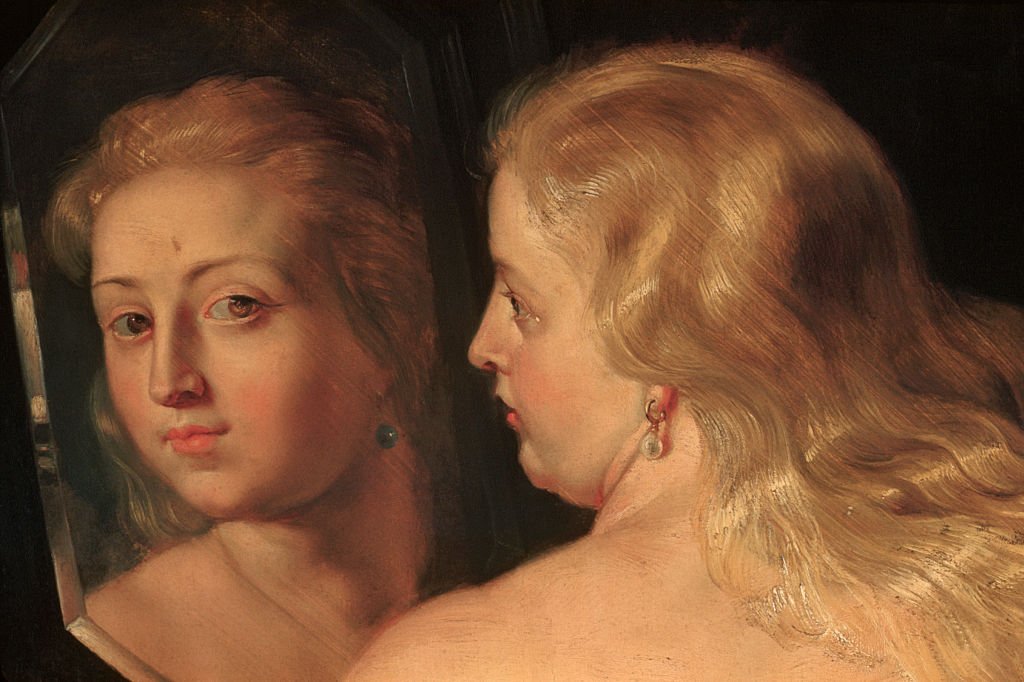
“Most of us encounter our face most frequently as a mirror reflection, so that reversed configuration becomes highly familiar,” says Dr. Valentina Cazzato, an associate professor of cognitive neuroscience at the University of Messina, Italy.
“Because nearly all faces are somewhat asymmetrical, an unreversed photograph changes the relative position of features in a way that may look subtly wrong to us, even though it looks perfectly normal to other people.”
In this way, we become accustomed to a daily version of ourselves that is a literal reversal of what everyone else sees, Epley says.
“The familiarity of [the mirror image] makes it easier to process psychologically,” he says. “You might like the mirror image of yourself, but other people see the opposite.”
However, differences between a still photograph and a mirror image are much more nuanced than a simple left-right reversal, according to Cazzato.
“Looking in a mirror is a dynamic and interactive experience: We move, adjust our expression, and select the angle from which we view ourselves,” she says. “A photograph freezes one fraction of a second, often under lighting, camera-distance and lens conditions that we would not normally choose.”
The unsettling feeling you might get from a photo, therefore, is likely related not only to the flipped image, but to a disconnect between the finite, momentary image captured in a photo and the animated, three-dimensional reflection we see every day.
There’s a deeper layer to how we see ourselves
There’s yet another wrinkle in how we perceive our own faces, and it involves a response that isn’t even fully deliberate. Researchers call it implicit self-esteem: a person’s underlying, not consciously examined sense of their own worth.
Epley has studied this directly. In one experiment, his team took neutral photos of participants staring into a camera, then digitally morphed each one along a spectrum toward either a highly attractive face, a composite average of many other faces, or a highly unattractive one. They created 11 versions per person, blended in varying degrees. Participants were then asked to pick out which one was actually theirs.
“On average, people tended to pick a face that was more attractive than their actual face,” Epley says.
Epley is careful not to overstate the finding, however. There are alternative interpretations too, which we did not test directly,” he says. He adds that participants were photographed with a neutral expression under lab conditions, which is not exactly how most of us look in our day-to-day mirror or phone-camera glances.
“Maybe you smile more in your pictures,” Epley says, “and that’s a more positive-looking image than the image we took of people in the lab.”
Related 'Ask Us Anything' Stories
Cazzato’s own research extended this concept even further. Her team morphed participants’ faces with images of unfamiliar women who had undergone cosmetic enhancements, specifically lip and cheek fillers, then asked people to identify which face was theirs.
“We found that, during brief viewing, participants continued to identify a face as their own even when it contained a substantial amount of information from the other face,” she says. “This does not show that everyone holds a prettier mental portrait of themselves. It suggests, more broadly, that self-face representations are flexible and can incorporate positively valued features from other faces, particularly during rapid, less deliberate judgments.”
Reconciling the face we know with the face everyone else sees can be jarring, but Epley says there’s a silver lining here: To the people in your life, that grotesque-seeming flipped image of you is as familiar (and perhaps as attractive) as your mirror image is to you.
“You might not like that image,” he says, “but if other people see that image all the time, they probably like it better than you do. There’s solace in that.”
In Ask Us Anything, Popular Science answers your most outlandish, mind-burning questions, from the everyday things you’ve always wondered to the bizarre things you never thought to ask. Have something you’ve always wanted to know? Ask us.
KioskNews shows a cleaned-up reading view extracted from the publisher’s page — the original always lives on their site, not ours.