10 Near-Perfect Sci-Fi Books That Everyone Must Read at Least Once

Luc Haasbroek is a writer and videographer from Durban, South Africa. He has been writing professionally about pop culture for eight years. Luc's areas of interest are broad: he's just as passionate about psychology and history as he is about movies and TV. He's especially drawn to the places where these topics overlap.
Luc is also an avid producer of video essays and looks forward to expanding his writing career. When not writing, he can be found hiking, playing Dungeons & Dragons, hanging out with his cats, and doing deep dives on whatever topic happens to have captured his interest that week.
Sign in to your Collider account
Every genre has its classics that all fans need to read, the foundational works that shaped our perception of them and impacted the culture as a whole. In science fiction's case, the masterpieces don't just imagine a possible future but strive to say something timeless about the human condition.
This list looks at some of the most essential sci-fi books, from the devastating psychological depth of Flowers for Algernon to the cyberpunk prophecy of Neuromancer. Calling any book perfect is asking for trouble, but these 10 certainly come close. Some transformed science fiction permanently; others simply demonstrate what the genre can accomplish when an exceptional writer pushes one great idea as far as it can go.
'The Forever War' (1974)

"Tonight we're going to show you eight silent ways to kill a man." In this one, author Joe Haldeman, himself a Vietnam veteran, introduces us to physicist William Mandella, who is conscripted into an elite force fighting the mysterious Taurans across interstellar space. Soldiers can travel enormous distances relatively quickly from their perspective, but relativity means decades or even centuries may pass on Earth while they're away.
Mandella survives a campaign lasting months, only to return home and discover that the society he fought to protect has become almost unrecognizable. While there is punchy action here and a bevy of cool futuristic tech, including stasis fields, power armor, and pods that resist extreme gravity, the focus is really on the protagonist's alienation. In other words, the hard sci-fi framework conceals a powerful, personal allegory about the lingering effects of combat.
'The Left Hand of Darkness' (1969)
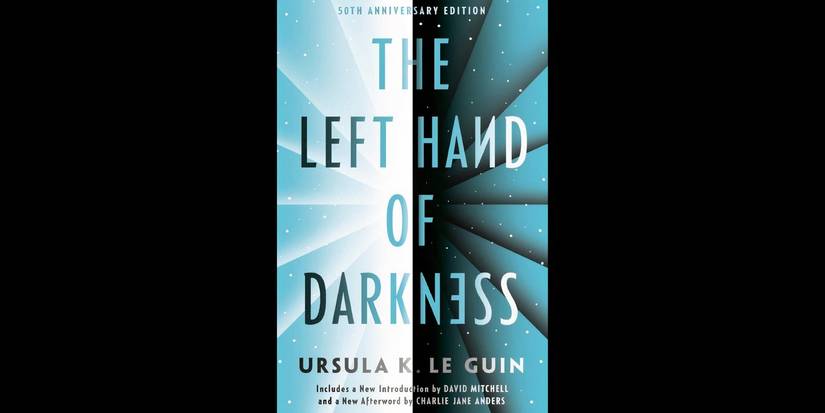
"I was taught as a child on my homeworld that Truth is a matter of the imagination." This is another allegorical classic. In The Left Hand of Darkness, the main character, Genly Ai, travels to the frozen planet Gethen as an envoy of the Ekumen, hoping to persuade its nations to join an interstellar civilization. There, he experiences serious culture shock, as the inhabitants of Gethen are generally neither male nor female, becoming sexually differentiated only during periods of fertility.
Genly understands this intellectually, yet his assumptions about gender continually distort how he perceives the people around him. Author Ursula K. Le Guin (the brains behind the Earthsea fantasy novels) uses that premise to explore gender, politics, nationalism, communication, and the difficulty of seeing beyond one's cultural conditioning. That said, even aside from the themes, the novel is simply a touching story, particularly when it comes to Genly's relationship with the Gethen politician Estraven.
'What We Can Know' (2025)

"The past is not behind us. It is beneath us." This is the latest masterpiece from Atonement's Ian McEwan. In the 22nd century, academic Tom Metcalfe studies the lost world of the early 21st century and becomes fascinated by a famous poem that was supposedly read aloud at a dinner in 2014 before disappearing. His attempt to locate it gradually turns literary scholarship into something resembling detective work. It's a wonderful reversal of conventional historical fiction tropes, as well as a believable (occasionally frightening) vision of the future.
More than that, however, What We Can Know is really a portrait of our own mad moment in time. We see the present through Tom's eyes, meaning that its flaws and inconsistencies become glaringly obvious. At the same time, McEwan keeps rich characterization and personal drama (not to mention some juicy mysteries) front and center.
'Hyperion' (1989)

"The Hegemony Consul sat on the balcony of his ebony spaceship and played Rachmaninoff's Prelude in C-sharp Minor." Hyperion focuses on seven pilgrims journeying to a distant world where the mysterious Time Tombs are moving backward through time and an almost mythical creature known as the Shrike waits among them. Each traveler has a deeply personal reason for making the journey, and the novel gradually reveals those reasons through a series of stories told along the way.
The structure famously echoes The Canterbury Tales, but writer Dan Simmons uses it to move effortlessly between different kinds of science fiction. One pilgrim's story plays like military sci-fi, another like a detective mystery, another like tragedy, another like horror. The result is a novel that keeps reinventing itself while steadily building its mythology. The Shrike is especially effective because it's never reduced to a conventional monster; rather, it exists somewhere between killer, god, devil, weapon, and cosmic mystery.
'The Dispossessed' (1974)

"There was a wall. It did not look important." Ursula K. Le Guin strikes again; this is another compelling sci-fi story with strong political and social undercurrents. Physicist Shevek leaves the anarchist society of Anarres for the wealthy neighboring world of Urras. Anarres was founded by revolutionaries who rejected hierarchy and private property, while Urras contains wealth, inequality, and concentrated political power that looks far more familiar to modern readers.
Neither world, however, is presented as an uncomplicated answer to the problems of the other. That refusal to create an easy utopia is what makes the novel so enduring. Anarres is remarkably equal in many respects, yet totally stagnant in others. Urras, meanwhile, offers abundance and intellectual opportunity, but also resentment and deep social discord. Back in the mid-'70s, with the Cold War still underway, these sorts of debates were very much at the forefront of the public consciousness.
Collider Exclusive · Sci-Fi Survival Quiz Which Sci-Fi World Would You Survive? The Matrix · Mad Max · Blade Runner · Dune · Star Wars
Five universes. Five completely different ways the future went wrong — or sideways, or up in flames. Only one of them is the world your instincts were built for. Eight questions will figure out which dystopia, galaxy, or desert wasteland you'd actually make it out of alive.
💊The Matrix
🔥Mad Max
🌧️Blade Runner
🏜️Dune
🚀Star Wars
01
You sense something is deeply wrong with the world around you. What do you do? The first instinct is often the truest one.
02
In a world of scarcity, what resource do you guard most fiercely? What we protect reveals what we believe survival actually requires.
03
What kind of threat keeps you up at night? Fear is useful data — if you're honest about what you're actually afraid of.
04
How do you deal with authority you don't trust? Every dystopia has a power structure. Your approach to it determines everything.
05
Which environment could you actually endure long-term? Survival isn't just tactical — it's physical, psychological, and very much about where you are.
06
Who do you want in your corner when things fall apart? The company you keep is the clearest signal of who you actually are.
07
Where do you draw the line — if you draw one at all? Every survivor eventually faces a moment that tests what they're actually made of.
08
What would actually make survival worth it? Staying alive is one thing. Having a reason to is another.
Your Fate Has Been Calculated You'd Survive In…
Your answers point to the world your instincts were built for. This is the universe your temperament, your survival instincts, and your particular brand of stubbornness were made for.
The Matrix
You took the red pill a long time ago — probably before anyone offered it to you. You're a systems thinker who can't help but notice the seams in things.
- You're drawn to understanding how the system works before figuring out how to break it.
- You'd find the Resistance, or it would find you — your instinct for spotting constructed realities is the machines' worst nightmare.
- You function best when you have access to information and the freedom to act on it.
- The Matrix built an airtight prison. You'd be the one probing the walls for the door.
Mad Max
The wasteland doesn't reward the clever or the well-connected — it rewards those who are hard to kill and harder to break. That's you.
- You don't need comfort, community, or a cause larger than the next horizon.
- You need a vehicle, a clear threat, and enough fuel to outrun it — and you're good at all three.
- You are unsentimental enough to survive that world, and decent enough — just barely — to be something more than another raider.
- In the wasteland, that distinction is everything.
Blade Runner
You'd survive here because you know how to exist in moral grey areas without losing yourself completely.
- You read people accurately, keep your circle small, and ask the questions others prefer not to answer.
- In a city where humanity is a legal designation rather than a feeling, you hold onto something that keeps you functional.
- You're not a hero. But you're not lost, either.
- In Blade Runner's world, that distinction is everything.
Dune
Arrakis is the most hostile environment in the known universe — and you are precisely the kind of person it rewards.
- Patience, discipline, and political awareness are your core strengths — and on Arrakis, they're survival tools.
- You understand that the long game matters more than any single victory.
- Others come to Dune and are consumed by it. You'd learn its logic and earn its respect.
- In time, you wouldn't just survive Arrakis — you'd begin to reshape it.
Star Wars
The galaxy far, far away is vast, loud, and in a constant state of violent political upheaval — and you wouldn't have it any other way.
- You find meaning in being part of something larger than yourself — a cause, a crew, a rebellion.
- You'd gravitate toward the Rebellion, or the fringes, or whatever pocket of the galaxy still believes the Empire's grip can be broken.
- You fight — not because you have to, but because standing aside isn't something you're capable of.
- In Star Wars, that willingness is what makes all the difference.
'Slaughterhouse-Five' (1969)

"All this happened, more or less." Here, Kurt Vonnegut draws on his experiences as a POW who survived the bombing of Dresden, but he refuses to transform that trauma into a conventional war novel. Instead, his protagonist Billy Pilgrim becomes "unstuck in time," bouncing uncontrollably between different moments in his life: childhood, war, marriage, middle age, death, and even his supposed abduction by aliens from the planet Tralfamadore. The sci-fi elements initially seem almost absurd, but they become essential to the story.
Billy cannot leave the war behind because, from his perspective, the past never really becomes past; he can be a comfortable middle-aged man one moment and a terrified prisoner in Dresden the next. This eerie but fascinating approach is paralleled by the way the Tralfamadorians perceive every moment as permanently existing. Ultimately,Slaughterhouse-Five becomes an exploration of PTSD, coping mechanisms, memory, and free will.
'The Stars My Destination' (1956)

"He was one hundred and seventy days dying and not yet dead." Stranded aboard the wrecked Nomad, Gully Foyle sees another spacecraft pass close enough to rescue him. It doesn't. His resulting fury gives a previously directionless man a purpose: find the ship, discover why it abandoned him, and destroy everyone responsible. Alfred Bester takes the basic architecture of The Count of Monte Cristo and detonates it inside a futuristic society where humans have learned to "jaunte," teleporting themselves across enormous distances through thought alone.
Indeed, The Stars My Destination is fundamentally a revenge story encased in sci-fi trappings. The protagonist is brutal, obsessive, frequently repellent, and enormously compelling, despite (or perhaps because of) his deep moral grayness. Not to mention, on the stylistic front, the novel's experimental typography and psychedelic later passages also feel startlingly modern for a book published in 1956.
'Neuromancer' (1984)
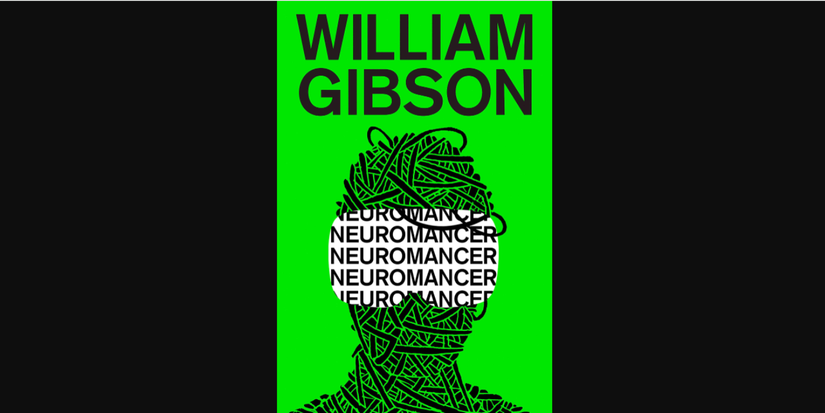
"The sky above the port was the color of television, tuned to a dead channel." Cyberpunk's center of gravity. Neuromancer centers on Case, a washed-up hacker whose nervous system has been deliberately damaged, leaving him unable to access cyberspace. An enigmatic employer offers to repair him in exchange for his participation in an extraordinarily dangerous job, pairing him with the lethally augmented mercenary Molly Millions. Together, they navigate a world of rogue AI and all-powerful corporations.
Here, author William Gibson seamlessly fuses high-tech with low-life, discarding the clean, optimistic spaceships of mid-20th century sci-fi for a gritty, neon-drenched, corporate-dominated dystopia. He innovated in all sorts of ways, even coining the term cyberspace itself. Much of his vision looks uncomfortably prescient now. Gibson's writing is also great on a sentence-by-sentence level here: the prose is noirish, hyperkinetic, and frequently poetic.
'Dune' (1965)
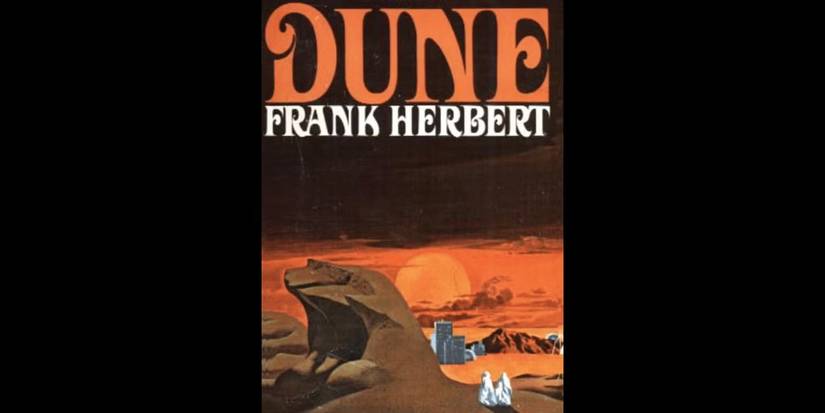
"A beginning is the time for taking the most delicate care that the balances are correct." Dune remains one of sci-fi's absolute high points when it comes to worldbuilding. With it, Frank Herbert created a universe whose politics, religion, ecology, economics, warfare, and mythology are tightly interlocked. Spice enables interstellar civilization, which makes control of the desert planet Arrakis politically indispensable. Likewise, the planet's brutal ecology shapes Fremen culture, while their religious beliefs have themselves been manipulated by outside powers.
It's against that colorful backdrop that the messianic cautionary tale of Paul Atreides plays out. He is soon entangled in realpolitik involving the Fremen, House Harkonnen, the Emperor, and the shadowy Bene Gesserit. Along the way, Herbert gives readers many of the pleasures of a grand adventure, like duels, betrayals, political maneuvering, enormous battles, and giant alien beasts, while also quietly interrogating the very fantasy of the chosen hero.
'Flowers for Algernon' (1966)

"Dr Strauss says I shoud rite down what I think and remembir and every thing that happins to me from now on." This is one of the most heartbreaking works of soft sci-fi ever written. In Flowers for Algernon, Charlie Gordon, an intellectually disabled man, undergoes an experimental procedure designed to dramatically increase his intelligence. His progress reports initially contain simple vocabulary and frequent spelling mistakes, but as the treatment works, the language itself transforms.
Charlie's writing becomes increasingly sophisticated at the same time as his understanding of himself and everyone around him deepens. In fact, the procedure goes better than expected: Charlie eventually has a genius-level IQ. However, his transformation proves short-lived. It becomes clear that the effects will wear off, meaning that Charlie is forced to watch as his mind once again fades and slips from his grasp. The plot takes unexpected twists and turns from here, and the themes hit hard, making for a tough but worthwhile read.
KioskNews shows a cleaned-up reading view extracted from the publisher’s page — the original always lives on their site, not ours.