Flying-foxes are turning up starving. Why are we still responding one crisis at a time?
Wildlife carers have been overwhelmed by large numbers of distressed animals needing care. Banana and berry growers are reporting crop damage and sightings of weakened bats. New South Wales and eastern Victoria are the areas currently affected. Grey-headed flying-foxes seem to be the worst affected species.
The most likely cause is a food shortage. Australia had a very warm winter, which may have changed the flowering patterns of some trees and led to a nectar shortage. This isn’t yet confirmed, as investigations are continuing.
Unfortunately, this is only the latest in a string of mass deaths of flying-foxes, the world’s largest flying mammals. Over the 2019–20 Black Summer, extreme heat claimed tens of thousands, and thousands more died from the same cause over the 2025–26 summer. Climate change is steadily making their lives harder.
Australia is poorly placed to respond to wildlife emergencies affecting these important, highly mobile bats. In 2016, land managers, researchers, conservationists and industry backed a national approach to managing flying-foxes. A decade later, there’s still no sign of change.
A forest is not a supermarket
Many Australians call flying-foxes “fruit bats”.
But grey-headed flying-foxes actually prefer eucalypt nectar and pollen over cultivated fruit. They turn to orchards only when their preferred foods are scarce.
Eucalypt flowering is highly variable. Forests with plenty of flowering gums one month can offer little the next. Flying-foxes are good at finding these ephemeral sources of food. But food isn’t always available in a land of droughts and flooding rains.
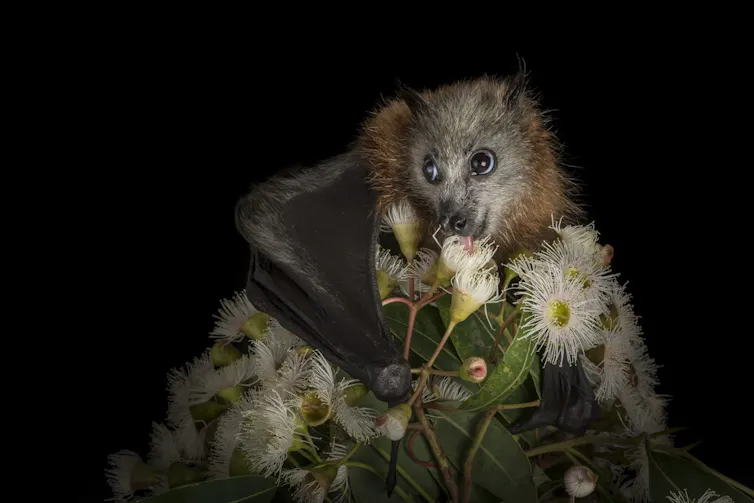
Flying-foxes have long had to deal with food shortages. Between 1996 and 2020, researchers documented recurrent food shortages, as well as changes in flying-fox distribution and their increasing reliance on agricultural and urban areas. Land clearing and urban development have removed much of southeast Queensland’s native winter-flowering habitat, making winter nectar harder to find.
Planting, protecting and restoring native food trees help sustain the irreplaceable role of flying-foxes as long-distance pollinators and seed dispersers, boosting the economy and reducing the chance of disease spilling over.
Life on the move
Flying-foxes are among the most mobile animals on Earth, able to fly over 100 kilometres a night. They’re nomads, moving between a vast network of camps. It’s easy to spot a flying-fox camp – the squawking and constant bustle make it hard to miss.

Australian cities offer flying foxes an attractive, stable supply of food, due to a mix of exotic and native trees fruiting or flowering at different times, allowing the bats to spend more time at urban camps.
When the megafires of the Black Summer burned large areas of prime habitat, flying-foxes began foraging very differently, seeking out lower-quality unburned forests further inland.
How do people respond?
Flying-foxes are weird, wonderful and ecologically vital. But they are not universally loved.
Desperate flying-foxes have been reported damaging crops, while sudden changes in camp size can make local communities concerned about noise and smell.
We can’t overlook the effects they can have on communities. But it’s wrong to treat them as pests – or let landholders face the sudden arrival of a colony alone. Instead, we should aim to recognise flying-foxes as natural and ecologically invaluable – while protecting both their habitat and our human crops.
Read more: Why we shouldn’t be so quick to demonise bats
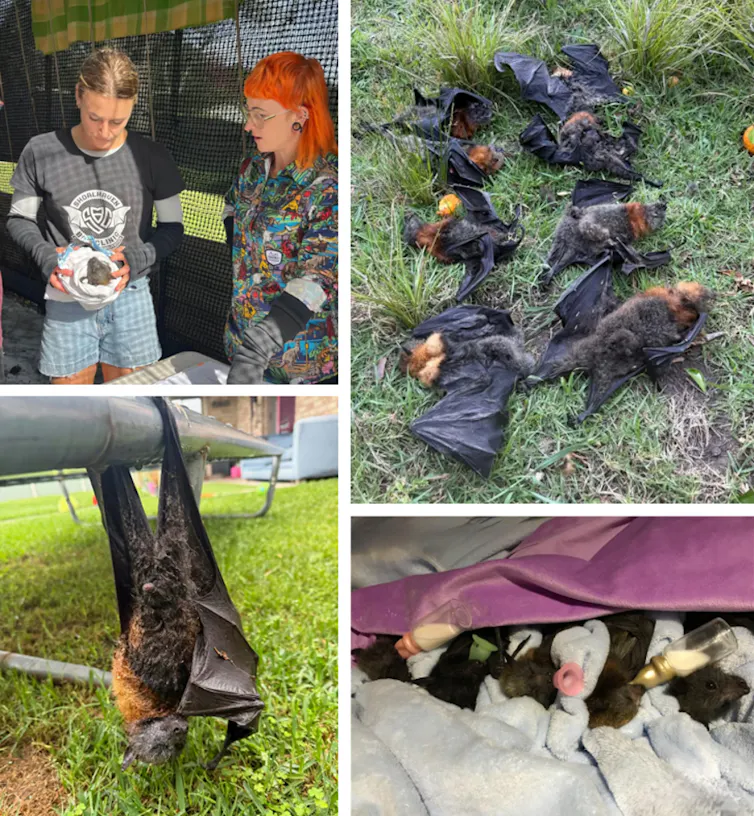
As reports of sick and hungry flying-foxes emerged this spring, local wildlife carers again stepped up. Their work is vital. But it comes at real cost – physically, financially and emotionally. These volunteers need much better support, across training, equipment, vaccinations, access to vets, and help to boost rehabilitation capacity.
‘No response to date’
When eucalypts flower en masse, thousands of flying-foxes can arrive rapidly. For local towns, this can create tensions.
These tensions even led to a federal parliamentary inquiry. The inquiry’s 2017 report called for a national or eastern-states flying-fox consultative body, and recommended dedicated funding for research, recovery and at least ten more years of monitoring. It also recommended decision-support tools for councils and community education.
Ten years later, the official outcome is “no response to date”. Meanwhile, national monitoring and crisis responses remain fragmented.
Read more: Not in my backyard? How to live alongside flying-foxes in urban Australia
In late 2022, the long-running National Flying-Fox Monitoring Program was defunded. This left Australia without an up-to-date national picture of flying-fox populations, making crises much harder to understand and manage.
In good news, other government agencies, land managers and volunteers have continued to monitor these animals locally. For example, of the 476 known flying-fox camps in NSW, 52% are now being monitored. In 2019, that figure was 35%.
To help improve the situation, our team at Western Sydney University has recently released the Australian Flying-Fox Monitor, which holds population records, tracking and citizen science data collected for all Australian flying-fox species. Users can also report entanglements, electrocutions, starvation and bats affected by extreme heat.

National protection requires follow-through
Three of Australia’s five flying-fox species are considered threatened nationally. But federal recovery planning is falling well short for all three, reflecting a broader failure to deliver on recovery commitments.
The Christmas Island flying-fox is critically endangered, but has no national recovery plan. The spectacled flying-fox is endangered, but still relies on a 2010 plan, now six years beyond its intended timeframe. And the grey-headed flying-fox is vulnerable, but its 2021 recovery plan is past its mandatory five year review period.
State and federal laws can clash. Queensland still allows grey-headed flying-foxes to be shot to protect crops, despite promises to ban the practice. To our knowledge, it’s the only nationally threatened species routinely culled at state level other than the great white shark.
From crises to coordination
This year’s flying-fox crisis isn’t the first and it won’t be the last. In the absence of proper coordination, it’s been left to wildlife carers to respond.
But they cannot do it alone. Local commitment cannot substitute for national coordination. It’s time to stop managing flying-foxes one crisis at a time.
KioskNews shows a cleaned-up reading view extracted from the publisher’s page — the original always lives on their site, not ours.