S’pore to expand scope of Rail Academy to better train workers amid MRT network expansion, upgrades
SINGAPORE – Singapore will be investing more resources into training workers responsible for the upkeep of its MRT system, by ensuring its engineers, technicians and operations staff have the right skills to make sound decisions and carry out works safely.
Transport Minister Jeffrey Siow on Oct 24 said that to achieve this, his ministry will be making changes to the Singapore Rail Academy.
The changes include standardising training programmes, expanding the list of workers eligible to join the courses, and introducing new industry certification pathways.
Launched in 2017, the academy currently conducts more than 20 training sessions each year for about 500 rail engineers who have just joined the industry.
These engineers also undergo separate training at their rail operators’ own training institutes. These facilities also offer training to their respective operations and maintenance staff.
Singapore has two rail operators - SBS Transit and SMRT Trains. Together, they manage six MRT lines and two LRT lines.
Siow said that from November, the Singapore Rail Academy will introduce a consolidated training curriculum that involves input from the Land Transport Authority (LTA) and both operators.
The training programme will be “standardised and true to the ground”, Siow said, with skills being transferable across either operator.
He added: “The academy will not just focus on the training standards for engineers, but going forward, we will also include technicians and operations staff, who play an equally vital role in keeping our trains running.”
He was speaking at LTA’s Singapore BusTech and RailTech Grand Challenge held at ITE College West. The event takes place every two years and sees public transport workers and students coming together to brainstorm solutions to engineering challenges, like troubleshooting electric bus batteries.
On the introduction of new industry certification pathways. Siow said the academy will also begin a formal partnership with the Institute of Technical Education, Nanyang Polytechnic, Republic Polytechnic, Singapore Polytechnic and the Singapore Institute of Technology.
This partnership would mean that on-the-job training and certification will count towards the pursuit of a diploma or degree, so rail workers will not need to start from scratch when pursuing educational certification.
He said: “At the heart of our transport system are people... You are the ones who keep Singapore moving every day.
“I want to make sure that we continue giving you the skills, support and opportunities to do your best work, and to build good, rewarding careers.”
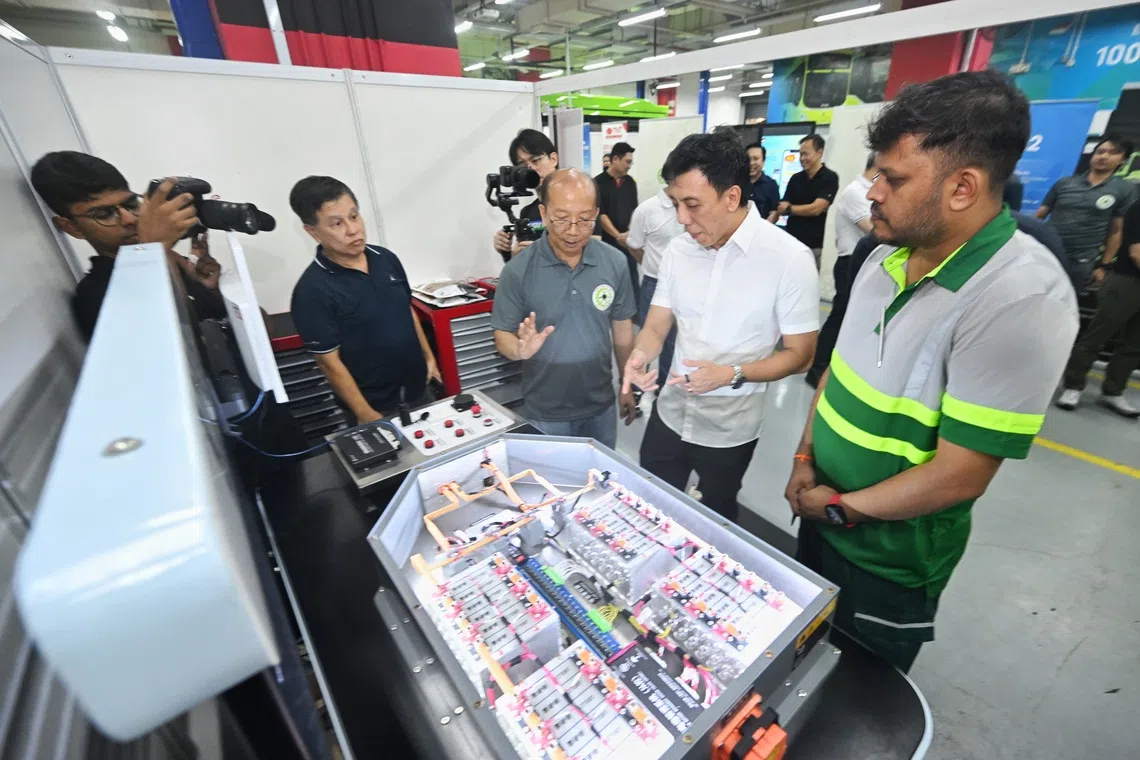
Transport Minister Jeffrey Siow (centre) with technicians at the Singapore BusTech and RailTech Grand Challenge on Oct 24.
ST PHOTO: AZMI ATHNI
The changes to the Singapore Rail Academy were first surfaced by a task force looking into solutions to improve the reliability of Singapore’s rail network.
In its report submitted to Siow in December 2025, it recommended that LTA and the rail operators work together to strengthen the role of the academy, so as to raise standards and prepare those in the industry for future challenges.
LTA said in a separate statement on Oct 24 that the changes will give the academy an expanded mandate, allowing it take on a more coordinated approach in developing those working in the rail industry.
Beyond helping develop a highly skilled and future-ready workforce in the sector, the authority said the changes will help make the industry be more attractive to future generations.
“This will be increasingly important as our rail network continues to expand and adopt more advanced technologies and systems, even as our existing lines undergo major renewals.”
For instance, the upcoming Jurong Region Line is slated to begin its first stage of operations in mid-2028, while the first phase of the Cross Island Line is scheduled to begin in 2030.
Lew Yii Der, the executive dean of the Singapore Rail Academy, said that as the rail network grows and technology advances, it is necessary to equip rail professionals with the skills to meet new challenges.
SBS Transit group chief executive Jeffrey Sim said the expansion of the academy will provide more opportunities for workers to deepen expertise, gain recognised qualifications and progress in their careers.
Aqil Hamzah is a transport journalist at The Straits Times. He is also interested in issues related to crime and technology.
KioskNews shows a cleaned-up reading view extracted from the publisher’s page — the original always lives on their site, not ours.