Dongju Lighthouse draws crowds to Matsu
By Shelley Shan / Staff reporter, on Dongju Island, Lienchiang County


The renovated Dongju Lighthouse (東莒燈塔) has become a popular tourist attraction, drawing hundreds of visitors to Dongju Island (東莒) in Lienchiang County (Matsu) over the past two months, the Maritime and Port Bureau said yesterday.
The British-designed lighthouse, designated a national historic site in 2008, was built in 1872, following the First Opium War, after which the Qing Dynasty was forced to open five treaty ports along China’s southeastern coast.
It was the first lighthouse in Taiwan to be constructed of granite.
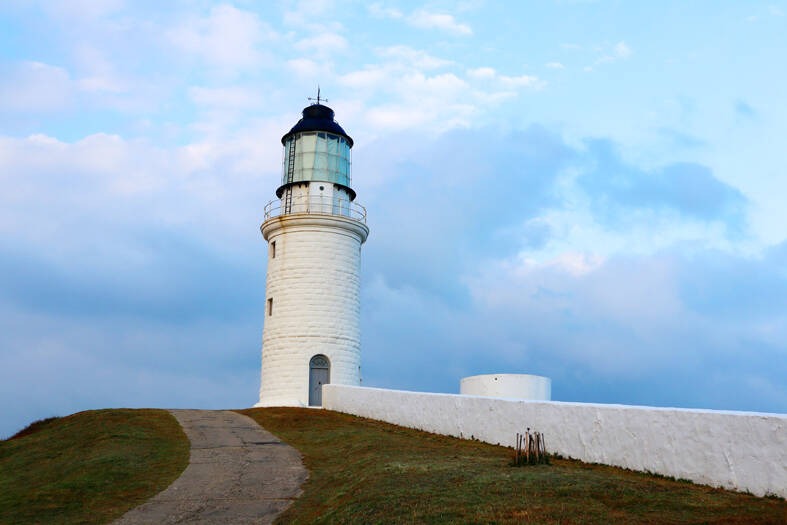
The Dongju Lighthouse in Lienchiang County is pictured yesterday.
Photo: Huang Yi-ching, Taipei Times
The lighthouse reopened on Sept. 17 after undergoing renovations in 2024 and has attracted more than 500 visitors in the past two months, the bureau said.
The bureau has also established a permanent exhibition next to the lighthouse to showcase its history.
Exhibits include a fireproof safe manufactured by Milner & Co in 1850, a bell used to signal shift changes, a detailed 1:20-scale cross-sectional model of the lighthouse and an interactive kerosene lantern installation.
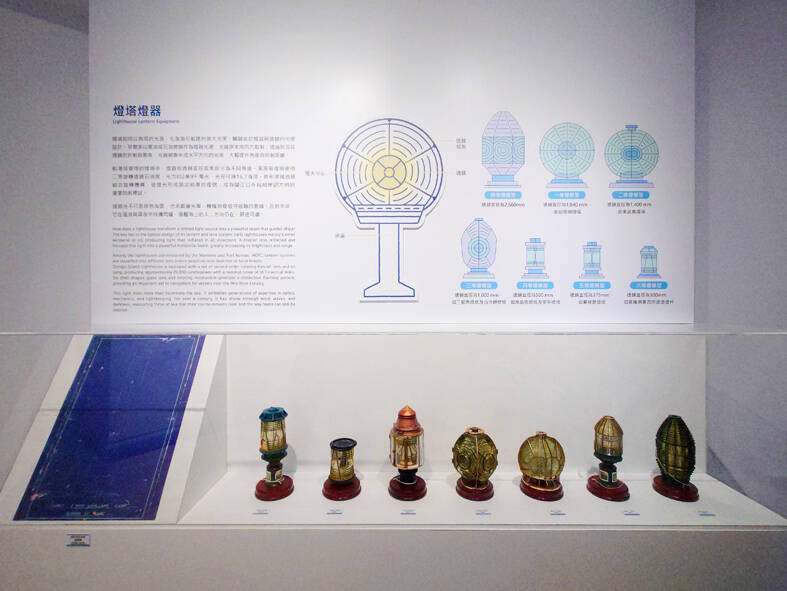
An exhibit on lamp designs is displayed in the permanent exhibition at Dongju Lighthouse in Lienchiang County yesterday.
Photo: CNA
Visitors can lift the lantern to activate its light while watching a projection of the Milky Way on a screen as a recording of the sound of waves breaking along Dongju Island’s shore plays.
The immersive experience allows visitors to imagine what it was like to be a lighthouse keeper on night watch in the past, the bureau said.
The bureau has also preserved a white windbreak wall between the lighthouse and the exhibition building, an architectural feature of historical significance.
Dongju Lighthouse management office director Tseng Hsiang-guan (曾祥官) told reporters during a tour on Wednesday that the lighthouse remains structurally sound, 154 years after its construction.
The lighthouse ceased operations from 1958 to 1993 due to the Second Taiwan Strait Crisis and subsequent military restrictions, he said.
The lighthouse was designed by British engineer David Marr Henderson, while its lantern was manufactured by British company Chance Brothers & Co.
It was among the first lighthouse lighting systems of its kind introduced to Taiwan, Tseng said.
Before electricity was introduced, the lighthouse relied on an oil lamp as its light source, while the large Fresnel lens in the lantern room was rotated by a weight-driven mechanical system, he said.
The system enabled the lens to rotate at a steady speed without requiring lighthouse keepers to turn it manually throughout the night, he said.
In addition to operating the rotation mechanism, keepers had to monitor the oil lamp continuously to ensure that its flame remained stable, Tseng said.
Before electricity was available, four to six keepers worked inside the lighthouse throughout the night, he said.
The oil lamp also produced smoke and consumed oxygen, making proper ventilation essential, he said, adding that ventilation openings could still be seen along the walls.
Today, the lighthouse uses a 250-watt electric bulb as its light source, Tseng said.
An electric motor has been installed to drive the rotation of the Fresnel lens.
Despite these modern additions, the original Fresnel lens and most of the lighthouse’s mechanical structures have been preserved.
The lens takes 19.5 seconds to complete one rotation, producing a distinctive light signal consisting of one long flash followed by two short flashes.
The three optical sections of the lens produce three beams of light that sweep across the surrounding sea as the lens rotates.
Under favorable weather conditions and with good visibility, the lighthouse can be seen from as far as 30km away.
Maritime and Port Bureau Deputy Director-General Liu Chih-hung (劉志鴻) said the renovation is part of the bureau’s lighthouse tourism initiative.
Similar projects have also been undertaken at Oluanpi Lighthouse (鵝鑾鼻燈塔) in Pingtung County, as well as Cape Santiago Lighthouse (三貂角燈塔) and Fuguijiao Lighthouse (富貴角燈塔) in New Taipei City.
In addition to renovating the lighthouse, the bureau worked with the Lienchiang County Government to upgrade facilities at Mengao Harbor (猛澳港) on Dongju Island and improve ferry services, Liu said.
Visitors can reach Dongju Lighthouse by flying to Nangan Airport and taking a ferry to Dongju.
Other attractions near the lighthouse include Dapu Settlement (大埔聚落), a village characterized by traditional Eastern Fujian-style stone houses; a Ming Dynasty inscription at Dapu Rock; and a spectacular coastal rock formation known as Mysterious Cove.
Admission to the lighthouse and permanent exhibition is free. Visitors receive a lighthouse-themed postcard as a souvenir.
Visitors who post photographs of their trip and leave a comment on the bureau’s Facebook page are eligible to enter a lucky draw for limited-edition lighthouse-themed night lamps and Matsu commemorative liquor.
KioskNews shows a cleaned-up reading view extracted from the publisher’s page — the original always lives on their site, not ours.