Taiwan News Quick Take
Staff writer, with agencies


DIPLOMACY
US senator visits: AIT
US Senator Michael Bennet of Colorado is visiting Taiwan, where he would meet with senior Taiwanese officials to discuss issues related to Taiwan-US relations, the American Institute in Taiwan (AIT) announced yesterday.
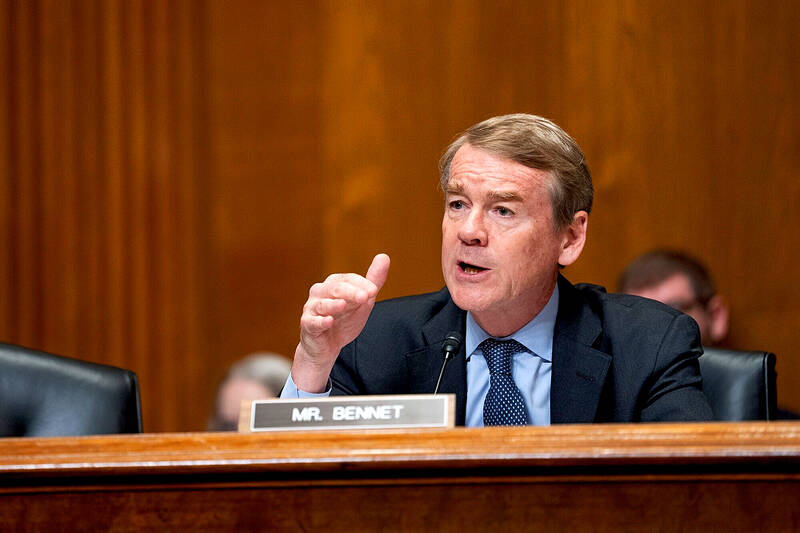
Photo: Bloomberg
During his visit from yesterday to tomorrow, Bennet would engage in a series of high-level meetings with senior Taiwanese leaders to discuss relations, regional security and other issues of mutual interest, the de facto US embassy in Taipei said in a press release. A member of the Senate intelligence, finance, agriculture and rules committees, Bennet has led efforts to enhance US-Indo-Pacific intelligence cooperation and strengthen the Taiwan-US space partnership, among other measures, the AIT said. His trip to Taipei is part of a larger visit to the Indo-Pacific region and underscores the US commitment to its partnership with Taiwan, while reaffirming a shared dedication to strengthening a free and open Indo-Pacific, it said.
DEFENSE
Bite-sized arms sales?
Minister of National Defense Wellington Koo (顧立雄) yesterday said he had not heard that the US was planning on carving up a potential US$14 billion arms sale into smaller chunks, but added that Washington’s commitments to Taipei’s defenses had not changed. US President Donald Trump has held back approval of the new package of arms sales to Taipei to maintain warm relations and a fragile trade truce with Chinese President Xi Jinping (習近平). In December, Trump approved an US$11 billion package. In May, after meeting Xi in Beijing, Trump said he was holding up a second package and described it as a “very good negotiating chip.” Officials in Taipei said Washington might carve up the arms sales into smaller chunks to avoid upsetting Beijing too much. Koo at the legislature yesterday said the US has repeatedly reaffirmed that its commitment to helping Taiwan strengthen its self-defense capabilities has not changed. The US Department of State did not immediately respond to a request for comment.
LABOR
Kuai Kuai strike ends
The union representing workers at snack maker Kuai Kuai Co’s only factory in Taiwan ended a five-day strike yesterday after reaching a deal with management on compensation for the company’s planned relocation. The deal was signed yesterday afternoon after two days of talks, with the company agreeing to provide more compensation than it had initially offered, according to a joint statement from the Taoyuan Confederation of Trade Unions and the Kuai Kuai union. Under the agreement, union members who resign within the next two years after being reassigned within the Jhongli factory in Taoyuan would receive statutory severance pay plus compensation equal to four months’ full wages, according to the statement.
Union members who resign by Sept. 30, 2028, due to required relocation would receive statutory severance plus eight months’ full wages. In addition, workers with at least 12 years of service under Taiwan’s new labor pension system would receive an additional NT$100,000, the statement said. The agreement contains a “no free rider clause,” meaning the negotiated benefits would apply only to union members. The strike began on Friday amid a dispute over the relocation of Kuai Kuai’s Jhongli factory.
CUSTOMS
Potato shipment intercepted
A shipment of potatoes imported from the US was intercepted after tests found excessive levels of potentially toxic glycoalkaloids, the Food and Drug Administration (FDA) said yesterday.
The 339.58 tonne shipment contained 248mg/kg glycoalkaloids, exceeding the legal limit of 200mg/kg, even though the potatoes had not visibly sprouted, director of the FDA’s Northern Taiwan Management Center Liu Fang-ming (劉芳銘) said. The importer would have an increased sampling and inspection rate of 20 to 50 percent for future imports, Liu said. Meanwhile, a 133kg shipment of melamine soup spoons imported from China failed dissolution testing and must be returned or destroyed, Liu said. The importer would be subjected to enhanced sampling and testing rate of 20 to 50 percent, he said.
Other intercepted imports announced by the FDA yesterday included fresh melons and pickled ginger from Japan, fresh white radishes and Chinese yams from China, cod roe paste from France and fresh Chinese cabbage from Vietnam. The products were found to contain excessive levels of pesticides, preservatives or sweeteners.
KioskNews shows a cleaned-up reading view extracted from the publisher’s page — the original always lives on their site, not ours.