London commuters braced for disruption as tube strike begins
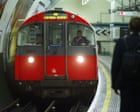
Severe disruption is expected across the London Underground on Thursday and Friday, when many tube drivers will go on strike.
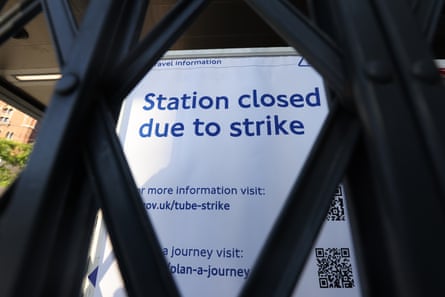
Drivers who are part of the national union of rail, maritime and transport workers (RMT) will strike for 24 hours from noon on Thursday, in the first of a fresh wave of strikes in the long-running dispute over the planned introduction of a four-day working week.
Talks to avert the strike ended at the Acas conciliation service on Tuesday without resolution.
The RMT has planned seven more strike dates, including two 24-hour stoppages in the week before Christmas, which will affect transport during four of the busiest shopping days in the capital.
The union, which represents just under half of tube drivers, claimed that the changes to working patterns were being imposed and could lead to increased fatigue and affect safety.
London Underground said the changes were voluntary, and the strike has been described as “strange” by the rival drivers’ union. Aslef, a union representing a slight majority of Tube drivers, warmly welcomed the proposal for a shorter working week.
Transport for London (TfL) warned passengers to plan ahead and expect disruption on all lines. Most tube lines will continue to operate on Thursday, aside from the Piccadilly and Circle lines. The Waterloo & City line will be closed from midday.
Reduced services are expected across the rest of the tube network from late morning on Thursday and will finish earlier in the evening. No service is expected after 9pm.
On Friday, trains will start running later than usual, from about 7am, and remain disrupted through the afternoon, with normal services only expected to resume by early evening.
The Elizabeth line, London Overground and national rail services will run as usual, but are expected to be crowded. Buses are not directly affected, but are likely to be busier than usual and slowed by increased congestion on the roads.
Nick Dent, director of customer operations for London Underground, said the strike was disappointing, after months of discussions about the voluntary proposals. He said London Underground had provided the option to address the RMT concerns to “give our colleagues a real, meaningful choice on their working pattern without having to change where they work.
“Drivers who choose a four-day week, and those who choose to work a five-day pattern with the same terms and conditions as the four-day pattern, will spend less time at work per year, while delivering a more efficient, reliable Tube service for our customers,” he said. “We continue to believe that the majority of the concerns from the RMT have now been resolved and we urge the RMT to put this proposal to their members.”
after newsletter promotion
The RMT said it had not been given the assurances it was seeking. The general secretary, Eddie Dempsey, said: “There is nothing voluntary about a scheme that forces drivers to give up existing protections whether they work four days or five and threatens those who refuse with displacement from their depots.
“Our members are being asked to spend more time driving trains, accept longer and more unpredictable shifts and surrender agreements that have been negotiated and defended over many years.
“This is not about improving work-life balance. It is about squeezing more work out of fewer drivers while giving management greater flexibility at the expense of our members.”
No further talks are expected before the strike. RMT’s next strikes are planned for Thursday 17 and Saturday 19 December, which businesses have said could significantly impact four days over the busiest shopping and entertainment weekend before Christmas.
Further strikes are planned immediately on the wider return to work in the New Year, on Monday 4 January and Wednesday 6 January 2027, with three more strikes scheduled in February.
Separately, some Eurostar services between London and Paris were cancelled on Wednesday because of unexpected strike action by some staff. Eurostar said the surprise industrial action, which came during annual pay talks, meant it was “experiencing cancellations and severe disruption”.
Year-end fundraiser
$0 of $2,000,000 goal
A moment full of possibility – and risk
We hope you appreciated this article. Before you close this tab, can we ask you to support the Guardian at this crucial time for democracy in the US? With Black Friday approaching, our most impactful monthly support option is just $7.50 a month for six months.
In the last two years alone, Donald Trump has eroded many of the pillars of US democracy – slashing funds for universities, undermining science, shutting down arts institutions, and attacking the free press as an “enemy of the American people” and “a threat to our national security”. While he and his allies have enriched themselves and spread lies, federal forces have harassed and imprisoned innocent people and violated the constitutional rights of many Americans.
Now, in a sweeping change election, the American people have spoken: Donald Trump, Pete Hegseth, RFK Jr, Elon Musk and the tech oligarchs may finally be held to account. A majority of American voters have demanded an end to the costly and immoral wars, the flagrant profiteering, and the corrosive attacks on communities and democratic institutions.
It’s a moment full of possibility, with more stories than we can possibly cover. New leaders are emerging from Texas and Michigan to Iowa and South Carolina – and heading to Washington to fight for affordability, against wealth inequality, and for human survival in the face of AI and the climate crisis.
These new leaders will be facing a cornered Trump and his hardline chief of staff, Stephen Miller, who have nothing left to lose. The next few years are critical for the future of the country. Journalism that covers the epic clash between these forces has a vital role to play right now.
Investigative journalism provides a fact-based paper trail for an emboldened Congress to follow. Members of Congress – and the American public – often rely on our in-depth reporting to inform the tough questions, to connect the dots and to pursue accountability for wrongdoing.
At the Guardian, our newsroom is devoted to uncovering the truth and conveying it to as many people as possible. We’re not alone in this mission, but this kind of journalism faces unprecedented hurdles: big tech threatening our financial stability and stealing our work for AI, billionaire owners telling journalists what to publish, and a hostile executive branch intent on suppressing our reporting.
The Guardian is free to dig deep without fear because we’re funded by our readers. Our readers hold us to account, and we hold the powerful to account.
However, this only works when enough of our readers contribute. Against the advice of most industry analysts, we’ve refused to put up a paywall – we believe good journalism should be freely available to all people, regardless of ability to pay. If you’re counting on our reporting, and you can’t afford to pay, please stop reading this message and go back to our articles.
If you can afford to contribute, please know that your support is not only helping yourself – from voters in Kansas to immigrants in Minnesota and families in Gaza, your generosity is bringing factual news to people around the globe.
Today is among our most important fundraising days of the year. To sustain our unique financial model, our goal is to raise $2,000,000 before the new Congress is seated on 3 January. More than 19,000 people have contributed already. All gifts are gratefully received, but for the next several days only, our most impactful monthly support option is $7.50 a month for the first six months. If you can afford 37 seconds, please join our ranks – and show your support for the rekindling of democracy in the US and around the world.
KioskNews shows a cleaned-up reading view extracted from the publisher’s page — the original always lives on their site, not ours.