Etiquette of location sharing: Who gets to keep tabs? Can you turn it off without explanation?

It used to be that one could make bad choices largely in private, but in today’s world of location sharing, there are few secrets.
Sign In or Create an Account
“I know messy things about people. I know when my friends are hanging out with their toxic ex-boyfriend again or when someone’s visiting their hometown that they hate,” said Paige Bradbury.
Bradbury, 24, lives in Toronto and shares her location with her closest friends — the type she’d trust to housesit. Most of the time it’s for a practical purpose, like meeting up at a music festival. Sometimes, it’s for an urgent purpose.
“Urgency is, your friend decides to go on a last-minute blind date at 7p.m. on a Friday and sends you her location, just in case. Now you’re her designated detective and have the responsibility of checking in with her until she tells you she’s home. You’re kind of a designated driver, but for safety,” Bradbury said.
And every now and then, she gets to have a bit of fun with it, too. If she sees a friend is at an ex’s house or with a toxic “situationship”, she’s not afraid to ask questions.
“I’ll screenshot it to send it to them later with a bunch of question marks and side-eye emojis,” she said.
Bradbury is hardly alone in location sharing. A 2026 study of 203 adults who use location-sharing apps found participants shared their whereabouts with an average of nearly four people. Romantic partners were the most common sharing recipients, at 62.6 per cent, followed by friends at 37.9 per cent, siblings at 31 per cent and mothers at 27.9 per cent.
And the reasons extended well beyond emergencies. Researchers grouped them into four broad categories: safety, practicality, casual use and relationship-related reasons such as trust. Friends and romantic partners most often shared for practical purposes, while safety was the most common reason for sharing among family members. Some participants described sharing as simply “natural” or “common” within certain relationships, suggesting the practice has developed its own social expectations.
As digital location tracking using apps such as Life360 or Apple’s Find My are becoming increasingly common, the etiquette around it is forming in real time. Who gets your location? Where’s the line between tracking and monitoring? Must you explain why you’re somewhere? And once you’ve started sharing, can you turn it off without explanation?
Though these rules might be unspoken, they’re the silent negotiations each person makes before clicking “accept” when they’re notified a contact wants to start location sharing.
For those who willingly share their location, there’s a difference between knowing someone can find you and having someone follow your every move.
“For me personally, it gives me this extra layer of confidence that someone’s always looking out for me,” Bradbury said.
That doesn’t mean she expects her friends to spend their days watching her dot move around a map.
“Having their location is more like you’ll check it when prompted,” she said.
Mary Lymburner, 79, and in Ontario, uses location sharing to keep tabs on travelling friends and coordinate with family.
“I like to call my sister once a week, but I use location sharing to see if she’s home before I do,” Lymburner said. When she’s at the family cottage on Lake Huron, location sharing is just a matter of convenience. She times the arrival of her daughters with her to-do list. “I know they’re on their way and I see how close they are, so I can get their bedrooms ready or get dinner ready,” she said.
Those mundane uses show up in the research, too. The 2026 study found people regularly bypassed a conversation altogether, checking someone’s location to coordinate meetings or decide when to start dinner. Researchers also found people checked simply to “stay informed” about where someone was, usually without describing that behaviour as surveillance or mistrust.
“For me personally, it gives me this extra layer of confidence that someone’s always looking out for me
But there is a line.
“It would be a breach of trust if you have your phone out and are following their exact route along the course of events of a day,” said Adam Boothe, 39, of Edmonton, who shares his location with his wife. “Monitoring is a lot more meticulous and you’re doing it with a different purpose than just making sure someone is OK.”
Boothe remembers when even the advent of cellphones made some people uncomfortable with the idea that they could suddenly be reached anywhere.
“Now, take that to the next level,” he said, “actually being able to see specifically, without contacting you, at any moment where you are.”
Sometimes location sharing is clearly temporary. What’s less clear is what happens when nobody turns it off.
Bradbury has shared her location with friends of friends at music festivals simply so everyone could find one another. Usually, that access ends along with the event.
But not always.
“I do have one person who I hung out with once three years ago and we’ve just had each other’s locations the entire time,” Bradbury said. “I feel like we’ve been through so much, we’ve kind of bonded after that, a weird connection.”
It’s a quirk of location sharing the researchers identified as “boundary passivity.” Unlike telling someone where you are once, location sharing can become a continuous stream of information that remains available until somebody actively switches it off on their mobile device. It was uncommon for participants to consider turning the faucet of information off once it was switched on. Some simply said there was “no reason to stop.”
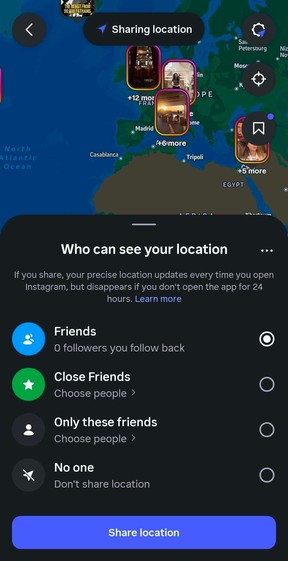
That can make it difficult to know whether continued access is intentional. Boothe noticed a friend was still sharing her location after a conference where the pair had used it to coordinate networking.
“I messaged her to ask if she knew that she had it on,” Boothe said.
There are also times when lingering access is useful. Boothe once lent his father a car equipped with its own location-tracking app. Boothe kept getting notifications showing where his father was going, along with alerts that he’d left the doors unlocked.
“I was able to lock the doors remotely,” Boothe said.
Often best friends will share their location. So, in some social circles this is a symbol of love and trust
The rules become considerably less ambiguous when a relationship ends.
“The etiquette very much is, you stop following that person’s location immediately,” Bradbury said. “You’re blocked and unfriended on everything. It’s one thing to forget, it’s another thing to keep it going.”
Sometimes the ability to turn location sharing off is itself an important dividing line between consensual tracking and control.
Suzie Dunn, interim director of the Law and Technology Institute at Dalhousie University, studies technology-facilitated gender-based violence. She said sharing can begin as an expression of connection and trust but take on a very different meaning in an unhealthy relationship.
“Patterns of behaviour that are abusive are often things like requiring location tracking so the person can see where someone is to control the relationship,” Dunn said.
In the most serious cases, Dunn said, tracking can even make it difficult for someone to seek help without an abusive partner knowing where they’ve gone.
The study found examples of pressure on a less extreme spectrum, too. Some participants described sharing because another person became anxious without it, while another said it “seems rude to stop sharing it.” One participant said a partner became suspicious whenever location sharing was turned off.
Dunn sees a greater risk for teens and people in their 20s to encounter this scenario; it’s one of the unintended consequences of the culture of surveillance they’ve grown up in.
“A lot of them grew up with parents who tracked their location. So they’re growing up in a society where people who love them have tracked their location and often in non-problematic ways. So, I think there’s this normalization of surveillance.
“It’s also a way to show friendship,”Dunn added. “Often best friends will share their location. So, in some social circles this is a symbol of love and trust that’s built into the cultural norm of a technological society. The safest thing to do is not to share your location with people, but that puts a lot of the blame and the expectation on the victim when the focus ought to be on preventing abusive behaviours,” she said.
A face on a milk carton was once society’s attempt at locating lost loved ones. Now, it could just take the toggle of a button to know where people are. But location sharing is only useful as a safety tool if somebody takes action. Using the data is one of the unspoken assumptions of agreeing to have someone’s location.
“If you see your friend’s phone on the side of the highway at 3 a.m., you’re going to call them,” Bradbury said. “That’s very much a given.”
The study makes the same point: location sharing alone is not a guarantee of safety. Someone must check, recognize that help might be needed and act. But researchers found that even the knowledge that somebody could do that offered a sense of comfort.
For Bradbury, that isn’t limited to emergencies. By her internal compass, it would be improper not to bring up potentially awkward situations, like spotting your friend at their ex’s house, if the whole point of having a friend’s location is to look out for them.
“We share our locations with each other with the sole intent to check in,” she said. “So, I feel the etiquette is more like a subway ad: if you see something, say something.”
“There is an aspect of, you expect to be surveilled,” Bradbury explained. “Nobody expects that power to be abused.”
Join the Conversation
This website uses cookies to personalize your content (including ads), and allows us to analyze our traffic. Read more about cookies here. By continuing to use our site, you agree to our Terms of Use and Privacy Policy.
KioskNews shows a cleaned-up reading view extracted from the publisher’s page — the original always lives on their site, not ours.