BOJ keeps rates steady, declares victory in hitting price target
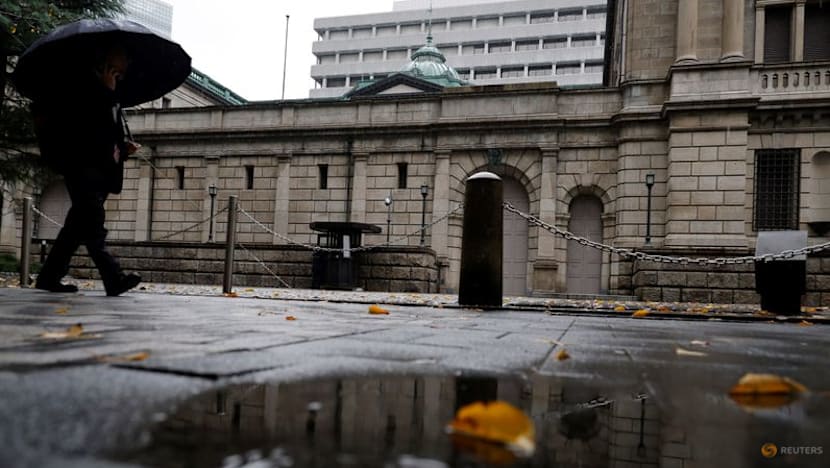
TOKYO: The Bank of Japan kept interest rates steady on Friday (Oct 30), but declared victory in a nearly 14-year battle to hit its price target and signalled vigilance against inflationary risks, suggesting scope to hike borrowing costs as soon as December.
With underlying inflation having roughly hit 2 per cent, the BOJ must focus on anchoring it around the target, the central bank said, stressing anew that its policy has entered a new, more hawkish phase open to raising rates once every few months.
The pivot aligns the BOJ with its US and European counterparts eyeing near-term rate hikes to battle inflationary risks from the AI boom and the Iran war-induced energy shock.
"Underlying inflation is at a level generally consistent with our price target, and is expected to remain at around that level," the BOJ said in a quarterly outlook report. "Against this backdrop, it will be important to examine the degree to which underlying inflation is anchored around 2 per cent."
At the two-day meeting ending on Friday, the BOJ maintained its policy rate at 1.25 per cent in a widely expected move, forgoing a back-to-back hike to spend more time scrutinising the effects of past rate hikes on lending conditions.
Hajime Takata, a hawkish BOJ board member, dissented to the decision to hold rates, instead proposing unsuccessfully a hike to 1.5 per cent.
In a surprise move, the BOJ also said it will accelerate the pace of its sales of exchange-traded funds from January to 860 billion yen (US$5.45 billion) per year from the current 330 billion yen.
Markets are focusing on Governor Kazuo Ueda's post-meeting briefing for clues on the timing and pace of future rate hikes.
In the report, the BOJ revised up its core consumer inflation forecast for the fiscal year ending March 2028 to 2.6 per cent from 2.4 per cent projected three months ago.
Declaring victory in hitting its 2 per cent inflation target marks a turning point for the BOJ, which has spent most of its history battling low or negative price growth since gaining legal independence from the government in 1998.
Under former governor Haruhiko Kuroda, the BOJ deployed massive monetary stimulus in 2013 to pull Japan out of deflation and fire up inflation to the 2 per cent target.
Even after ending its mix of unorthodox easing steps in 2024, the BOJ has trodden cautiously in raising rates on the view underlying inflation - or price moves excluding one-off factors and driven by domestic demand - remained below target.
With stubbornly high energy costs and rising import prices from a weak yen adding to inflationary pressures, the BOJ raised rates in September after delivering a hike in June - a shorter interval than the roughly twice-a-year hikes in 2024 and 2025.
Most analysts polled by Reuters expect the BOJ to raise its policy rate to 1.5 per cent in December, followed by further hikes next year. Their terminal rate projection centres around 1.75 per cent to 2 per cent.
Annual core inflation in Tokyo, seen as a leading indicator of nationwide price trends, well exceeded the central bank's 2 per cent target in October, data showed on Friday, highlighting mounting price pressure.
Rising prices could weigh on consumption as they prod Japanese households, many of whom have never experienced widespread price gains in their lifetime, to seek discounts.
KioskNews shows a cleaned-up reading view extracted from the publisher’s page — the original always lives on their site, not ours.