Apple launches an AI health tool as part of a research study
Artificial intelligence chatbots are becoming popular tools for people seeking information about their health. But so are headlines about possibly incorrect or even harmful information.
On Sunday, Apple announced a new approach, launching the Apple Health AI Usage Study app that they say will answer health questions only using trusted medical research and based on your health metrics and records -- if you choose to allow it.
The study hopes to evaluate user trust, how well information is understood, how helpful the information is and how much it helps patients interact with their doctors.
"It’s important to create interactions that are responsible, easy to understand, and can help someone navigate traditional care,” Dr. Sumbul Desai, Apple's vice president of Health and Fitness, told ABC News. "When people have access to clear, medically grounded information, they can walk into their doctor’s appointments feeling more prepared, informed, and confident. Rigorously studying these experiences is essential to ensuring AI serves as a bridge, not a barrier, to better care.”
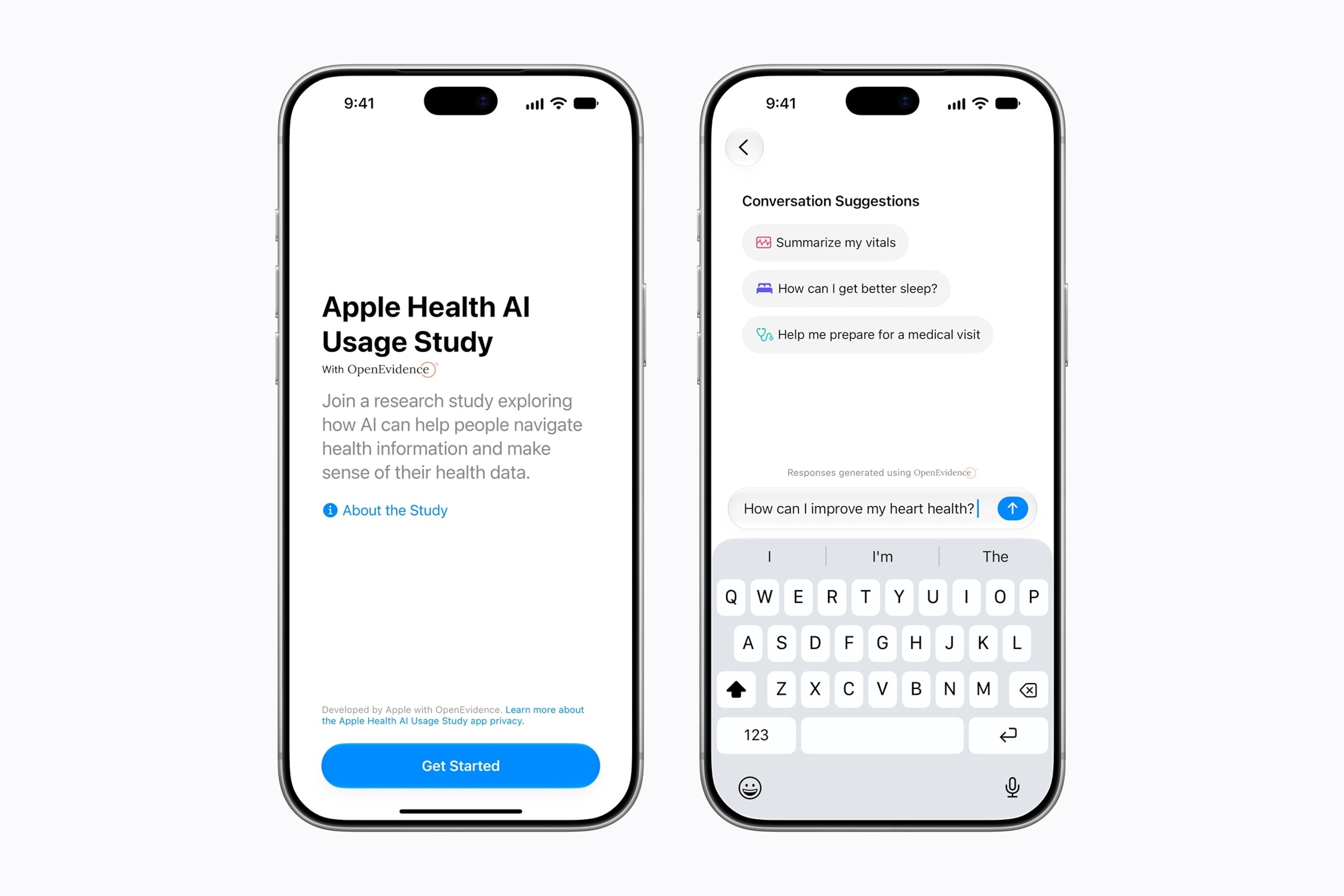
On Sunday, Apple announced a new approach, launching the Apple Health AI Usage Study app that they say will answer health questions only using trusted medical research.
Apple
Users will be able to ask the study app everyday health questions and see linked, peer-reviewed clinical citations -- showing users where the advice is coming from.
Apple is collaborating with OpenEvidence, an AI tool that is used by doctors and is trained on sources like medical journals that may not be available to other AI platforms.
Full access to OpenEvidence is currently only available to health care professionals and returns answers in a language that they are used to.
Apple says they are using their own technology to turn that research into easy-to-understand answers.
According to a February 2026 Oxford study published in Nature Medicine, AI chatbots accurately identify medical conditions nearly 95% of the time when tested on clinical cases, yet everyday users reach the right answer less than 35% of the time when trying to understand dense guidance. Yet 35% of adults, or about half of adults under 30, are already using AI chatbots, according to the Pew Research Center.
“Millions of people are turning to AI for health advice, but accurate answers aren’t always useful. Confusing or incomplete information can create false reassurance or delay care. We need to understand how people actually use these tools,” said Dr. John Brownstein, professor of pediatrics and biomedical informatics at Harvard Medical School and an ABC News contributor.
Users who sign up for the study can also choose to share or not share data that they may already have on their phone's health app, such as resting heart rate, activity, sleep, or blood test results, to get more personalized responses.

On Sunday, Apple announced a new approach, launching the Apple Health AI Usage Study app that they say will answer health questions only using trusted medical research.
Apple
The study will also explore how health AI can potentially help participants better prepare for clinical visits with their own doctors and will ask the user for feedback along the way about how the experience is going. For example, someone asking how to improve their resting heart rate could receive advice based on their own health measurements, rather than general recommendations.
“We're collecting enormous amounts of personal health data through phones and wearables, but turning that information into something people can actually understand and act on remains a challenge,” Brownstein said.
Another part of the research is finding out whether users understand the answers they receive. Participants can rate the answers they receive and complete occasional surveys to share their experiences.
“We need to understand not just whether AI provides accurate answers, but whether people understand those answers, trust them appropriately and ultimately make better health decisions,” Brownstein said.
What about privacy and safety?
Apple says questions are processed through privacy protections designed to remove identifying information before reaching OpenEvidence.
OpenEvidence will delete question-and-response data within 24 hours and not train its model on the queries, according to Apple. The app also includes safeguards intended to recognize potentially dangerous situations and encourage users to seek professional medical assistance.
Apple emphasizes that the study does not provide live medical monitoring or replace a healthcare professional, and the app will make that clear while using it.
Who can participate?
The study is open to U.S. adults ages 21 and older who have an Apple Intelligence-enabled iPhone (iPhone 15 Pro or later) running iOS 26 or later.
Participants can download the dedicated study app and complete an informed consent process. You can download the study app to learn more about the study and choose to enroll.
Apple told ABC News the goal of this research project is not just to inform their future products, but they plan to make the research available broadly to help the future of computer-assisted health communication.
KioskNews shows a cleaned-up reading view extracted from the publisher’s page — the original always lives on their site, not ours.