US defense firm planning local drone production
By Wu Che-yu and Jonathan Chin / Staff reporter, with staff writer


Kratos Defense is seeking US government authorization for Taiwan to produce the jointly developed Mighty Hornet IV one-way strike drones, Kratos representative Steve Fendley said.
Fendley, president of Kratos’ uncrewed systems division, was speaking after taking part in the uncrewed aerial vehicle’s (UAV) flight certification tests held recently in a facility in southern Taiwan.
Kratos has received inquiries about the Mighty Hornet IV from dozens of countries, including seven that have allotted budgets or requested estimates on pricing for the system, Fendley said.
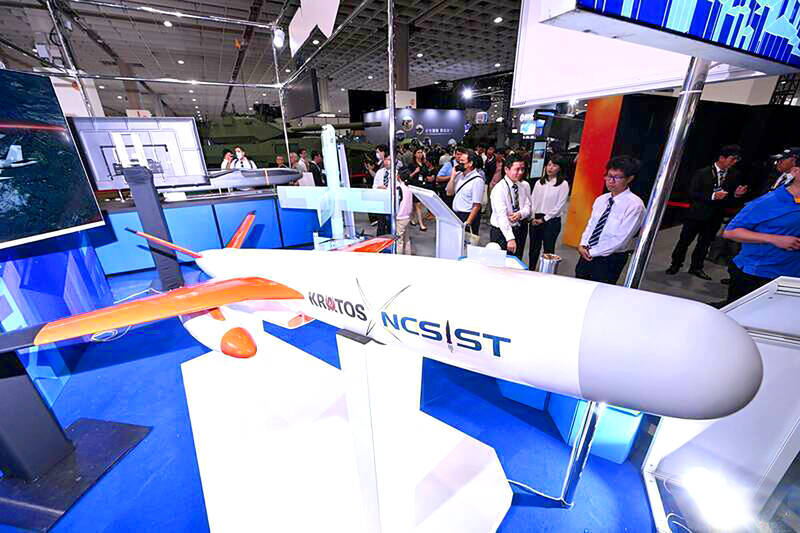
A Mighty Hornet IV is displayed during the Taipei Aerospace & Defense Technology Exhibition in Taipei on Sept. 17 last year.
Photo: Fang Pin-chao, Taipei Times
Designed around the affordable mass concept, the Mighty Hornet IV is a jet-engined loitering munition that possesses 90 percent of a crewed fighter jet’s strike capabilities for US$500,000 per unit, he said.
The Mighty Hornet IV can reach a top speed of 0.7 to 0.85 Mach (864kph to 1,049kph), significantly faster than conventional propeller-driven designs, he said.
The jet-powered drone can engage targets maneuvering at high speeds and create a dilemma for the opposing force of expending expensive interceptor munitions or allowing its assets to be destroyed, Fendley said.
The drone uses an airframe based on Kratos Defense’s Firejet, and the National Chungshan Institute of Science and Technology (NCSIST) designed its sensors, navigation system, electronic warfare suite and high-explosive warhead, he said.
It is an integrated system designed for Taiwan’s operational environment, Fendley said.
Under the Kratos-NCSIST partnership, the transfer of Mighty Hornet IV technology would begin with Kratos producing airframes and Taiwan outfitting them with mission-critical components and the payload, he said.
In the next phase, Kratos would supply NCSIST with kits to assemble, incrementally increasing Taiwan’s manufacturing, quality control and system integration capabilities, he said.
The end goal is for Kratos to secure technology transfer licenses from the US Department of State to establish full assembly lines in Taiwan, Fendley said.
Taiwan could expect Mighty Hornet IV orders from the US government, should NCSIST successfully develop domestic mass-production capabilities, he said.
Another Kratos Defense and NCSIST project is aimed at developing a variant of the former’s XQ-58 Valkyrie, a stealth autonomously piloted collaborative combat aircraft, Fendley said.
This type of platform is designed to add its sensors, electronic warfare suites and strike capabilities to support crewed aircraft in missions, he said.
The XQ-58A utilizes an open architecture and an internal weapons bay, enabling modularity in its sub-systems, he said.
The drone can use its onboard artificial intelligence (AI) to operate singly or in swarms, he said.
The US Marine Corps has selected the XQ-58 for its collaborative combat aircraft program, and Kratos is bidding for the German air force’s “loyal wingman” contract, Fendley said.
KioskNews shows a cleaned-up reading view extracted from the publisher’s page — the original always lives on their site, not ours.