US and China consider making AI channel
DEDICATED CHANNEL: The communication channel would help the two countries notify each other about ‘incidents’ or other AI-related national security issues
US and Chinese economic officials discussed creating a communication channel for artificial intelligence (AI) concerns at meetings on Sunday as they set the stage for a summit of the countries’ leaders this week.
The talks come as the countries confront broadening fears that increasingly capable AI systems could wipe out humanity, offering a rare incentive for cooperation despite an intensifying race for technological supremacy.
“We just had a very successful engagement with the Chinese on trade and AI,” US Secretary of the Treasury Scott Bessent said after talks with a team led by Chinese Vice Premier He Lifeng (何立峰).
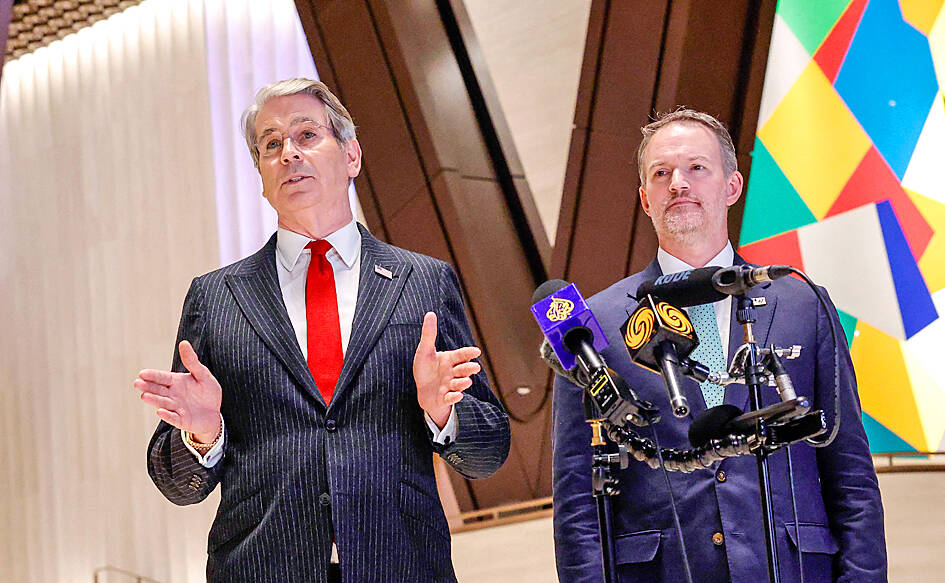
US Secretary of the Treasury Scott Bessent, left, and US Trade Representative Jamieson Greer address the media after a meeting with China’s trade delegation.
Photo: AFP
The talks are a prelude to a meeting in the White House on Thursday between US President Donald Trump and Chinese President Xi Jinping (習近平).
The discussions, which included US Trade Representative Jamieson Greer, went for about eight hours at JPMorgan Chase & Co’s headquarters in New York.
Bessant said the two sides discussed setting up a way to communicate about AI issues called the “US-China AI dialogue.”
“The US has proposed that we have a notification mechanism between the two countries,” Bessent said.
Such notifications are for “incidents,” or a situation “that rises up to a national security level from AI,” he said, adding that both sides have agreed to meet again.
Bessent and He also spoke one-on-one, a source familiar with the matter said.
China’s top trade negotiator, Li Chenggang (李成鋼), said the talks were held in a “good atmosphere” as he left JPMorgan headquarters on Sunday, while Greer said Sunday it is “imperative that we are able to work together.” State-run Xinhua News Agency described the meetings as “candid, in-depth and constructive.”
Asked about the possibility of mutual tariff reduction on certain goods, Greer said teams “are continuing to work through this.”
The aim is to identify “non-sensitive” goods that can be considered separately from trade measures in the future, he added.
Such products could cover consumer goods from the Chinese side and energy, agricultural and other products like medical devices on the US side.
Beyond less sensitive items, US officials are seeking to ensure the continued flow of rare earth magnets and critical minerals that are vital for US manufacturers.
Working level meetings could continue into yesterday, a source familiar with discussions said.
Earlier negotiations saw China pledge purchases of US agriculture goods too, and their fulfilment of the terms could be an issue under scrutiny.
Another issue is US economic pressure on Iran, as Washington’s war with Tehran has entered its seventh month.
China is a top economic partner of Iran that buys much of its oil output and a key diplomatic backer.
Analysts caution that expectations for the Trump-Xi summit are low.
“One of the only things we can hope for in the short term is a truce, and that this will likely continue through the remainder of this year,” former US deputy secretary of state Kurt Campbell said.
“I think you will hear [Trump] announce the intention to meet with Xi Jinping two more times,” added Campbell, who is chairman of The Asia Group consultancy.
Trump and Xi are expected to meet in November at the Asia-Pacific Economic Cooperation forum in Shenzhen, China. Trump is also anticipated to invite Xi to the G20 summit in December at his Doral resort in Miami.
KioskNews shows a cleaned-up reading view extracted from the publisher’s page — the original always lives on their site, not ours.