Taiwan in Time: Defection or deception to freedom?
When a People’s Liberation Army bomber landed in Taiwan in 1965, its crew members were lauded as ‘anti-communist heroes’ – but their stories later took different turns
By Han Cheung / Contributing reporter


Nov. 9 to Nov. 15
When a People’s Liberation Army (PLA) warplane crash-landed at Taoyuan Airbase on Nov. 11, 1965, officials called it the “greatest birthday present for Sun Yat-sen (孫逸仙).”
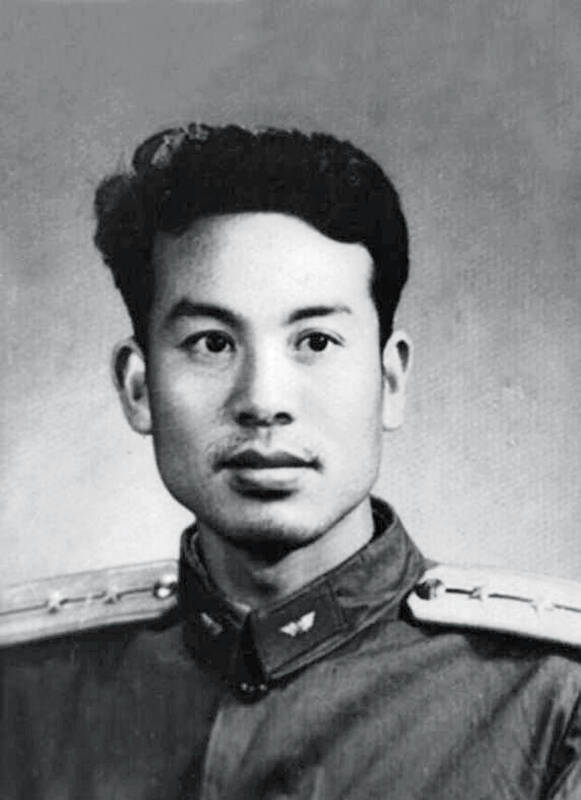
On the eve of the Republic of China (ROC) founder’s birthday, three airmen had apparently defected to Taiwan: pilot Lee Hsien-pin (李顯斌), navigator Lee Tsai-wang (李才旺) and radio operator Lien Pao-sheng (廉保生). Lee Tsai-wang had suffered injuries to his legs in the crash, while Lien was found dead.
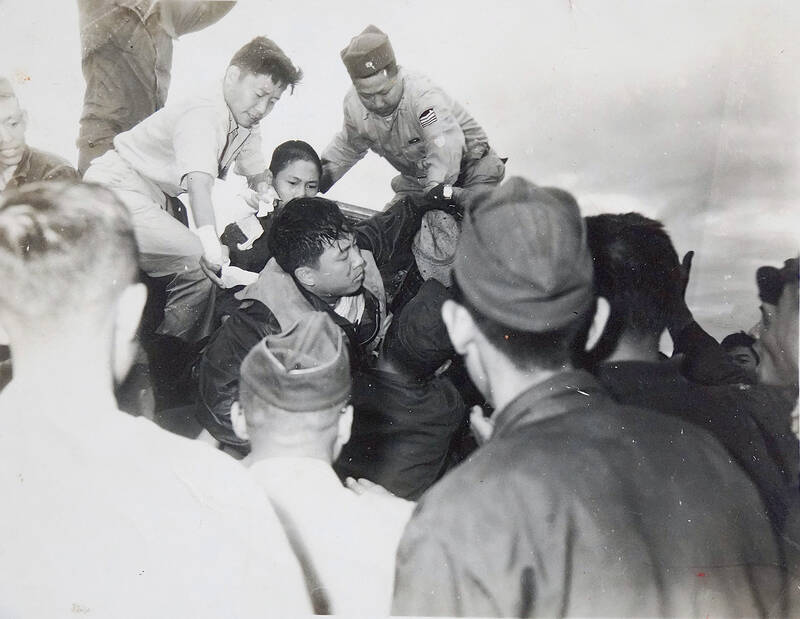
Chinese defector Lee Hsien-pin is helped out of the crashed Ilyushin Il-28 by ROC Air Force personnel on Nov. 11, 1965.
Photo courtesy of Hsueh Chin-feng
As was customary at the time, the two survivors were hailed as “anti-communist heroes” (反共義士) and awarded substantial sums of gold and military ranks. They publicly slammed Chinese Communist Party (CCP) rule and their “defection to freedom” was celebrated nationally and widely reported in the press. Both eventually married and settled in Taiwan.
Decades later, the two survivors would both give conflicting accounts of what happened aboard the plane, including the circumstances of Lien’s death. The fates and reputations of the three men would also take unexpected turns as the political fortunes of the two sides of the Taiwan Strait shifted.
FLIGHT TO ‘FREEDOM’
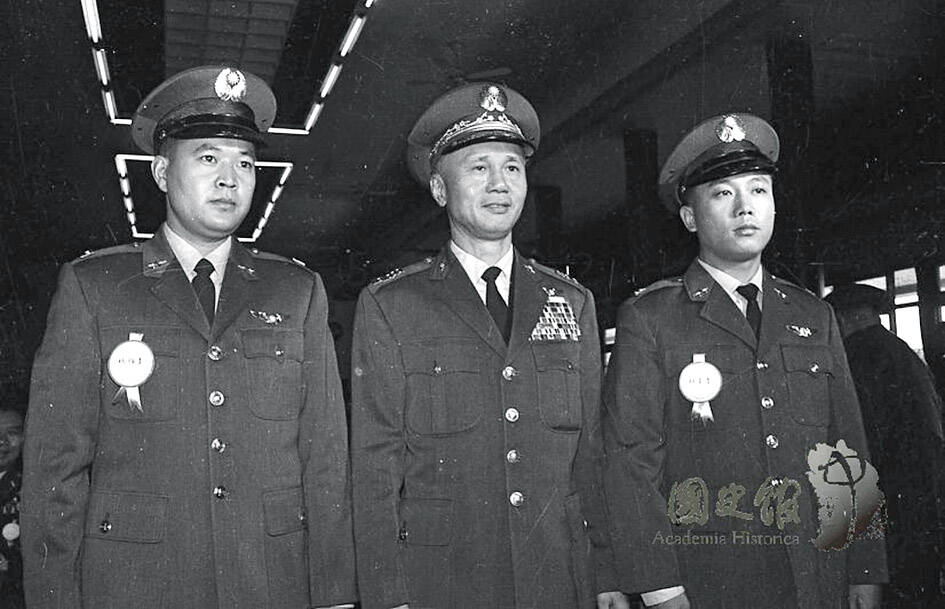
Chinese defectors Lee Hsien-pin, left, and Lee Tsai-wang, right, are awarded ROC military ranks on Jan. 2, 1966.
Photo courtesy of Academia Historica
According to the state-run Central Daily News (中央日報), this was the second PLA plane to successfully defect directly from China to Taiwan. According to regulations enacted in 1962, each aircraft would receive 4,000 liang of gold. Lee Hsien-pin received 2,000, Lee Tien-tsai got 1,000, while Lien’s share was deposited in the bank, which would be returned to his family upon the “successful retaking of China.”
In a gushingly patriotic report, the paper noted that Lee Hsien-pin had been planning the defection for about seven months and that his two crewmates had agreed to join him. Eager to return to the “loving care” of their “prosperous and happy free motherland,” they departed Hangzhou’s Jianqiao Airport around noon and were soon greeted by their “brothers” in the ROC Air Force once they reached the northern airspace of Taiwan. The plane reached Taoyuan in about 30 minutes, but it missed the runway, resulting in a botched landing.
Lee reportedly opened the hatch, tossed out his gun and surrendered to a warm welcome. Their arrival was widely celebrated and portrayed as evidence that people living under communist oppression would “do anything to inhale a breath of free air” — despite Taiwan itself being under authoritarian rule and martial law at the time.
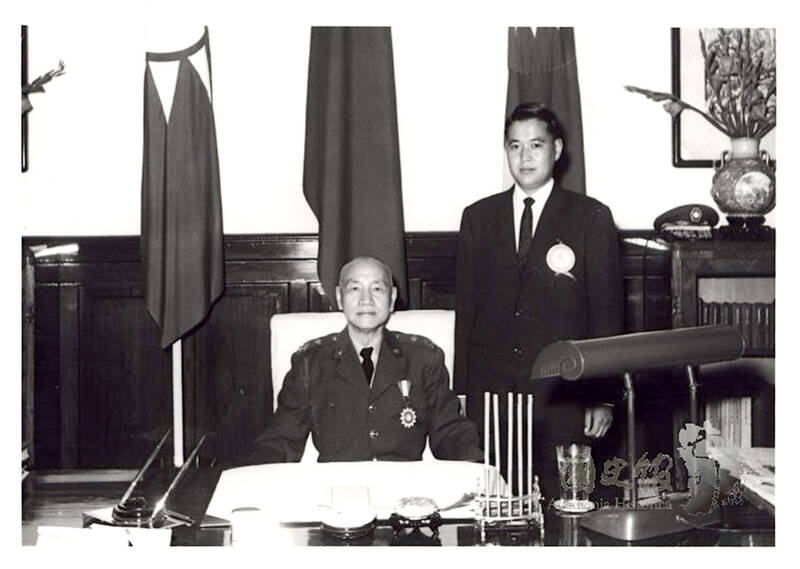
Chinese defector Lee Hsien-pin poses for a photo with then-president Chiang Kai-shek on Nov. 12, 1965, a day after arriving in Taiwan.
Photo courtesy of Academia Historica
The paper also noted that the advanced, Soviet-made Ilyushin Il-28 bomber was the first of its type to fall into the hands of an anti-communist country and could provide valuable insight into enemy capabilities.
BROADCAST TO CHINA
While Lee Tsai-wang recovered in the hospital, Lee Hsien-pin met with then-minister of defense Chiang Ching-kuo (蔣經國) and was welcomed at a banquet hosted by ROC Air Force commander Hsu Huan-sheng (徐煥昇). He met with then-president Chaing Kai-shek (蔣介石) the following day.
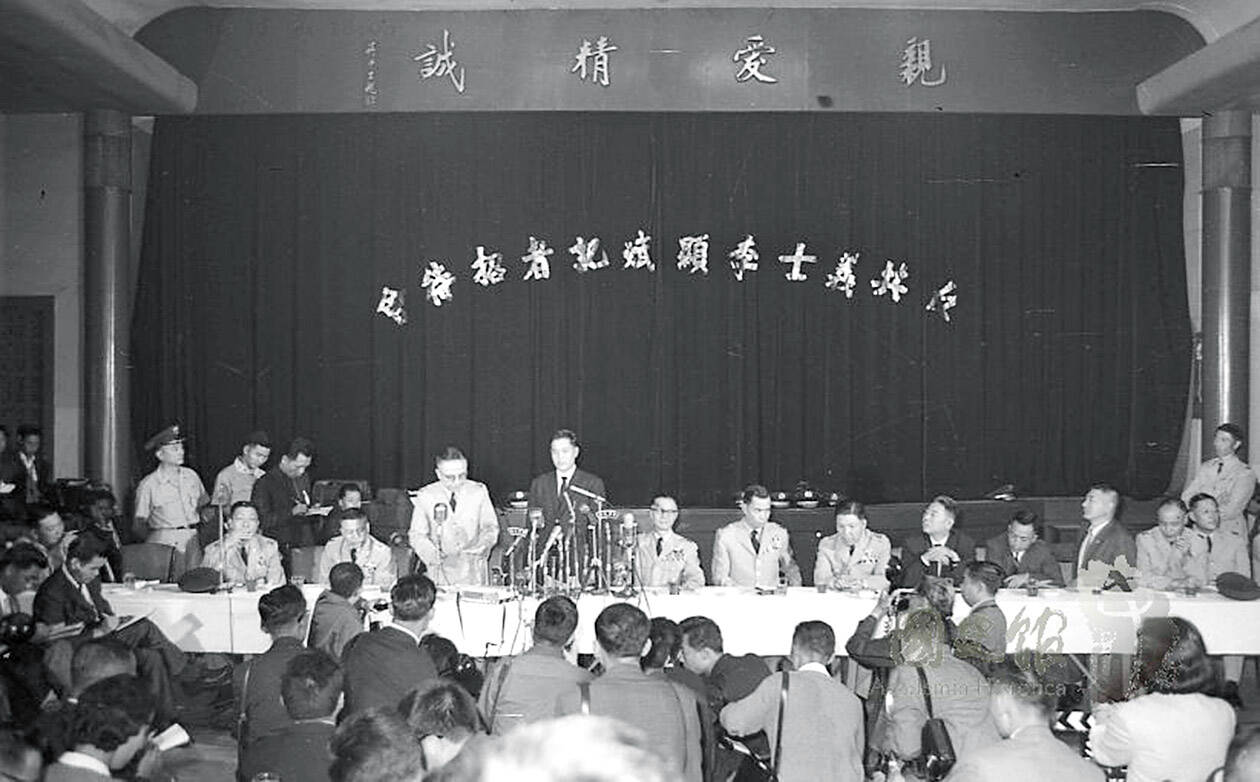
Lee Hsien-pin, standing in dark suit, speaks at his welcoming press conference on Nov. 11, 1965.
Photo courtesy of Academia Historica
Lee Hsien-pin told the press that he did not do it for the money: “I’ve obtained freedom, which is everything!”
He also made a broadcast to his former comrades:
“To my brothers in the PLA Air Force: The Republic of China is our true motherland, and it is where we should look toward. Chiang Kai-shek is the true savior of China.”
A photo of People’s Liberation Army airman Lien Pao-sheng, who allegedly committed suicide before the defecting plane he was on landed in Taiwan.
Photo courtesy of Chen Hui-hsing
He mentioned his handsome reward, stating, “I hope everyone will follow my example, seize the opportunity to defect to freedom, and, under President Chiang’s leadership, join in destroying the tyranny of the communist bandits and saving our compatriots on the mainland.”
He ended his statement by vowing to pay in blood if his family in China were harmed.
CONTRASTING ACCOUNTS
After retiring in 1975, Lee Tsai-wang emigrated to the US. On Dec. 19, 1983, he returned to China and immediately issued a statement denouncing Taiwan’s ruling Chinese Nationalist Party (KMT).
“During flight training, Lee Hsien-pin deliberately deceived Lien Pao-sheng and me, preventing us from realizing in time that he intended to defect to Taiwan. I did not discover his plan until the plane reached Taiwan’s northern coast,” he said.
The cockpit was separated from the cabin, so he was unable to stop Lee Hsien-pin by force. He added that he was coerced into making anti-communist broadcasts, but never wrote any anti-communist statements, claiming that the KMT had fabricated them.
The CCP accepted his account, while Taiwan stripped him of his “anti-communist hero” designation.
In 1988, Lee Hsien-pin corroborated this account when he petitioned the government to award him the gold originally allocated to his crewmates. He argued that they did not deserve it because he had taken them to Taiwan against their will, further claiming that Lien had committed suicide before landing when realizing what had happened.
By then, travel to China to visit relatives had become legal. Lee Hsien-pin made the trip in 1991 to see his mother, upon which he was arrested by Chinese authorities. He was sentenced to 15 years in jail for defecting to the enemy, serving 11 years before being released due to cancer. He died in Shanghai soon afterward, and requested that his family bring his ashes back to Taiwan.
By contrast, Lien’s family, who had been persecuted because of his alleged defection, wanted to bring his remains back to China.
Lien was not interred at the Martyrs’ Shrine or the Air Force cemetery. Instead, he was buried in a plot outside Taoyuan Air Base, which had become overgrown with weeds, and his gravestone, which bore the designation “anti-communist hero,” was damaged.
On Nov. 27, 2016, three days before Martyrs’ Day in China, his nephew came to collect his remains. He was designated as a “revolutionary martyr” and reburied at the Tianjin Martyrs’ Cemetery — a rare distinction to have been honored by both sides of the strait.
Taiwan in Time, a column about Taiwan’s history that is published every Sunday, spotlights important or interesting events around the nation that either have anniversaries this week or are tied to current events.
KioskNews shows a cleaned-up reading view extracted from the publisher’s page — the original always lives on their site, not ours.