New York synagogue bids ‘sacred farewell’ to Holocaust memorial by Louise Nevelson
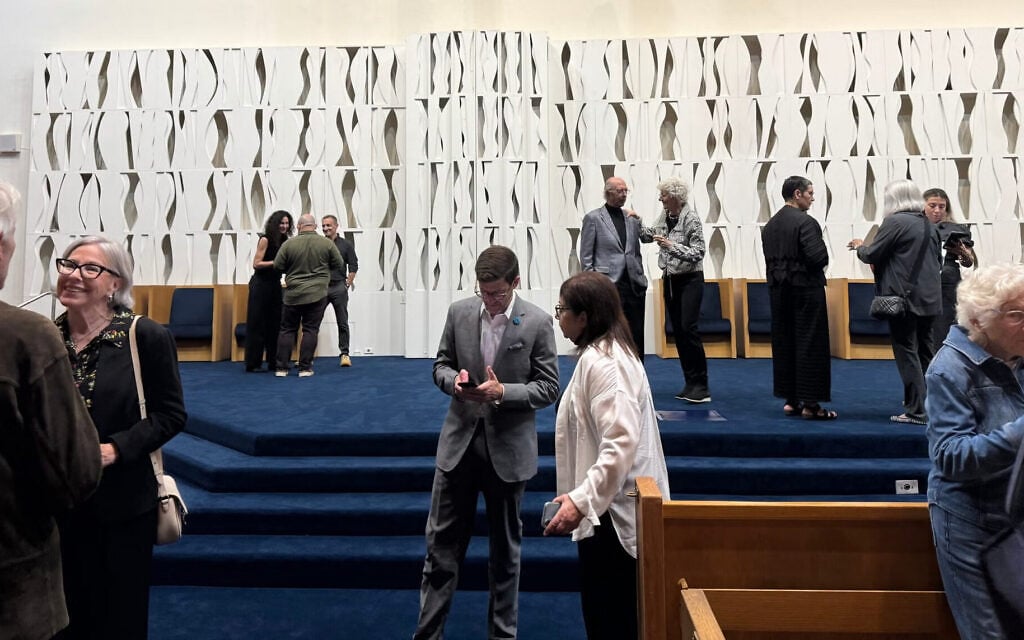
JTA — Louise Nevelson, the storied American sculptor, created “The White Flame of the Six Million,” a 50-foot-long, 11-foot-high bimah sculpture incorporating a Torah ark and serving as a Holocaust memorial, for Temple Beth-El in Great Neck, New York. It has remained there for more than 50 years.
Now, due to demographic change in suburban Long Island, the work has been deconsecrated.
In September, immediately after Neilah, the closing prayers on Yom Kippur, the Torah scrolls were removed from the ark. The sculpture itself will soon be disassembled and put into storage, its new home to be determined.
0:00 / 0:00
Promoted: JPPI

Beth-El’s congregation once had an active membership of 1,500 families and a long waiting list. But because of shifts in the makeup of Great Neck’s Jewish community, that number has fallen to 400 families. The Reform congregation sold its property to Yeshivat Kol Yaakov, an Iranian/Sephardic Orthodox yeshiva. Beth-El is currently leasing its original chapel from the yeshiva.
On October 1, members of the synagogue bid a “sacred farewell” to the Nevelson at a reception attended by Maria Nevelson, the artist’s granddaughter and founder of the Louise Nevelson Foundation. Curators from the Jewish Museum in New York and the North Carolina Museum of Art in Raleigh also attended. Both have major Judaica collections and have expressed interest in the piece. The synagogue has hired an agent to raise funds to facilitate the donation of the sculpture to a museum.
Get The Times of Israel's Daily Edition by email and never miss our top stories
By signing up, you agree to the terms
“Through my foundation work, I have an eye on what I leave for future generations, so they have quality information,” said Maria Nevelson, wearing a silver reproduction of a necklace her grandmother made. “I look at Temple Beth-El’s passing ‘The White Flame’ in this regard and I love that the lucky museum will always acknowledge the temple’s role in bringing this impressive sculpture into being… My grandmother lived in the present and I’m sure she would nod her head in approval for this transition.”
It was a bittersweet evening, with many longtime congregants expressing their love for the Nevelson, telling stories about its place in their lives, and sharing their enthusiasm for its next chapter. The piece played an integral role in services and events, appearing in many b’nai mitzvot and wedding photos.
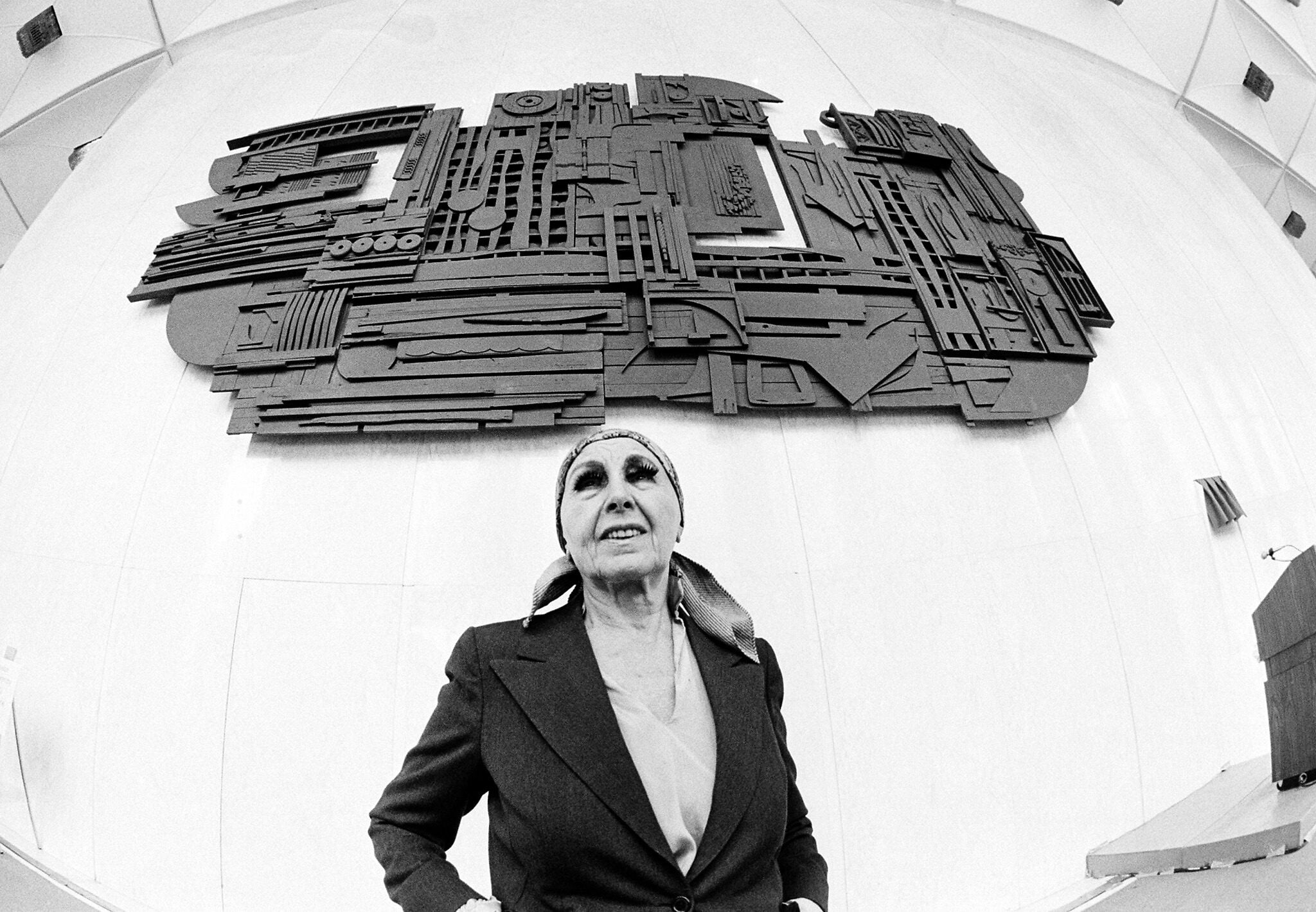
Roger Tillis, whose parents were involved in the 1970 acquisition of the bimah, recalled that when he was 10 years old, his parents invited Louise Nevelson for dinner. “I met her in the living room,” he said. “She was wearing a babushka. It was a very exciting time.”
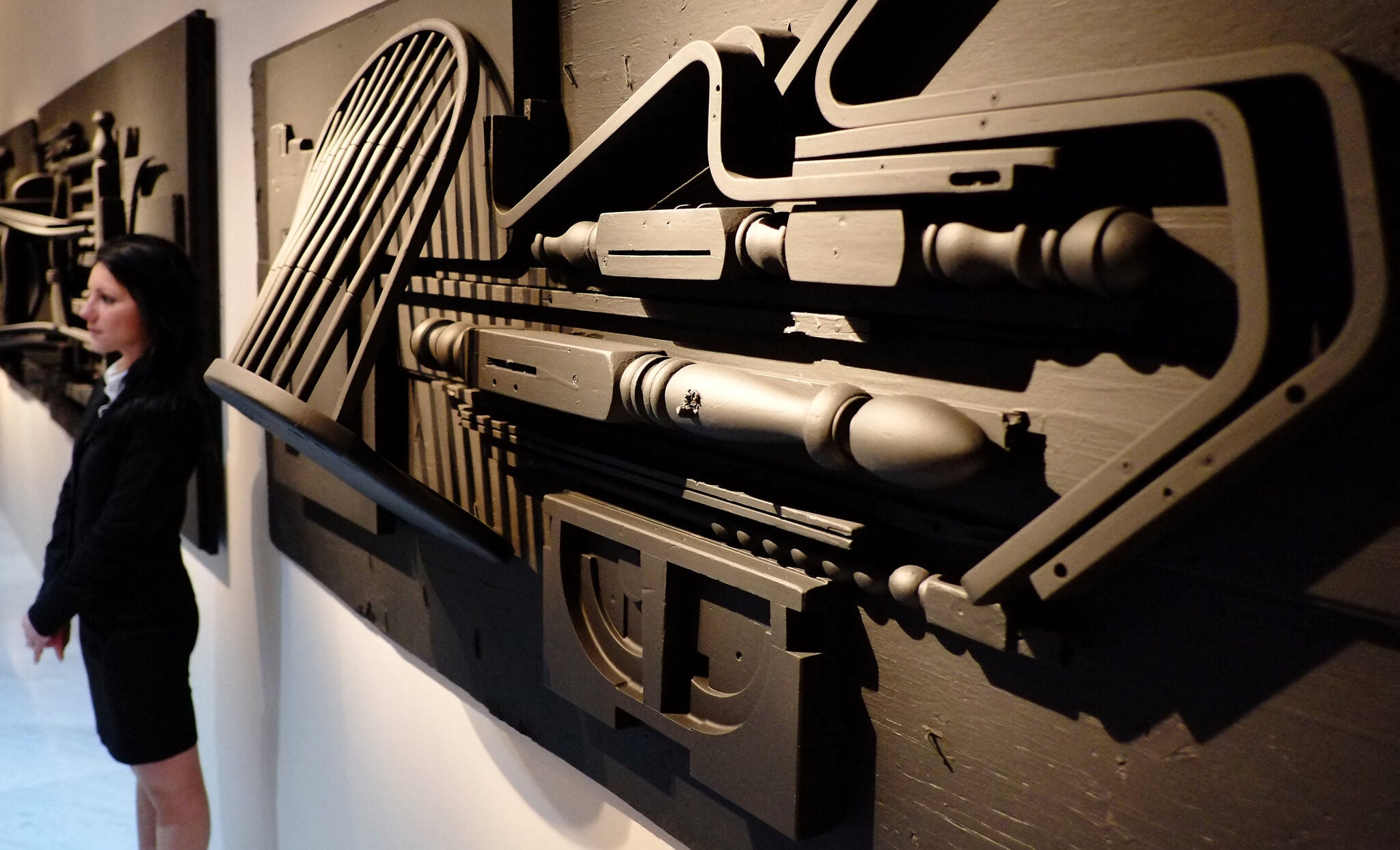
Louise Nevelson, born Leah Berliawsky in 1899 in Ukraine, is known for monumental, monochromatic wood assemblages made from scavenged everyday objects and discarded architectural fragments. Some of her sculptures were made from metal, including “Night Presence IV,” which can be seen on Park Avenue and 92nd Street in New York.
Her art is in the collections of over 250 museums and public spaces worldwide, according to her foundation. Nevelson created sculptural pieces for other houses of worship, including Temple Israel in Boston in 1973 and the Chapel of the Good Shepherd in St. Peter’s Lutheran Church in New York in 1977.
“The White Flame” is the longest contiguous wall sculpture Nevelson ever made. The New York Times, in its 1988 obituary, called her a “pioneer creator of environmental sculpture who became one of the world’s best-known artists.”
Her connections in Great Neck dated back to the 1950s, when she gave sculpture classes in the town and became known to the Jewish community. In 1970, real estate developer Wilfred Cohen and his wife Rose, Beth-El congregants, commissioned her to create a bimah sculpture for a new 1,900-seat sanctuary, an addition to the congregation’s original 250-seat chapel from 1932. Nevelson also designed the sanctuary’s ner tamid, the eternal flame.
“For those of us who have been a part of Temple Beth-El for many years, this ark is much more than a remarkable work of art,” board president Jordana Levine said at the October 1 event. “It has been at the heart of our sanctuary and has been part of the life of this congregation for more than 50 years. Generations of our members have prayed before it, celebrated alongside it, and found comfort and meaning here.”
Records for how much Nevelson was paid for her work no longer exist, but a six-foot-long model of “The White Flame” sold for $327,600 at Sotheby’s in 2022. Ann Freedman of FreedmanArt, who has an exclusive contract to find a new home for the bimah sculpture, is working to raise funds so that the piece can be donated to a museum for permanent placement.
Congregant Andy Aaron, who has been a member at Beth-El for 50 years, said he perceives the bimah’s wavy cutouts as people. “The smaller ones at the bottom are children,” he said. Other members reported seeing flames or souls rising up in the all-white work — an unusual color for Nevelson, who mostly painted her sculptures black. Several congregants mentioned how the piece operated like a sundial during services, as beams of light moved across its surface.
Temple Beth-El was one of the most prominent Reform synagogues in the country in the 1960s, welcoming visitors like Martin Luther King Jr., Robert F. Kennedy, Gov. Nelson Rockefeller, and pianist Peter Nero, who played at the new sanctuary’s dedication.
Help us report truthfully on social media

As a multimedia journalist, my job is to take the quality, fact-based journalism produced by The Times of Israel newsroom and make it accessible across every platform — from Instagram posts to podcasts to short-form videos.
This is how many, especially young people, consume news these days. But misinformation is rampant on social media. Our team at ToI produces accurate, responsible short-form reporting on Israel and the Jewish world.
If you believe in the importance of factual social media journalism, please consider joining our reader support group, The Times of Israel Community. Your financial support is essential to sustain responsible multimedia reporting.
— Gabriella Jacobs, multimedia journalist
Support our work Support our work Already a member? Sign in to stop seeing this
KioskNews shows a cleaned-up reading view extracted from the publisher’s page — the original always lives on their site, not ours.