Is Andy Burnham serious about climate security? Here’s how we will know
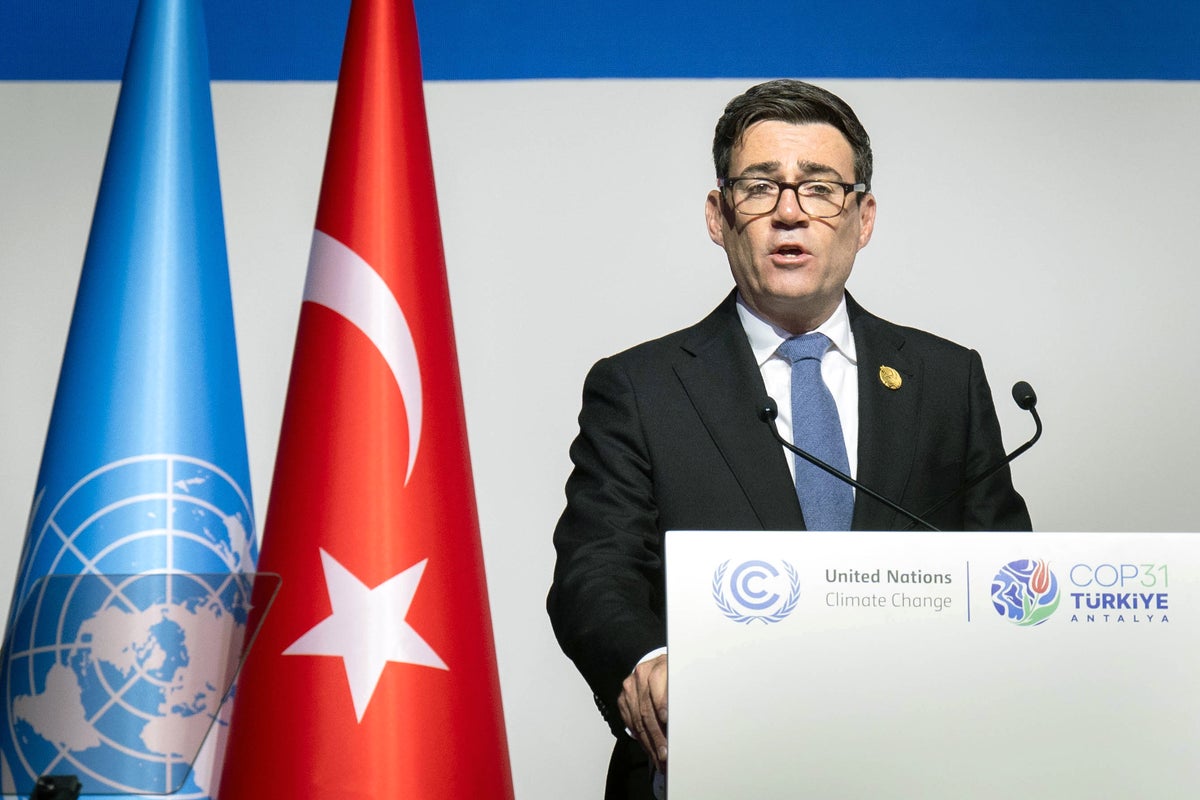
At Cop31, Andy Burnham was right to describe climate change as a security issue. By appointing the world's first Special Representative for Climate Security, the UK is acknowledging a simple fact: climate change is no longer a future challenge. It is already disrupting food systems, straining energy security and amplifying economic and social pressures at home and abroad – a shift captured clearly in the recent Joint Intelligence Committee assessment.
For years, climate security was treated as something happening elsewhere, affecting fragile states or distant humanitarian crises. Today, that distinction is becoming harder to sustain. Four of the UK's five worst harvests on record have occurred since 2020, reducing domestic food production. At the same time, droughts and crop failures in major agricultural exporters have increased pressure on global food markets.
Climate security is no longer about instability "over there". It is increasingly about the resilience of the systems on which daily life in Britain depends. Burnham should, however, resist the temptation to frame climate change through the lens of traditional security thinking. Instead he must use this moment to rethink what security means for Britain’s role in the world.
The more interesting question, therefore, is not whether climate change is a security threat. It is whether Burnham is willing to follow the logic of his own argument and a chart a new course for Britain on the global stage. Three tests will provide an early indication.
Climate security starts beyond our borders
Security in an age of climate disruption depends not only on preparedness at home, but also on whether communities elsewhere can withstand climate shocks before they become humanitarian, economic or political crises that reverberate across borders.
If Burnham is serious about climate security, then the agenda must extend well beyond risk assessments and security reviews. COP31 offers an immediate opportunity. As developing countries push for greater support to cope with escalating climate impacts, the UK could use its diplomatic weight to help break the deadlock on adaptation finance and reinforce commitments to the Loss and Damage Fund. Looking beyond COP31, the upcoming UK G20 Presidency, during which Burnham pledged to put climate resilience back on the agenda, provides another opening to build a coalition around climate adaptation, disaster preparedness and food-system resilience, areas that remain chronically underfunded despite their importance for global stability.
Cut the risks that come with fossil fuel dependence
Recent years have demonstrated how quickly global crises can reach British households. Russia's invasion of Ukraine triggered energy price shocks that reverberated across Europe and drove up bills for millions of families. The recurring instability around the Strait of Hormuz, through which around 20 per cent of globally traded oil flows, offers another reminder that Britain remains exposed to geopolitical events thousands of miles away. Energy security is no longer just about ensuring supply. It is about reducing vulnerability to increasingly frequent external shocks.
The UK cannot control wars abroad or volatility in global gas markets. But it can reduce its exposure to them. The Clean Electrification Roadmap unveiled at COP31 signals that the government understands the link between decarbonisation and security. The challenge now is delivery. Electrification will only strengthen Britain's resilience if it is matched by sustained investment in grid infrastructure, clean power generation, home energy efficiency and industrial decarbonisation.
Use climate security to rebuild British influence
COP31 is taking place against a difficult international backdrop. The United States has stepped back from climate leadership. China is expanding its influence through clean-energy technologies and supply chains. Unresolved disputes over climate finance continue to undermine trust between developed and developing countries.
Against that backdrop, Burnham's announcements are more than a series of climate initiatives. Alongside the establishment of the Climate and Nature Security Taskforce earlier this year, it suggests an attempt to position Britain as a convening power and agenda-setter.
This is where the UK retains a genuine advantage. It still has significant diplomatic reach, deep development expertise and an unrivalled ability to mobilise capital through the City of London. In a more fragmented world, Britain's influence may depend less on economic scale than on its capacity to convene partners, broker agreements and build coalitions around shared challenges.
Can Burnham match words with action?
Of course, Burnham is governing in difficult circumstances. Two major wars, economic uncertainty, pressure on public finances and lingering concerns over energy prices inevitably constrain what any government can do. It is also fair to ask whether he is hedging his bets: signalling ambition on climate while reassuring businesses, investors and voters that economic stability remains the priority.
That balancing act may be politically necessary. But climate security cannot become a way of sounding serious without making hard choices.
The appointment of a climate security envoy matters because it raises expectations. If the concept simply reinforces a narrower, more defensive vision of national interest, it will have achieved very little. But if it helps redefine security around resilience, cooperation and long-term stability, it could become one of the most important innovations in British foreign policy for decades.
Beatrice Mosello is a senior research fellow in the Environment and Society Centre at Chatham House
KioskNews shows a cleaned-up reading view extracted from the publisher’s page — the original always lives on their site, not ours.