Eight food products fail inspections at border, FDA says
By Jake Chung / Staff writer, with CNA


Japanese cantaloupes, fresh black truffles from Bulgaria and Thai bird’s nest drinks were among eight imported food products found to contain excessive pesticide residues, heavy metals or sweeteners, the Food and Drug Administration (FDA) said yesterday.
The list also included celery from Vietnam and sesame products from Tanzania.
Part of a shipment of Japanese cantaloupes imported by Kaohsiung-based fruit importer Yang Jhen International Co contained 0.07 parts per million (ppm) of the pesticide isofetamid, exceeding the 0.01 ppm limit, the FDA said.
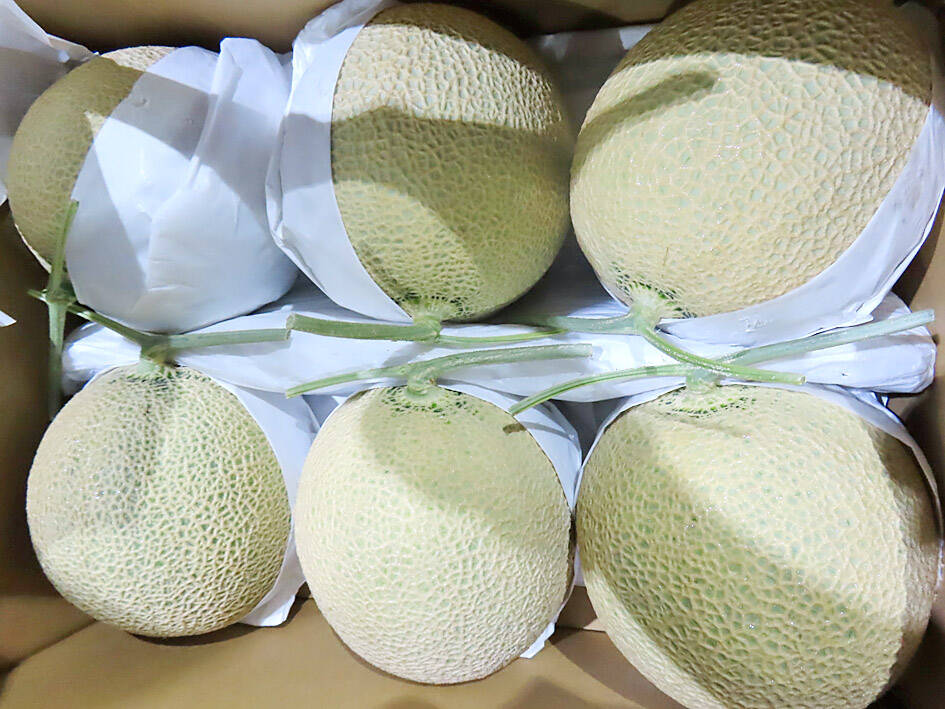
Cantaloupes imported from Japan are pictured in an undated photograph.
Photo courtesy of the Food and Drug Administration
Taiwan does not permit the use of isofetamid on cantaloupes, FDA Northern Center for Regional Administration Director Liu Fang-ming (劉芳銘) said.
The 320kg shipment must be returned or destroyed, Liu said, adding that all future shipments from Yang Jhen would be subject to border inspections.
In the past six months, 11 of 111 shipments of fresh melons imported from Japan failed inspections, with excessive pesticide residues the main reason for noncompliance, FDA data showed.
The FDA would inspect all batches of fresh melons imported from Japan through Oct. 28, Liu said.
Fresh black truffles imported from Bulgaria by European Arcade Food Ltd contained 5 milligrams per kilogram (mg/kg) of cadmium per kilogram, exceeding the 2mg/kg limit, the agency said, adding that the 4.5kg shipment must be returned or destroyed.
Although the batch was the company’s only noncompliant shipment in the past six months, it had contravened regulation in September last year, and so all future shipments would be inspected, Liu said.
Three of 17 shipments of truffles from Bulgaria inspected over the past six months failed inspections, FDA data showed.
A shipment of Thai bird’s nest drink imported by Hsiang Yen Trading Co contained 0.06g/kg of saccharin, which is not permitted in the product category. The 4,991kg shipment must be returned or destroyed.
Separately, a Consumers’ Foundation survey found that 80 percent of basil samples and 20 percent of scallion samples bought in traditional markets, supermarkets and big-box stores in Taiwan’s six special municipalities contained pesticide residues exceeding legal limits.
The foundation bought 10 samples each of garlic, scallions and basil in May and June and tested them for 410 pesticides and dithiocarbamate pesticides.
Of the 30 samples, eight basil and two scallion samples failed. The 10 noncompliant samples contained 16 types of pesticides, while the risk coefficient for basil ranged from two to 141.9.
The tests detected chlorpyrifos, an organophosphate insecticide that can affect the nervous system after prolonged or excessive exposure, the foundation said.
Taiwan removed chlorpyrifos from its permitted pesticide-residue standards in April 2024 and has been phasing out its use.
The foundation advised people to soak garlic, scallions and basil in water for 10 to 15 minutes and thoroughly rinse them under running water before using them.
KioskNews shows a cleaned-up reading view extracted from the publisher’s page — the original always lives on their site, not ours.