This 'Arab' Factor Holds Critical Balance Of Power In Israel Elections
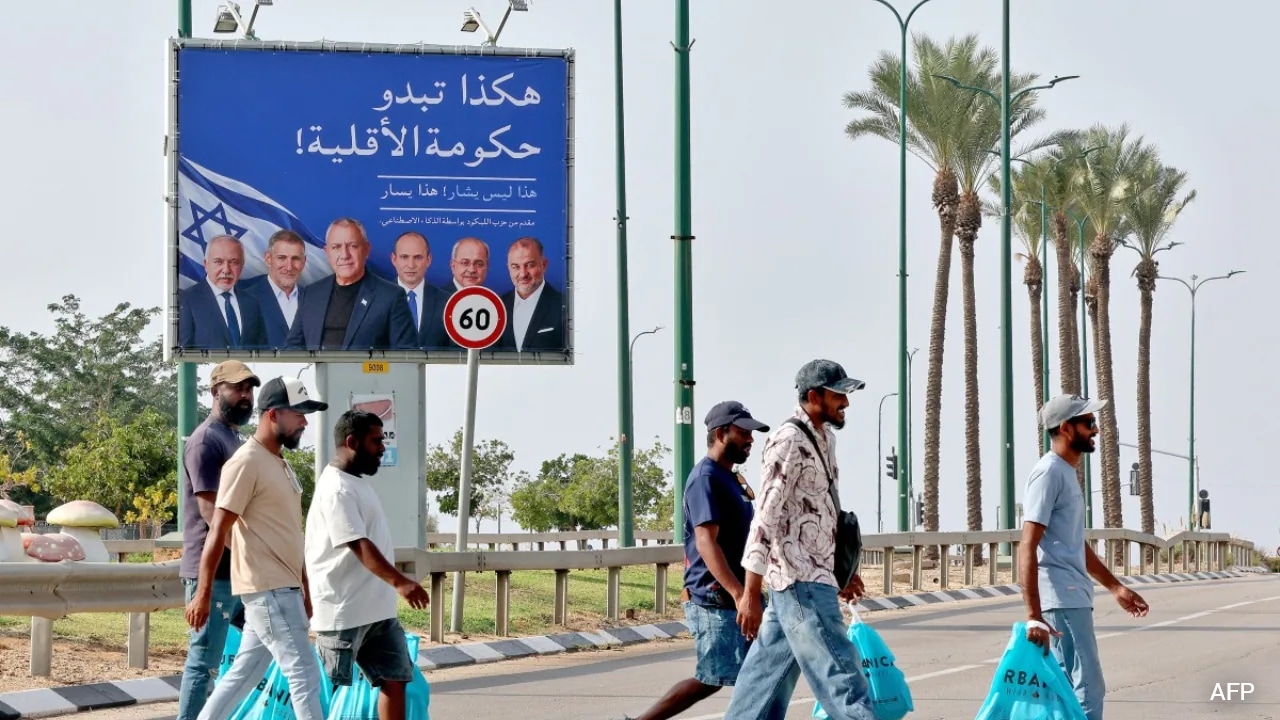
The question hovering over Israel's election on October 27 is not simply whether Benjamin Netanyahu can stay on as prime minister. It is whether either of the rival camps could manage to get the numbers to govern, and what happens if neither can without the help of Arab political parties.
In Jerusalem, where the campaign takes place against a backdrop of war, security concerns and deep political divisions, the arithmetic of the election is taking on an ever greater importance. In Israel, the 120-seat Knesset needs a majority of 61 seats to form a government. If neither camp reaches that threshold, parties that have been on the periphery of the mainstream political contest could find themselves in a position to shape the outcome.
But the campaign has a striking inconsistency. Arab citizens are around a fifth of Israel's population, and Arab-led parties could win seats that could matter in the final reckoning. But publicly courting their support is still politically sensitive for both Netanyahu's right-wing bloc and the opposition.
The Numbers That Decide Results
Coalition arithmetic is central to the election in Israel's proportional representation system. Voters vote for party lists, and seats are allocated according to the party's percentage of the vote, provided it crosses the electoral threshold.
The system allows smaller parties to potentially play an important role if the major political camps do not gain a majority.
Arab political representation is not one united bloc. The United Arab List, or Ra'am, and other Arab-led political parties have different political priorities and different approaches to cooperation with Jewish-led parties. Their post-election decisions will depend on how many seats they win, what concessions are on offer, and whether supporting a government is perceived to be in the interests of their voters.
It is also important to distinguish between joining a government and supporting it from outside. A party can affect the parliamentary maths without holding ministerial portfolios or being in a governing coalition.
That difference could matter to an opposition hoping to replace Netanyahu if the final result leaves it one or two seats short of the 61 needed.
The Hesitation
The difficulty for Netanyahu's rivals is that to remove the prime minister, they might have to strike political bargains that elements of their electorate will not stomach.
The October 7, 2023 Hamas-led attacks and the ensuing war in Gaza have shifted the political debate in Israel. Security and the future of the country's relations with the Palestinians are still highly divisive issues. Cooperating with Arab parties in this environment carries a political liability, even if the numbers in parliament make such cooperation attractive.
Netanyahu's own coalition includes right-wing and religious parties, some of them far-right politicians who oppose concessions to the Palestinians. The challenge for his opponents is to show they can offer an alternative government while managing divisions within their ranks.
This places the Arab parties in a strange position. The bigger blocs have reasons to keep their potential support from being a prominent campaign issue, even if it could impact the final result.
A Precedent
There is already a precedent for an Arab party helping to determine who governs Israel. In 2021, Ra'am joined the coalition led by Naftali Bennett and Yair Lapid, with Mansour Abbas at the helm. The deal helped end Netanyahu's long stint as prime minister, demonstrating that an Arab party can be part of the parliamentary coalition-building process.
The government that was formed lasted only a short time, and the political scene has changed considerably since. Cooperation has become even more contentious in the wake of the October 7 attacks and the war that broke out, while disagreements on security and the Palestinian question continue to constrain political options.
But the 2021 experience is relevant to the current election. It showed how the negotiations following an inconclusive result can differ from the campaign rhetoric of the public.
What If No One Gets Majority?
The outcome will depend on turnout, the distribution of votes among smaller parties, and whether parties close to the electoral threshold enter parliament.
One thing to watch is the Arab voter turnout. The number of seats won by Arab-led parties may determine whether they have any real leverage in negotiations after the election. But their power will also depend on the size of Netanyahu's bloc and on his rivals' ability to devise a governing formula.
The main question at this moment is whether the main political groupings can win enough seats to govern without making compromises they avoided discussing in the campaign.
The stakes are clear from Jerusalem: the election may be fought between Netanyahu and his challengers, but the final decision about who can govern could depend on parties that the leading camps have been hesitant to court.
The real test could come when the votes are counted, and campaign positions are set aside for the more difficult task of creating a majority.
KioskNews shows a cleaned-up reading view extracted from the publisher’s page — the original always lives on their site, not ours.