FREYJA missile shield: Ukraine's new bet against Russian ballistic missiles
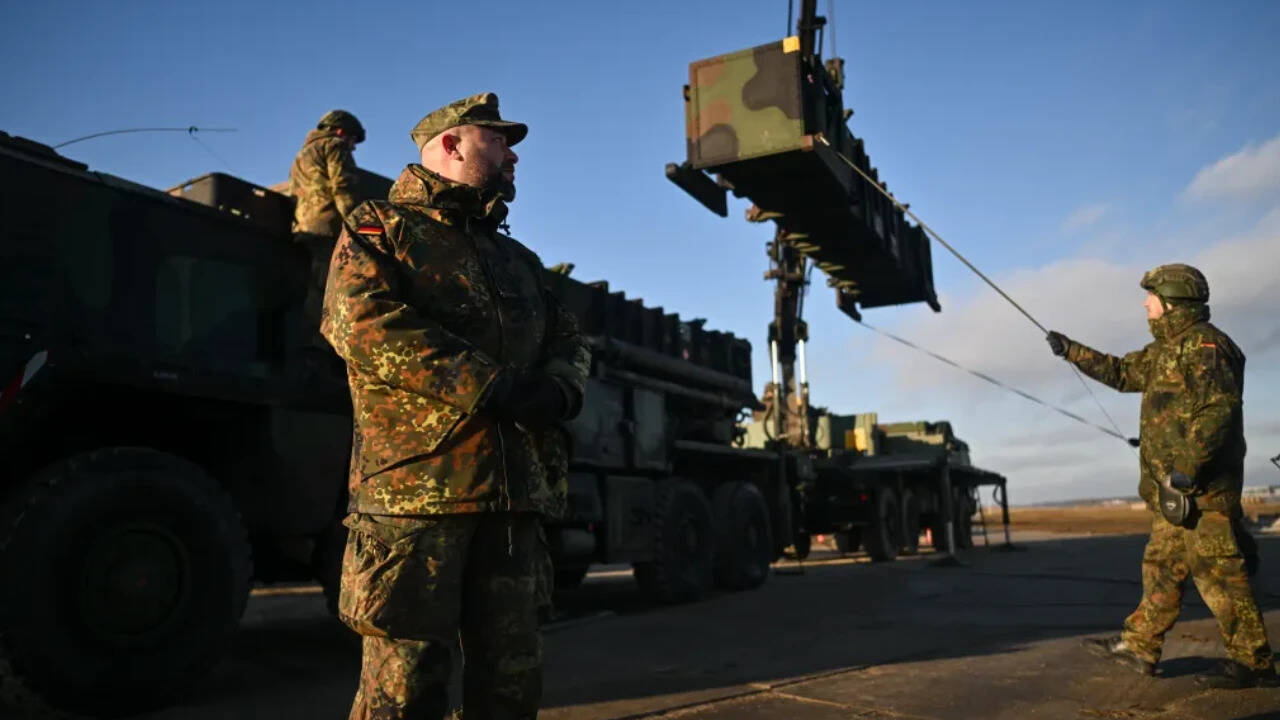
German soldiers unload the US made MIM-104 Patriot surface-to-air missile (SAM) system
Ukraine has completed its part of a new multinational missile defence system designed to intercept ballistic missiles, but the programme is still waiting for critical components from European partners before it can move towards testing.
The development marks a major step in Kyiv's effort to build an alternative to US-made Patriot systems as Russia continues to intensify missile and drone attacks on Ukrainian cities.According to Defence News, the system, called FREYJA, is being developed through a coalition of Ukraine and European countries. Ukrainian defence company Fire Point has completed its assigned work on the FP-7.X interceptor and launcher, while European partners are responsible for supplying key technologies, including radar, infrared seekers and command-and-control systems.The programme is targeting initial testing by the end of 2026, with battlefield deployment planned for 2027. However, the timeline depends on the delivery and integration of the remaining European components."Ukraine has done what it was supposed to do, and that is good news," Zelenskyy told journalists, adding that 10 countries were participating in the programme and working on their respective contributions.
"People work on systems like this for decades. We want it very fast, because there is no time," he said, highlighting the urgency of developing an indigenous capability to intercept ballistic missiles.Which countries are involved and what are they contributing?The Integrated Anti-Ballistic Missile Coalition was formally established on July 13, 2026, in Paris. According to the joint declaration published by the Swedish government, its 10 founding members are Ukraine, Denmark, France, Germany, Italy, the Netherlands, Norway, Spain, Sweden and the United Kingdom.Ukraine is developing the FP-7.X interceptor missile and launcher through its defence company Fire Point. Germany is contributing radar technology through Hensoldt, including its TRML-4D radar, while Diehl Defence is involved in infrared seeker development. Norway's Kongsberg Defence and Aerospace is developing the command-and-control centre.Other potential technology suppliers include Sweden's Saab and France's Thales for long-range surveillance radar, and Denmark's Weibel Scientific and Italy's Leonardo for fire-control radar.
These are proposed contributions in the preliminary design, not all confirmed contracts. Poland joined the coalition in September, while Canada has expressed readiness to contribute technology.How FREYJA will work and why Ukraine needs its own missile shieldFREYJA is being designed as an integrated ballistic missile defence network combining Ukraine's FP-7.X interceptor and launcher with European radar, tracking, guidance and command-and-control technologies.Its surveillance radars will detect incoming ballistic missiles, while tracking radars monitor their trajectory and relay information to a central command centre being developed by Norway's Kongsberg. The system will use NATO's Link 16 communication standard to connect with Ukraine's wider air defence network, while the Asterix protocol will facilitate radar-data exchange.The initial FP-7.X interceptor is designed to engage threats at an altitude of approximately 20 to 25 kilometres using a blast-fragmentation warhead, with a hit-to-kill version planned for the future.
The architecture is modular, allowing components from different manufacturers to be integrated or replaced.Ukraine's push to develop FREYJA is driven by its growing dependence on the US-made Patriot air defence system to intercept Russian ballistic missiles. However, the supply of Patriot PAC-3 interceptors remains limited, with high production costs and growing international demand adding to the pressure.According to Defense News, a PAC-3 interceptor costs approximately $3.8 million, while Ukrainian defence company Fire Point is targeting a production cost of less than $1.2 million for its FP-7.X interceptor in serial production. The shortage has become more pressing after the US-Israel war with Iran depleted an estimated two-thirds of America's prewar PAC-3 interceptor stockpile.With Russia continuing to launch ballistic missiles, cruise missiles and large numbers of drones against Ukrainian cities, Kyiv wants to build a more affordable and sustainable missile defence capability.FREYJA could help Ukraine expand its interceptor supplies, reduce dependence on American weapons and strengthen its domestic defence industry through European technological cooperation.
KioskNews shows a cleaned-up reading view extracted from the publisher’s page — the original always lives on their site, not ours.