How Indian Railways aims to maximise its freight revenue potential
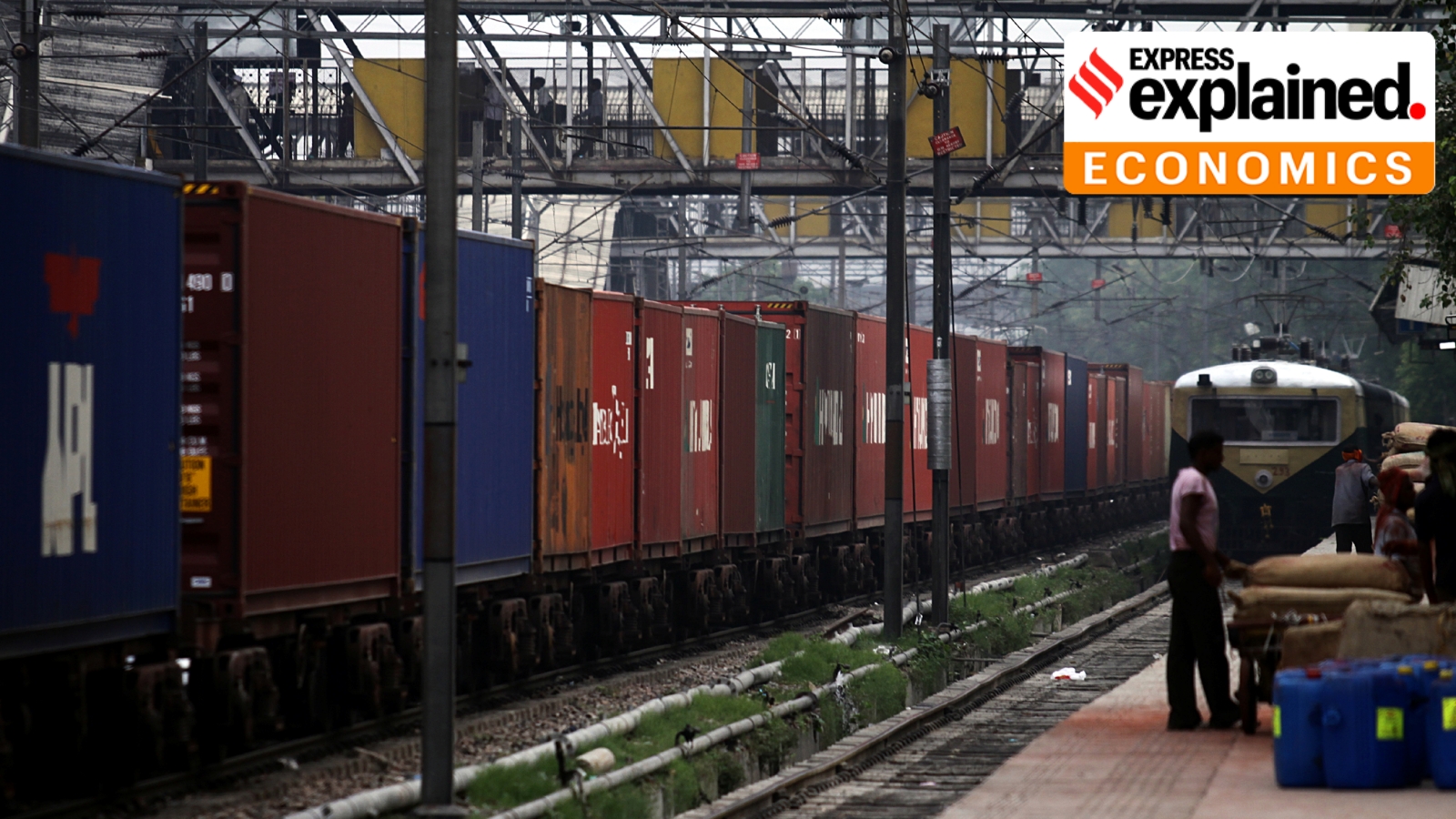
The Indian Railways is often called the lifeline of the country, given its passenger carrying capacity of over 20 million people everyday — one of the largest in the world. But it is also among the world’s largest freight transportation systems: in fact, the freight revenues — accounting for over 65% of the Railways’ total earnings — subsidise passenger travel.
With the expansion of the National Highways network by over 60% in the past decade, the Railways is facing stiff competition in increasing its share of the country’s overall freight transport. Although freight transport via rail is cheaper and environmentally sustainable due to very low emission, the congestion across the network and inadequate last-mile connectivity are major roadblocks in utilising its full potential.
To resolve these challenges, the Indian Railways has now taken up its ambitious project to quadruple or four lining all the seven high density networks (HDNs), which accounts for over 40% of the Railways’ traffic. Along with this, after the commissioning of Vaitarna-JNPT section, which marked the completion of the 1,506-km Western dedicated freight corridor (DFC), the Railways is expediting its third DFC connecting Dankuni (West Bengal) in the east to Surat (Gujarat) in the west. The 1,337-km Eastern DFC was fully operationalised by the end of 2023.
Here’s what to know about high density routes and what is being done to ease congestion on them, and why India needs freight corridors.
High Density Network
HDNs, or high density routes, are the passenger-freight corridors where the number of trains are running beyond its capacity in most of the sections. For instance, in the 28-km Karjat-Lonavala section near Mumbai, on an average 67 trains run each way per day against the maximum capacity of 40 trains. This overutilisation of the network causes congestion, delays in passenger and freight trains, and affects the overall efficiency of the network.
Of the 69,000-plus km network of the Indian Railways, the HDN is 11,051 km or almost 16% of the total. These corridors, though comparatively small, are also called the backbone of the Railways, as they handle over 40% of the total traffic.
The seven HDNs, covering all sides of the country, are the 1,422-km Howrah-Delhi route, the 2,039-km Howrah-Mumbai route, the 1,322-km Mumbai-Delhi route, the 1,876-km Delhi-Guwahati route, the 2,037-km Delhi-Chennai route, the 1,117-km Howrah-Chennai route, and the 1,238-km Mumbai-Chennai route.
Story continues below this ad
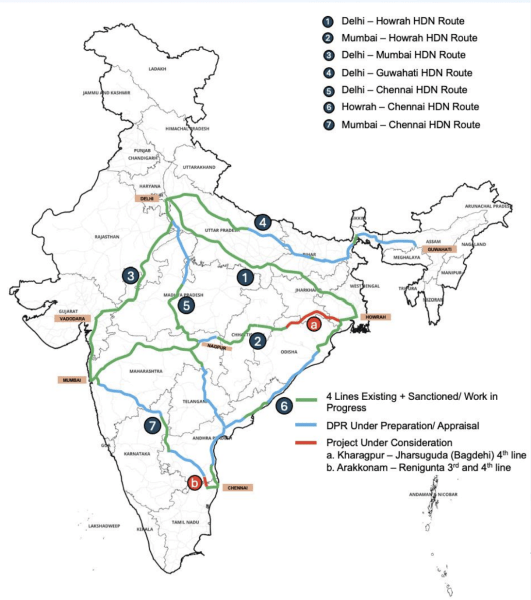 India’s high-density routes.
In the Railways, it is considered that the network should operate at 70-80% of its total capacity to avoid congestion and allow trains to run seamlessly. The data, however, shows that only 4.6% of the HDN is operating below 80% of capacity. The line-capacity utilisation of 18.89% of the high-density network is 80-100%, 32.75% of the network is operating at 100-120%, 29.53% of the routes are running at 120-150% utilisation, and 14.11% of the HDNs are seeing trains operating at over 150% of route capacity.
So, congestion occurs frequently in sections, which leads to the delay in train arrival, mostly the freight trains. The average speed of freight trains is still only 25 kmph.
Multitracking
The multitracking of these sections are important not only for passenger convenience but increasing freight loading as well. The model share of Railways in the country’s freight transportation is around 27%, and it carried 1,670 million tonnes freight in 2025-26. The national carrier has set an ambitious target to increase its loading to 3,000 million tonnes by 2030.
In order to achieve this, the high-density routes have to be converted to normal routes. According to the National Rail Plan, if multitracking of HDNs is not taken up, the line-capacity utilisation by 2031 of 50% of the network will be over 150%, 39% will see 100-150% utilisation, and 9% of sections will operate at 70-100% of capacity.
Story continues below this ad
For the current financial year 2026-27 (FY27), the Railways has set a target of constructing 500 km of new lines, while doubling of lines are planned for 2,400 km. In FY26, its revised target for doubling was 2,600 km, while the target for new line construction was 700 km.
The Union Cabinet recently approved eight multitracking projects spanning 1,196 km worth Rs 20,804 crore. While announcing the Cabinet decision, the Minister for Railways Ashwini Vaishnaw said that multitracking will not only decongest these sections but also reduce India’s logistics cost.
“Of the 11,000 km of the high density corridor, about 2,000 km is already four-line. In 5,000 km, the project is sanctioned and work is underway. In 4,000 km, the DPR (Detailed Project Report) is being prepared and work will be approved in future,” said Vaishnaw.
The logistics cost can be reduced by minimising transit delays, lowering inventory holding requirements, and reducing wastage and degradation of goods during transit.
Story continues below this ad
Upon being asked by the Standing Committee on Railways on logistics cost, the Ministry on February 10, 2025, had said: “If we talk about comparison, if we see, approximately Rs 3.60 per tonne per kilometre is the cost on road, and on rail, it is Rs 1.60. In this way, it is cheaper. If we see, we have to reduce the logistics cost, so the more we take onto rail, the cost will come down to 8-9%. Currently, our logistics cost is 12-13%, and it costs a lot.”
Freight corridors
The freight corridors are special lines for goods trains, which in some sections run parallel to the high-density corridors, while in others they take a detour to bypass passenger-dominated terminals. The idea of Eastern and Western DFCs came about because of the oversaturation of the existing trunk routes — Howrah-Delhi on the eastern corridor and Mumbai-Delhi on the western corridor — with line capacity utilisation varying between 115% and 150%.
Now, both the corridors are fully operational and see running of an average 420 freight trains per day. Eastern DFC runs from Ludhiana (Punjab) to Sonnagar (Bihar), and caters mostly to coal and mineral traffic from eastern India. Traffic on the western corridor mainly comprises ISO containers — standardised steel shipping boxes built to move goods safely across ships, trains, and trucks without unloading the cargo — from JNPT and Mumbai Port in Maharashtra, and Pipavav, Mundra and Kandla ports in Gujarat, headed for Inland Container Depots located in north India, mostly at Tughlakabad (Delhi), Dadri (UP), Dhandari Kalan (Punjab) and Khatuwas (Rajasthan).
The Railways is now moving ahead with the construction of the proposed 1,738-km East-West DFC from Dankuni to Surat. The major traffic generators on the section are coal mines, iron ore, bauxite, manganese, steel plants, ports, fertilisers, FCI godowns, etc.
Story continues below this ad
There are two more such projects in the pipeline: the East Coast corridor from Kharagpur (West Bengal) to Vijayawada (Andhra Pradesh), running parallel to the existing Kharagpur-Vijayawada coastal railway line; and North-South corridor from Itarsi (Madhya Pradesh) to Vijayawada via Nagpur. These projects, however, have not yet been sanctioned and might be taken up in the future.
KioskNews shows a cleaned-up reading view extracted from the publisher’s page — the original always lives on their site, not ours.