NTUT’s lab-on-chip wins HLGC award
GOALS: The team said it hoped to connect the device to phones to make monitoring more convenient and affordable, and to reach areas with limited medical resources
By Yang Mien-chieh and Jake Chung / Staff reporter, with staff writer


A team from National Taipei University of Technology (NTUT) won an Honorable Mention at the National Academy of Medicine’s Healthy Longevity Global Competition (HLGC) for a portable device that detects heart disease biomarkers in 10 minutes.
The winners were announced late last month, marking the culmination of the competition’s seven-year international initiative.
The NTUT project, titled “Democratizing Cardiovascular Diagnostics: A Portable Lab-on-a-Chip for Healthy Longevity,” received an Honorable Mention and a US$10,000 prize in the competition. It was the only Taiwanese team to receive the distinction.
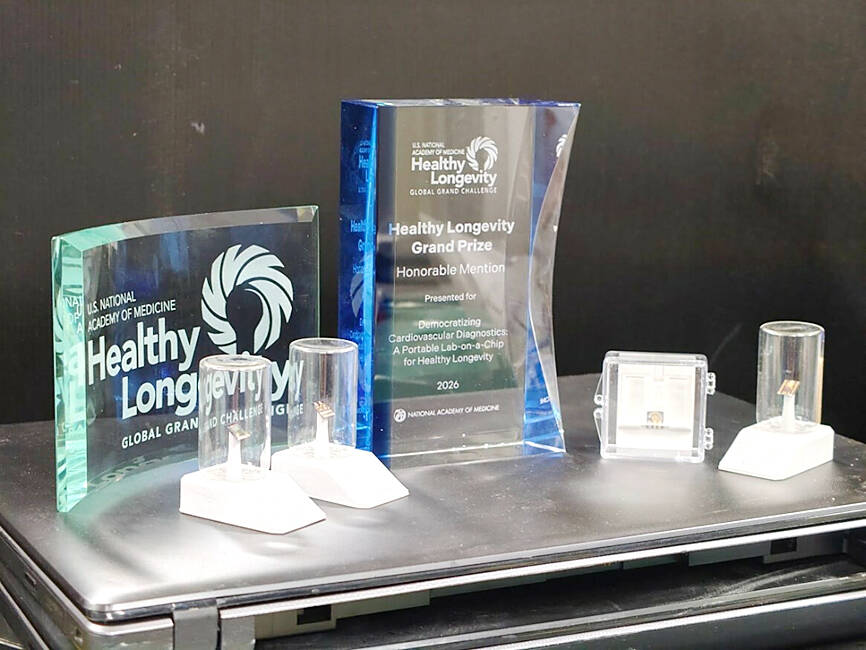
Devices developed by a team from National Taipei University of Technology (NTUT) that won an Honorable Mention at the Healthy Longevity Global Grand Prize Competition are pictured in an undated photograph.
Photo courtesy of NTUT
The project developed a portable chip-based testing system that costs less than US$10 to produce, offering a new approach to point-of-care testing.
The device can detect three biomarkers associated with cardiovascular disease: cardiac troponin I, creatine kinase-MB and B-type natriuretic peptide.
Test results are available within 10 minutes, using only 10 microliters of blood.
The technology combines magnetic nanoparticle swarms with aptamer structures, designed with the assistance of AlphaFold.
It has a detection sensitivity of less than 1 pg/mL and reduces reliance on expensive equipment, the development team said.
The team also reduced the production failure rate to 1.8 percent, and is collaborating with Mackay Memorial Hospital to test the chips, it said.
An application for human research approval is pending. Formal research cannot begin until approval is granted.
The team plans to proceed with clinical validation, regulatory applications and preparations for mass production, it said.
Huang Jung-tang (黃榮堂), the project’s principal investigator, said recognition in the competition was an important encouragement for the team’s long-standing efforts in biomedical sensing and innovative medical research.
The achievement demonstrated Taiwan’s capabilities in biomedical research, he said.
Jakkrapatr Baiyokvichit, a researcher on the team, said making medical technology more accessible was not merely a goal of technological innovation, but also a commitment to research that benefits humanity.
Taiwan’s strengths in semiconductor technology, microelectromechanical systems and photolithography could help the team develop lab-on-a-chip technology that is highly sensitive, affordable and suitable for mass production, he said.
The team said it hopes to connect the device to smartphones, making cardiovascular health monitoring more convenient and affordable.
It also hopes to improve access to testing in areas with limited medical resources and create new opportunities for aging societies.
KioskNews shows a cleaned-up reading view extracted from the publisher’s page — the original always lives on their site, not ours.