Starwatch: Catch the striking trifecta of Venus, the moon and Spica at break of dawn
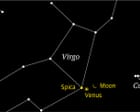
Early risers have a beautiful sight to look forward to this week as brilliant Venus joins the waning crescent moon and the star Spica in the morning sky.
The chart shows the view looking east-south-east from London at 0600 GMT on 7 November. Venus will be the easiest object to identify, shining brilliantly. Next to it will be Spica, the brightest star in the constellation of Virgo, the virgin, situated about 250 light years from Earth.
The tiny sliver of the waning moon completes the tableau. On this morning, the moon will be just two days away from new, with only 4% of its Earth-facing disc illuminated. It may also be possible to see the faint outline of its unlit portion, illuminated by sunlight reflected from Earth. This phenomenon is known as earthshine.
The three objects will form a striking grouping low above the horizon, so you will need a clear view towards the east-south-east to appreciate the spectacle. At 0600 GMT, the sky will still be relatively dark, although the approaching sunrise will gradually wash out the fainter stars.
The grouping will also be visible from the southern hemisphere, where Venus, the moon and Spica will appear higher in the eastern sky before sunrise.
KioskNews shows a cleaned-up reading view extracted from the publisher’s page — the original always lives on their site, not ours.