Boston Dynamics Faces Employee Protest Over Robot Deal With ICE

Two months after reports that the robotics company Boston Dynamics would supply US Immigration and Customs Enforcement with some of its four-legged products resembling metal dogs, the company says it has no plans to abandon the deal despite objections from hundreds of employees.
The controversy began in late August, with reports that ICE planned to spend up to $2 million on Spot robot devices made by Boston Dynamics. According to documents supporting the purchase, the robot dogs would be used to listen for movement inside buildings and do searches in places humans can’t reach.
In September, employees sent management a petition, although the company has said it can’t verify that all of the more than 300 signatures are from Boston Dynamics staff because it claims nearly half of them were signed anonymously.
More from CNET
The Boston radio station WBUR posted a copy of the employee petition, minus signatures, which was sent to what the petition called “top management” on Sept. 8. In the letter, employees say they have been proud of the work they’ve done at Boston Dynamics, but the deal presents them as working directly with ICE: “We cannot be proud of working at BD when that work is being used by a government agency that brutalizes civilians, including some of our own colleagues at Hyundai.” In September 2025, ICE raided a Hyundai facility in Georgia and detained hundreds of workers, many of them from South Korea. Hyundai owns Boston Dynamics.
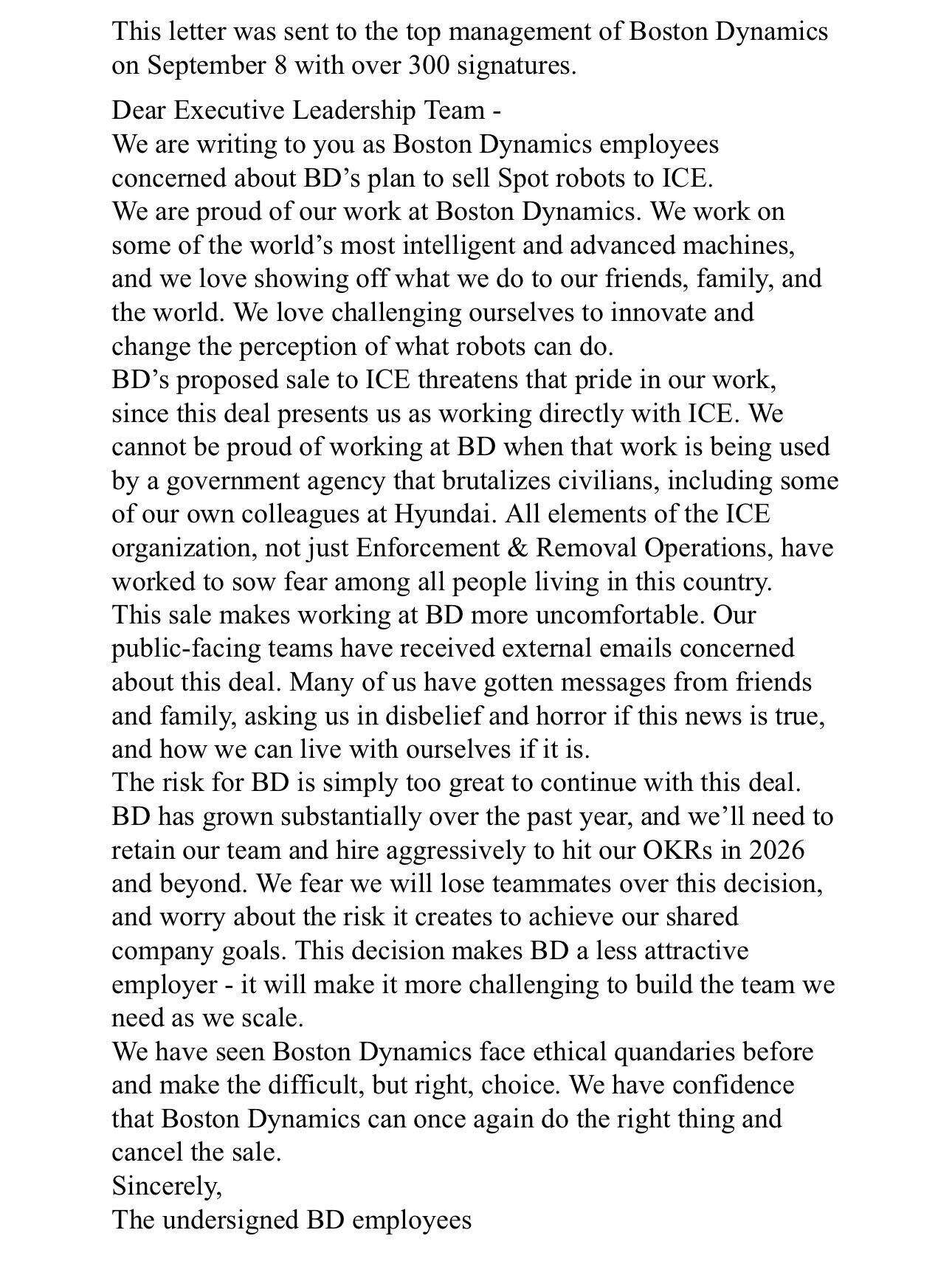
The letter expresses concerns that, in addition to making employees uncomfortable, the deal will cause Boston Dynamics to lose employees and will make the company a less attractive employer as it tries to grow. “The risk for BD is simply too great to continue with this deal,” the letter states.
Boston Dynamics stands firm on its sale
The petition didn’t block the sale of the robots, which was approved in late September by the government and acquired through a company called Radeco, which installed software called Cerberus.
Boston Dynamics told CNET in an email that it addressed the petition in several ways, starting with a letter to the petitioners from the company’s interim CEO, Amanda McMaster, that made clear the company was going ahead with the sale.
“We consider this decision final, and it’s time to move forward… I ask you to respect and accept this decision, even if you do not agree with it,” she wrote in a message sent to petitioners a week after the petition was received.
The company’s defense of the sale has been that its terms and conditions of sale for customers make it explicit that its products cannot be used to harm people. “Those T&Cs prohibit any attempts to weaponize our robot or use it for purposes of harm or intimidation,” McMaster wrote.
Boston Dynamics said it gave employees additional information about the ICE deal (the company had an existing relationship with the Department of Homeland Security), hosted roundtables about ethics and explained its decision-making process. In the company’s mind, at least, employee sentiment has shifted with additional information, and the company has been putting out information about how the robot canines will be used and why it’s working with ICE. “Spot robots are tools that help keep people out of harm’s way. Regardless of any political implications or personal feelings about the organizations involved, if our robot can help keep people safe, we believe it should,” a spokesperson said in a background document about the controversy the company provided to CNET.
Can employee protests make a difference?
At the very least, the Boston Dynamics employee petition caused the company to explain in detail why it was providing its products to ICE and created conversation within the company about its mission and direction going forward, even if it didn’t alter the terms of the sale or cancel it entirely.
Employee protests have become common in the tech industry in recent years, especially as AI is increasingly used in military applications. Google employees recently resigned over a military contract, and a 2018 protest led the company to decline to renew a Department of Defense contract. That same year, Microsoft was called out by employees for work it was doing with ICE.
Jamie E. Wright, a California employment attorney and founder of Wright Law Firm, said employee protests like these are often a way for employees to exercise the power they have to effect change in their workplaces. “They can play a big role in these situations,” she said, but “it’s never guaranteed.”
“While Boston Dynamics may not back down from their decision, employees can show that there are people that care and want to help prevent this from happening in the future,” Wright said. “Employees may not get what they are asking for in these situations, but they can open the doors to allow for changes.”
While protesting against labor conditions may offer some protection from retaliation, calling out an employer’s business deals likely doesn’t, she said. “Some states allow greater protection for political practices or off-duty activities that are legal. Some do not protect at all,” Wright said.
Debra Guckenheimer, a sociologist who closely follows employee protests, said that when people petition for change at their workplace, “That is a sign that they are concerned about retaliation.”
“The job market is very rough right now, and employees who are immigrants, especially immigrants of color, are under enormous pressure at this time,” Guckenheimer said. “The petition represents a lot of bravery and risk.”
Working in a place that is acting in ways that go against an employee’s morals, she said, can be “crushing” and lead to mental and physical problems. Ultimately, Guckenheimer said, employees who protest their employer on moral grounds may have nothing to gain personally other than peace of mind.
“The people who signed the petition at Boston Dynamics are trying to act in not only their own interest to ensure their work does not violate their conscience. They are also trying to preserve the legacy of the company,” Guckenheimer said.

Omar Gallaga has covered technology, digital culture and other topics for outlets including CNET, NPR, Wired, Texas Monthly, MSNBC, Consumer Reports, The Washington Post, the Los Angeles Times, The Atlantic and the Austin American-Statesman, where he was a longtime tech reporter, editor and podcaster. He lives in the Texas Hill Country. See full bio
The Latest from Omar
KioskNews shows a cleaned-up reading view extracted from the publisher’s page — the original always lives on their site, not ours.