Saving the Siamese crocodile: Cambodia moves to protect one of the world’s last wild populations
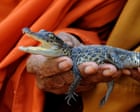
In the 1990s, conservationists in Cambodia feared the Siamese crocodile had disappeared for good. Fishing and hunting had devastated the species throughout the 20th century, leaving populations across its native south-east Asia on the brink of extinction.
But in villages dotted among the wetlands of the remote Cardamom mountains, Indigenous Chorng communities still reported seeing them. Passing this knowledge to researchers surveying the area in 2000 led to an official recording of the species – and bolstered the mission to revive the population.
“[The Chorng] share a spiritual relation between nature, sacred species and the forest,” says Sony Oum, the country director for Conservation International in Cambodia. “They believed that [the crocodiles] were there, and they helped the scientists and researchers to spot the sites.”
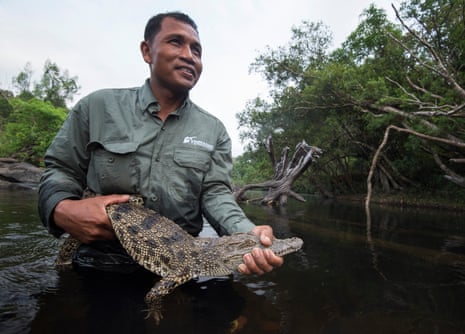
Now, more than a quarter of a century on from the initial sighting, a 315-hectare (778-acre) wetland in Pursat province at the northern end of the Cardamom mountains has been formally declared a genetic conservation area to protect the habitat of one of the world’s last wild populations of Siamese crocodiles.
The area, formally designated by Cambodia’s environment ministry on 22 July, will be home to at least 40 Siamese crocodiles that are thought to live there, making it a crucial site for a species still classed as critically endangered on the International Union for Conservation of Nature (IUCN) red list.
Habitat destruction, poaching and cross-breeding with crocodiles kept on farms have left few genetically intact wild populations of Siamese crocodiles. With small, isolated groups in the wild vulnerable to inbreeding, conservationists say preserving genetic diversity can improve the animals’ ability to reproduce and withstand disease.
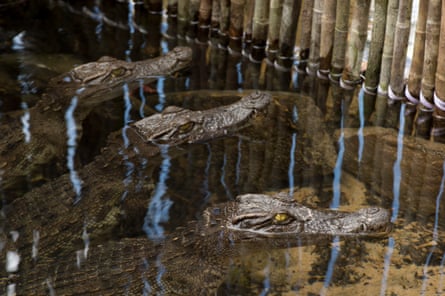
Oum describes the site as a “genetic bank” for the species – a population that, if it remains healthy and expands, could one day help support crocodile recovery in Malaysia, Myanmar and Indonesia, where the reptile is thought to have become extinct.
The new protection area is the latest stage in a conservation effort that has undertaken an extraordinary task.
In 2011, the conservation charity Fauna & Flora International set up a Siamese crocodile breeding facility to boost numbers of genetically pure Siamese crocodiles for release into protected rivers.
The charity has released 246 Siamese crocodiles into the wild since then, with 100 of those released since 2024.
“Natural recovery of this species takes a long time,” says Vanny Lou, who manages the Siamese crocodile programme in Cambodia for Fauna & Flora. “This is one of our approaches to boost the species’ recovery from the brink of extinction.”
“We have 648 individuals [at the breeding centre], including the parents,” he says. “Seventy-one of those are breeding parents – 54 female and 17 male.” Lou says it takes three to four years to get a baby crocodile to the appropriate age and size to release back into the wetlands.
Before release, some crocodiles are fitted with acoustic tags, allowing conservationists to track where they move and target protection efforts. Local community wardens then help monitor the animals and their habitats.
The wardens help the conservation organisations by identifying potential nesting sites, monitoring rivers, patrolling for illegal fishing and poaching, and reporting threats to government officials. And who better than the people who put the species back on the map – the Chorng.
Oum says the fact that Chorng communities have lived alongside the crocodiles for generations and regard them as sacred guardians of the rivers and forests makes them the perfect people to assist the conservation.
“The Indigenous people have a strong belief in the connection to nature,” says Oum. “They do some cropping and farming alongside the river, and when the Siamese crocodiles come to destroy the crops, [the Chorng] smile happily and feel blown away. They’ve been coexistent for a long time.”
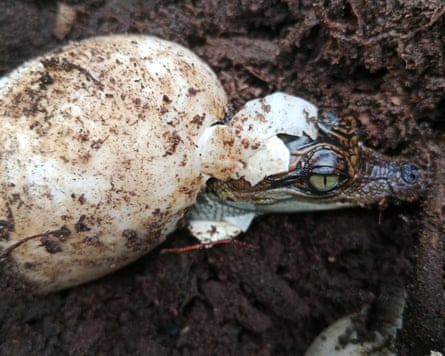
In 2024, five wild Siamese crocodile nests containing 106 eggs were found in the Cardamom mountains. Community wardens monitored them and saw 60 hatchlings emerge – the species’ largest recorded breeding event in the wild this century.
“Without active involvement from the community as the frontline, our programme would not be successful,” says Lou.
Sim Khmao, a Chorng community warden, says they are happy to do it. “They are not afraid of the crocodiles,” he says. “They understand them – because they have been here since our ancestors’ period.”
Find more age of extinction coverage here, and follow biodiversity reporters Rebecca Ratcliffe, Phoebe Weston and Patrick Greenfield on the app for all the latest news and features
KioskNews shows a cleaned-up reading view extracted from the publisher’s page — the original always lives on their site, not ours.