A joyful harvest: the young Welsh farmers growing food for Birmingham
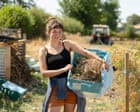
Kilos and kilos of courgettes, cucumbers, tomatoes and salad leaves are ripe and ready for picking on a small Welsh farm in the rural county of Powys.
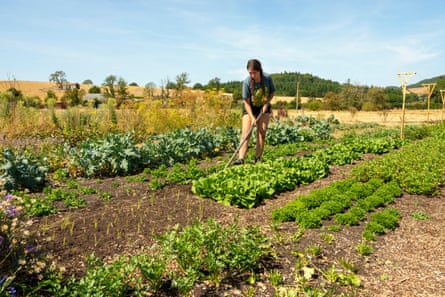
The haul being harvested by Tilly Gomersall is not just impressive after a difficult growing season hit by a record string of heatwaves and drought across all of Wales and most of England, but all the more remarkable given that 18 months ago the site was uncultivated pasture.
“Until now, I’ve just been turning the earth with my own power,” Gomersall says. “We’ve got a two-wheel tractor, but you do have to heft that around with your body quite a lot and we’re cultivating from pasture, so it’s really hard work.”
The site at Wern farm, near Newtown, is part of a scheme to encourage young growers to supply fresh produce to nearby towns and cities and boost domestic production in the face of increasing risks to national food supplies.
The 15-hectare (36-acre) site is divided into three plots, each with a holiday chalet where the growers live, as well as shared facilities including a barn and diesel generator, to cover any power not provided by the farm’s solar panels.
Gomersall’s farm, Cân y Pridd (Welsh for Song of the Soil), totals 4.9 hectares but she is now only growing on half a hectare, including in polytunnels, where she says she is “producing very big volumes for the scale”.
She and her two neighbours are already providing fresh fruit and vegetables for the local community, through a veg box subscription service and at markets. In late July, they also started supplying fresh produce to Birmingham city council, where it is distributed to holiday clubs, giving disadvantaged children a taste of homegrown veg for perhaps the first time.
The Wern farm project was launched by Our Food Trust, a charity which is working to increase levels of homegrown produce and aims to tackle Britain’s food insecurity.
The UK depends on imports for about 40% of its food and has one of the lowest food self-sufficiency ratios among large western European countries, leaving it exposed to supply shocks prompted by the climate crisis, or other risks including geopolitical tensions and cyber-attacks.
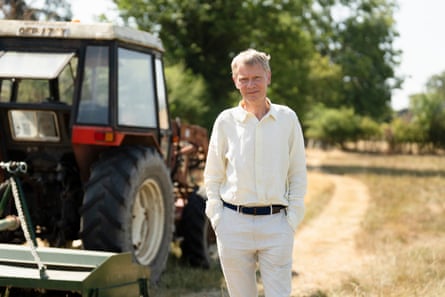
Just 0.2% of land in Wales is used for horticulture, according to the charity, giving huge scope for expansion. “We have to produce a lot more food for the regional and local market and for our cities,” says Duncan Fisher, joint chief executive at the charity.
One way to do this is to remove barriers for young people who want to get into growing, Fisher says, but who often find themselves priced out of renting or buying land and a suitable home. “There are lots of well-trained and skilful growers who can’t find land to grow food on,” he says. “The price of land here is set by the market, by people who are not going to farm it.”
The charity has given Gomersall the chance to turn a dream into reality and start a farm just 10 miles from where she grew up, while her neighbour, Lydia Dibben, says she was “quite blown away by the opportunity”.
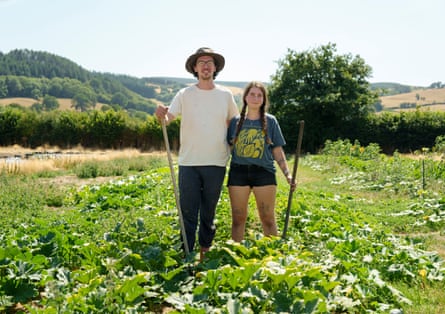
“It was amazing to be offered seven acres, which is a big amount for small-scale vegetable production, with a house with affordable rent and shared infrastructure,” says Dibben, 28. She and her partner Charlie James have named their plot Tir a Nant (Land and Stream).
Our Food worked with the landowner, Powys county council, on the project, securing a 95-year lease for the plot and changes to the county’s planning guidance for rural enterprise dwellings, to enable growers to have a home on the land they work.
The council leader, Jake Berriman, says “there was a perception that planning was a barrier and we wanted to remove that barrier”. He says local worries about extreme weather had also encouraged the authority to get involved. “We are starting to see genuine concern,” he says. “We have gone from flood to drought to fire.”
The charity also negotiated the contract for the farmers to supply Birmingham, which has two aims: to give the growers a guaranteed buyer for some produce as they find their feet, while ensuring nutritious and sustainably produced fruit and vegetables reach deprived areas.
The farmers have 35 customers for their veg box subscription service, along with selling to a local wholesaler and at regional markets. While they stress the importance of growing for their community, they do not believe that doing so would currently sustain their businesses.
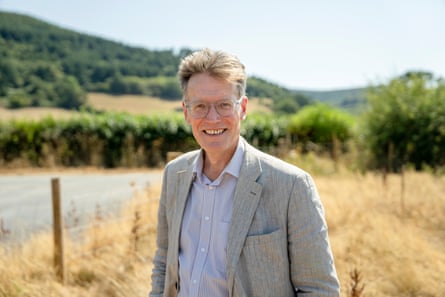
“Because of the cost of living crisis, there’s a limited amount of people who can afford to buy the veg we produce, and we are growing a hell of lot more than we can sell locally,” says Dibben, adding it was “really amazing being able to sell a hundred kilos of courgettes a week” to Birmingham.
after newsletter promotion
Gomersall reels off a list of the produce the farmers have supplied to the city in the course of a few short weeks, including a “couple of bathtubs” of salad leaves, 28kg of spring onions and 18kg of French beans.
The gently rolling hills above Wern farm feel a world away from the urban sprawl of Britain’s second-largest city, although it is just 70 miles away on the other side of the Shropshire hills.
The UK, and its largest cities in particular, have become too dependent on international supply chains and imported food sold by large retailers, according to food experts such as Tim Lang, a professor emeritus of food policy at City St George’s, University of London.
This challenge is recognised by Birmingham council and its food system team, led by Sarah Newton.
“Birmingham is an urban area surrounded by urban areas,” she says. “If you’re going to feed 1.2 million people, supply chains are the absolute crux of the matter, and we need to strengthen them.”
Produce grown at Wern farm is sent to the city’s holiday activities and food programme, part of a national scheme for children from low-income families. About 1,000 children who attended these summer holiday clubs received boxes filled with vegetables from Powys, which they could eat fresh or cook as part of activities.
Newton adds: “You’ve got children who have not had exposure to different vegetables. There are huge barriers to trying new foods if you’ve never had the opportunity to be exposed to it, it takes 10 to 15 tastes to develop the liking for food.”
The Powys scheme is deliberately small-scale, she says, with one van of produce travelling from Wales to Birmingham each week. The goal is to prove that a direct relationship between food growers and a city of diners can work.
“It’s connecting the entire supply chain on a small scale, looking at all the barriers and the facilitators on the way,” says Newton. “If we had a coordinated, national approach that we should be eating target foods, you could line up supply and demand nationally and then you’d get a meaningful shift in economies of scale.”
This kind of national approach to overhauling food systems is already under way in other countries: the French government introduced its projets alimentaires territoriaux (territorial food projects) in 2014, which work to connect local production with public health priorities.
Back at Wern farm, the growers are planning how to expand their cultivated area as they further develop the site.
Gomersall says: “What’s so joyful about the Birmingham project is … we really enjoy harvesting knowing that kids are going to be eating it and enjoying the flavours of real food.”
KioskNews shows a cleaned-up reading view extracted from the publisher’s page — the original always lives on their site, not ours.