Forget Mumbai: These Maharashtra cities had far worse air after Diwali
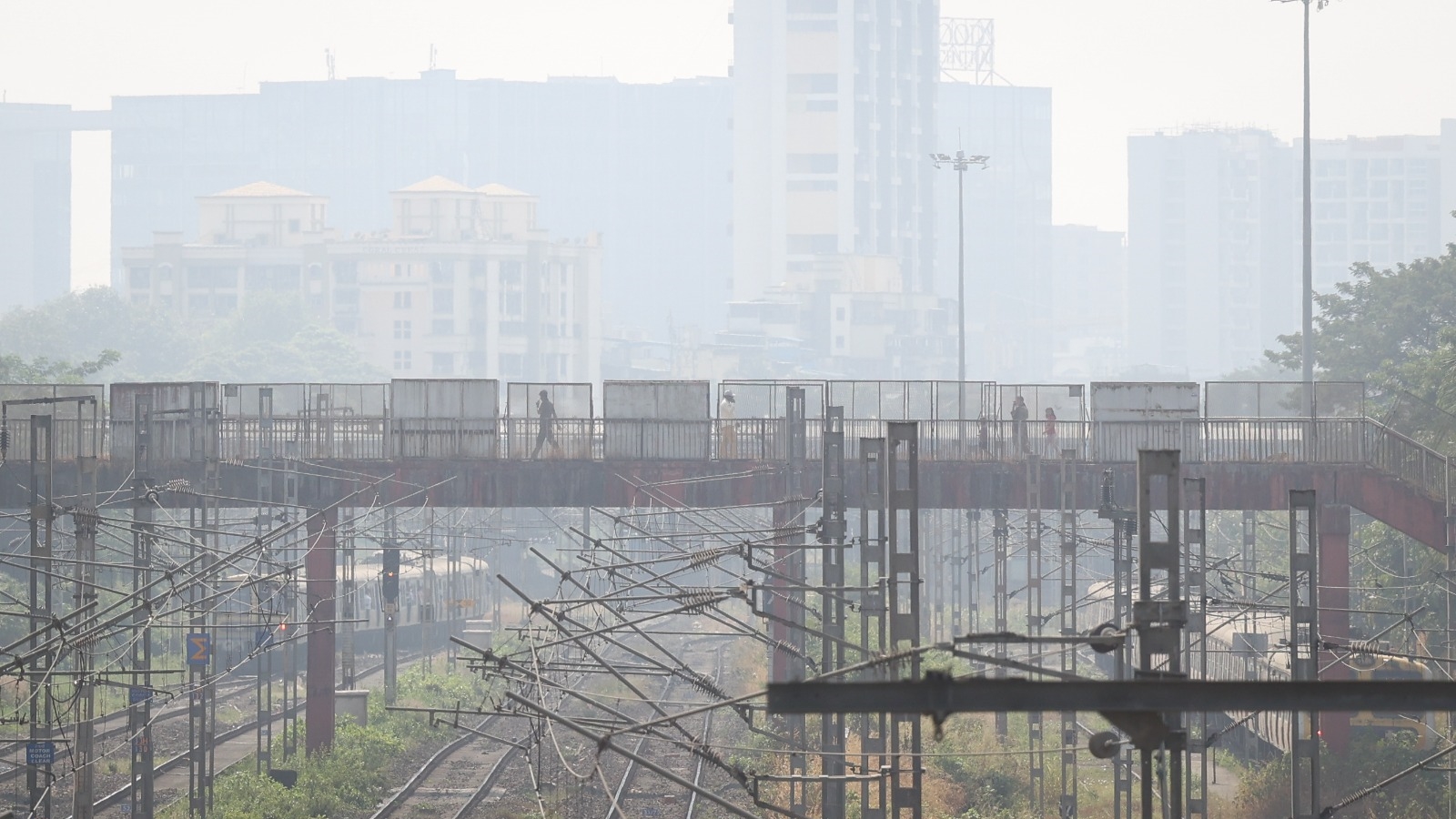
Mumbai’s air quality post-Diwali has drawn some attention, but it turns out that inland cities in Maharashtra faced even worse conditions. The Air Quality Index (AQI) in Pimpri Chinchwad soared past 300, while Pune’s levels were 2.5 times what they were last year. On November 9, 13 cities in the state fell into the ‘poor’ or ‘very poor’ categories.
Of this year’s 10 worst-hit cities, only Nanded was ‘poor’ on the day after Diwali last year. This year, all ten cities found themselves in that category. Meanwhile, Mumbai managed to remain in the ‘moderate’ zone with an AQI of 172.
Looking closer at the data from the Central Pollution Control Board (CPCB) dashboard at 4 pm on Monday, Pimpri Chinchwad topped the list at 301. Following it were Nanded at 296, Pune at 288, Malegaon at 273, and Nagpur, the home constituency of Chief Minister Devendra Fadnavis, at 268. The numbers continued with Jalna at 266, Parbhani at 246, Jalgaon at 243, Nashik at 234, Akola at 230, Belapur at 218, Chhatrapati Sambhajinagar at 211, and Chandrapur at 202.
How much worse is it than last year?
When you compare this year’s figures to last year’s, it’s striking. The ten worst-hit cities all showed higher levels than they did on October 22 last year, the day after Diwali. Pune jumped from 115 to 288; Malegaon rose from 123 to 273; Akola increased from 109 to 230; and Pimpri Chinchwad climbed from 154 to 301. Nanded, already struggling at 216 last year, went up by about 37 percent.
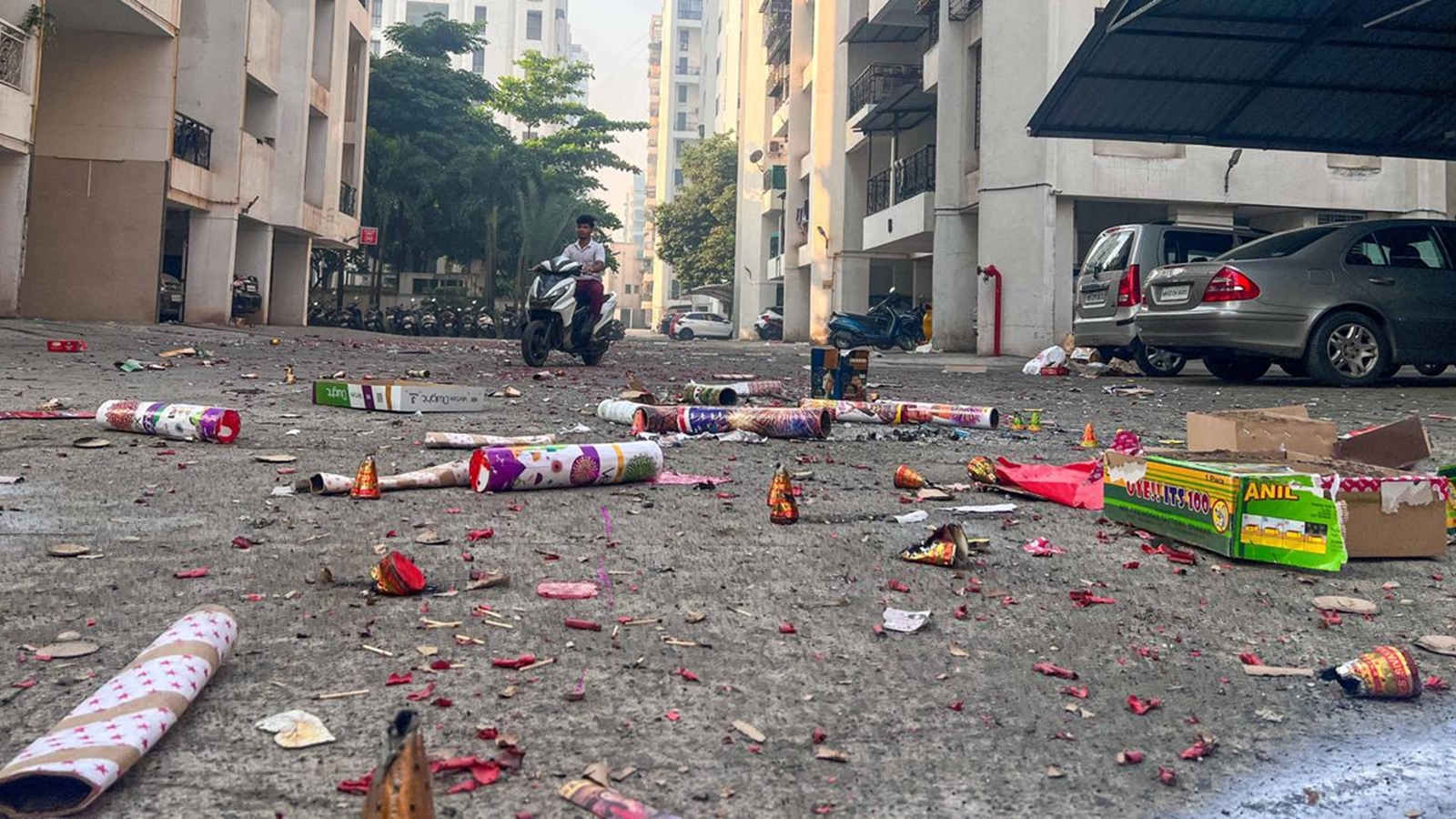 Spent firecrackers litter a housing society in Pune on Monday, a day after Diwali. The city’s AQI stood at 288, 2.5 times last year’s post-Diwali reading. (Express Photo)
What about Mumbai?
In contrast, Mumbai’s AQI of 172 is considered moderate, and most areas in the Mumbai Metropolitan Region stayed in the ‘moderate’ category. Bhiwandi had the highest at 195, while Dombivali was at 176, Kalyan at 170, and Navi Mumbai at 160. Some places like Mira Bhayander saw a drop, going from 256 to 148, while Bhiwandi experienced an increase from 111 to 195.
Why is inland Maharashtra worse than Mumbai?
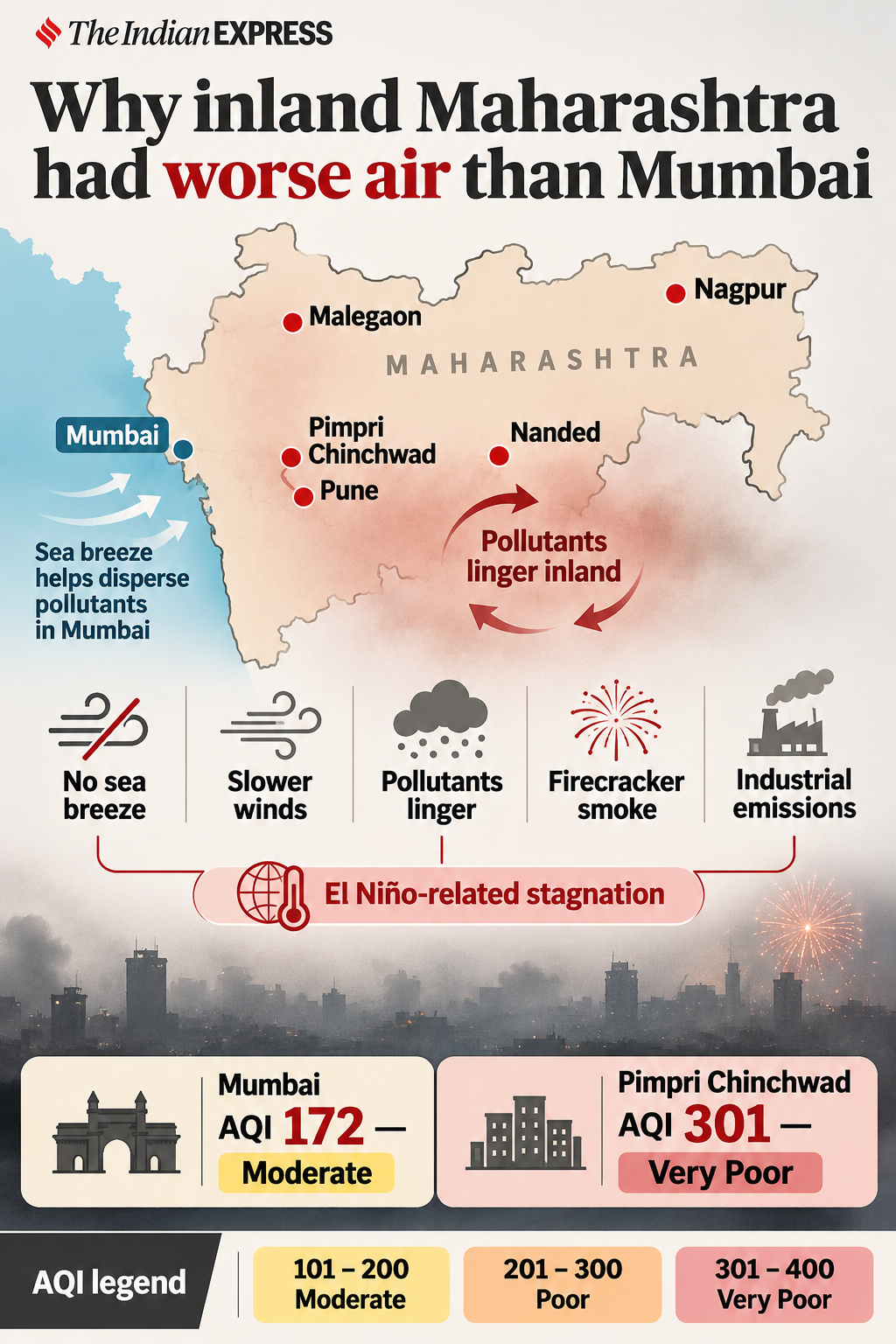
Gufran Beig, an atmospheric scientist at the National Institute of Advanced Studies (NIAS), explained that an anticyclonic circulation forming over the Himalayas starting November 10 brought in easterly winds for coastal areas like Mumbai, helping to disperse pollutants.
Story continues below this ad
“Since Mumbai is having the advantage of sea breeze, the pollution levels there have remained lower. However, Pune, Pimpri and Nagpur are located far away from the sea and they don’t have the advantage of sea-breeze. Additionally, the El-Niño condition has led to the slowing down of winds due to which these places are witnessing poor AQI. Therefore, now that crackers are being burst on such massive scale the pollutants are lingering in the atmosphere and there is also no air which can blow the pollutants away,” Beig told The Indian Express.
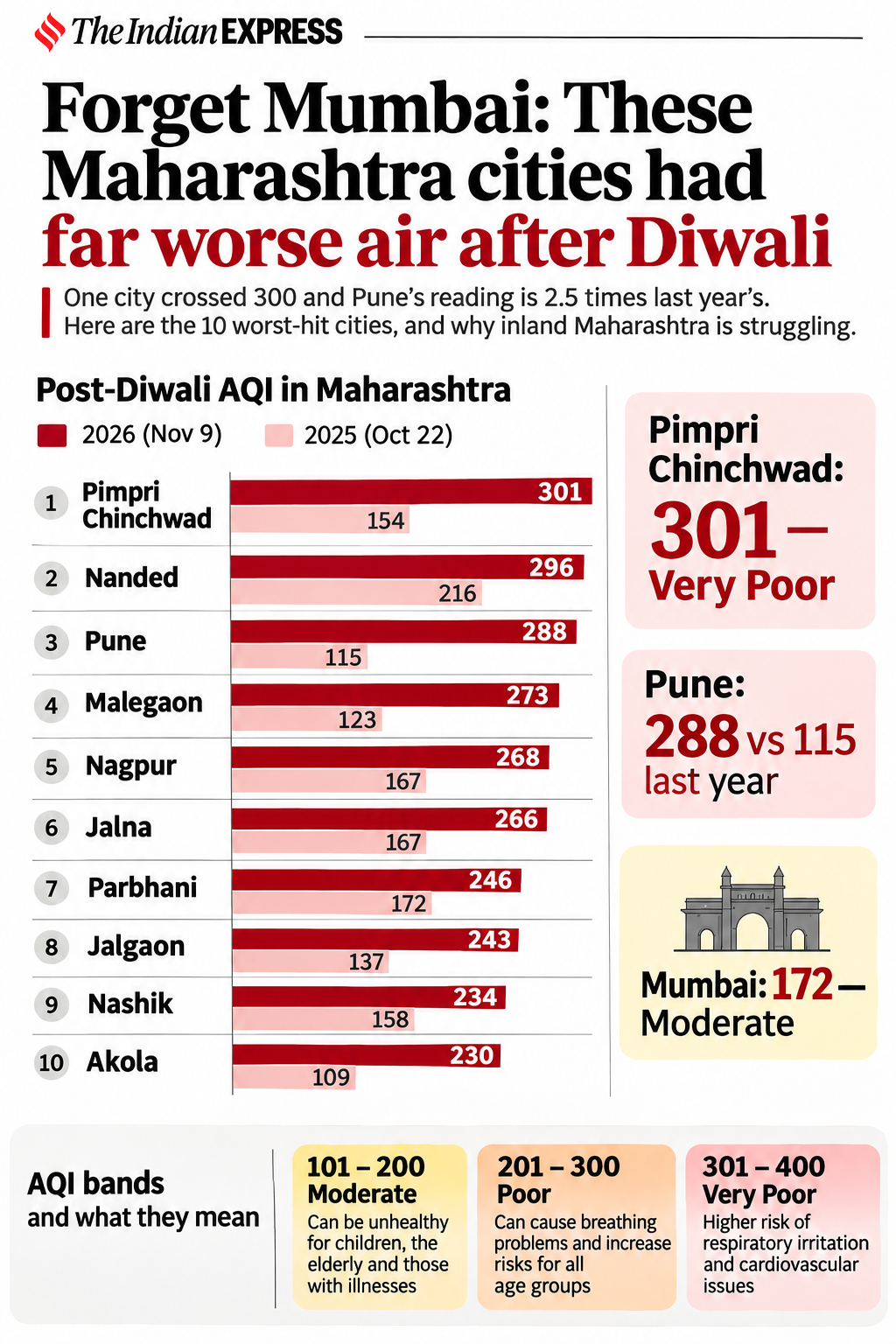
Tuhin Banerjee, a former scientist at the National Environmental Engineering Research Institute (NEERI), added that local issues have made things worse. Normally, Maharashtra’s coastal position would allow for wind reversal, where hot polluted air moves to the sea and is replaced by cooler sea air. However, this year, rising sea temperatures due to El Niño have created a stagnation point, he said. Plus, local factors like firecracker use and industrial emissions, particularly in districts like Chandrapur, are compounding the problem.
What have authorities done?
“The statewide AQI has worsened mainly because of cracker bursting. We have issued directions to all municipal bodies, tehsils and district collector’s offices to put an immediate ban on cracker bursting. We have also instructed the state police department to take immediate action on anyone seen bursting crackers in public places,” Satish Padval, joint director (Air) at the Maharashtra Pollution Control Board (MPCB), told The Indian Express on Monday.
In an unusual move on Monday, Thane district collector Shrikrishna Panchal imposed a ban on rockets and similar aerial firecrackers across the district, citing public safety. Shortly after, the Brihanmumbai Municipal Corporation (BMC) issued a similar order. The ban lasts until November 25 in Mumbai and until January 8, 2027, in Thane district. These measures cover the Mumbai region, except for Vasai Virar and Panvel.
Story continues below this ad
The decisions came after a spike in fires during Diwali night. The Mumbai Fire Brigade received 142 fire-related calls on Sunday, with 137 linked to fireworks, according to BMC data. Meanwhile, all 44 calls to the Thane Fire Brigade until Sunday night were caused by firecrackers.
What do the AQI categories and PM2.5 mean?
On the AQI scale, 101-200 is considered moderate, while 201-300 is poor and 301-400 is very poor. Those in the moderate range can be unhealthy for vulnerable groups like children and the elderly. In contrast, poor and very poor levels can pose health risks to all age groups, potentially leading to cardiovascular issues and respiratory irritation.
The main pollutant identified by the CPCB at these locations was PM2.5, which consists of fine particles measuring 2.5 micrometers or smaller. These particles, primarily emanating from smoke and combustion, are significantly smaller than a human hair and can easily be inhaled into the lungs.
KioskNews shows a cleaned-up reading view extracted from the publisher’s page — the original always lives on their site, not ours.