Pneumonia still third-biggest cause of death
VACCINATIONS: Getting pneumonia could lead to life-threatening conditions such as meningitis and sepsis, medical experts said on World Pneumonia Day
By Lee I-chia / Staff reporter


Pneumonia continues to be the third-most common cause of death in Taiwan, with one person dying from the disease about every 30 minutes on average, four medical associations said yesterday, urging elderly people to get vaccinated.
To mark World Pneumonia Day, held annually on Nov. 12, the Taiwan Association of Family Medicine (TAFM), the Infectious Diseases Society of Taiwan (IDST), the Pediatric Infectious Diseases Society of Taiwan (PIDST) and Taiwan Immunization Vision and Strategy (TIVS) held a joint news conference to raise public awareness.
Pneumonia is not a common cold and can trigger a systemic inflammatory response, especially in elderly people or those with underlying health conditions, TAFM member Fang Wen-hui (方文輝) said.
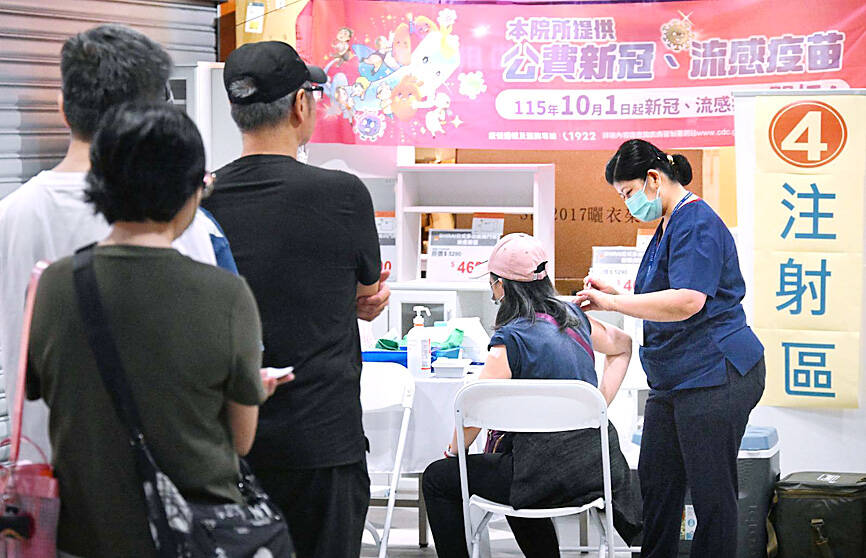
A person receives a vaccine shot in Taipei on Monday last week.
Photo: Fang Pin-chao, Taipei Times
Streptococcus pneumoniae is one of the most common pathogens of community-acquired pneumonia, and it usually remains latent and might invade the body when a person catches a cold or experiences declined immunity, he said.
If pneumonia progresses into invasive pneumococcal disease (IPD), leading to life-threatening conditions such as meningitis or sepsis, the mortality rate could become higher, he added.
PIDST chairperson Chiu Cheng-hsun (邱政洵) said that children younger than five and people aged 65 or older have the highest incidence rates of IPD, and if it triggers meningitis in young children, they might experience long-term neurological damage, such as hearing loss or epilepsy.
IDST president Chang Feng-yee (張峰義) said immune function gradually declines with age, making the lungs and airways increasingly vulnerable to infections.
As of Monday, IPD cases this year had reached 239, about half of whom were elderly people, Centers for Disease Control (CDC) Director-General Philip Lo (羅一鈞) said at the news conference.
The figure was about 20 percent lower than the same period last year, and the lowest in the same period in three years, while IPD deaths this year were also the lowest in four years, indicating the positive effect of vaccination, Lo said.
TIVS chairman Lee Ping-ing (李秉穎) said S. pneumoniae can easily spread from person to person, so unless one lives alone on an island, getting vaccinated is the best way to prevent infection.
Some people think vaccination is not important and they can just seek treatment when they get pneumonia, but this is risky, as they might develop severe complications that cannot be treated with antibiotics, he said.
Lee suggested that people who are eligible for the government-funded vaccine to get vaccinated for better protection.
People who have underlying health conditions or who smoke, but are not eligible for free vaccination can consult a doctor about whether they should get a vaccine shot paid out of pocket, Lee said.
Separately, the CDC said that as Monday, vaccination coverage among elderly people had reached 40.9 percent, but about 2.9 million elderly people have yet to be vaccinated.
Starting from Oct. 1, people aged 18 or older can receive 600 “health tokens” for getting a pneumococcal vaccine, either publicly funded or paid out of pocket, it added.
KioskNews shows a cleaned-up reading view extracted from the publisher’s page — the original always lives on their site, not ours.