Nazi-looted Kandinsky returned to Jewish heirs sells for £31.56m
Pic credit: Christie's
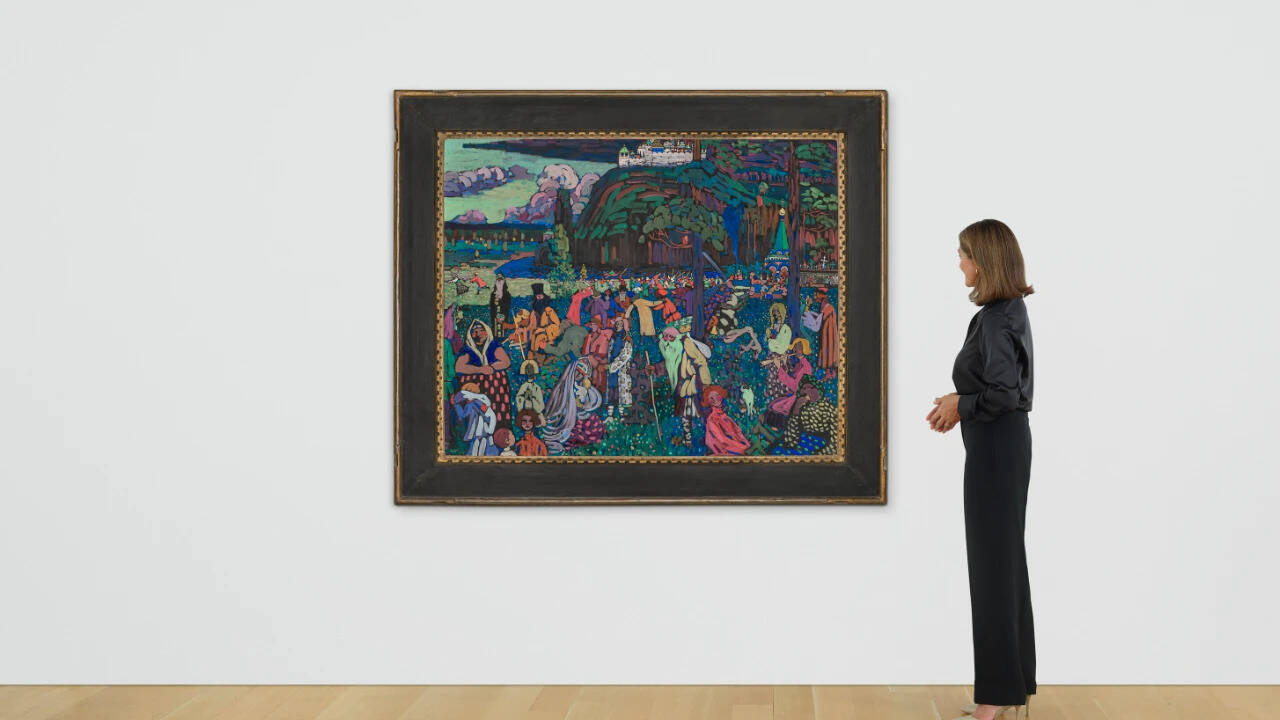
A 1907 masterpiece by Russian painter Wassily Kandinsky, looted from a Dutch-Jewish family during the Nazi occupation of the Netherlands, sold at a London auction earlier this week for £31.56 million (about $42 million, including fees), The New York Times reported.
The painting, Das bunte Leben (The Colorful Life), was returned to the family’s heirs in 2023 after decades of disputed ownership.
A Paris canvas
Pic credit: Christie's
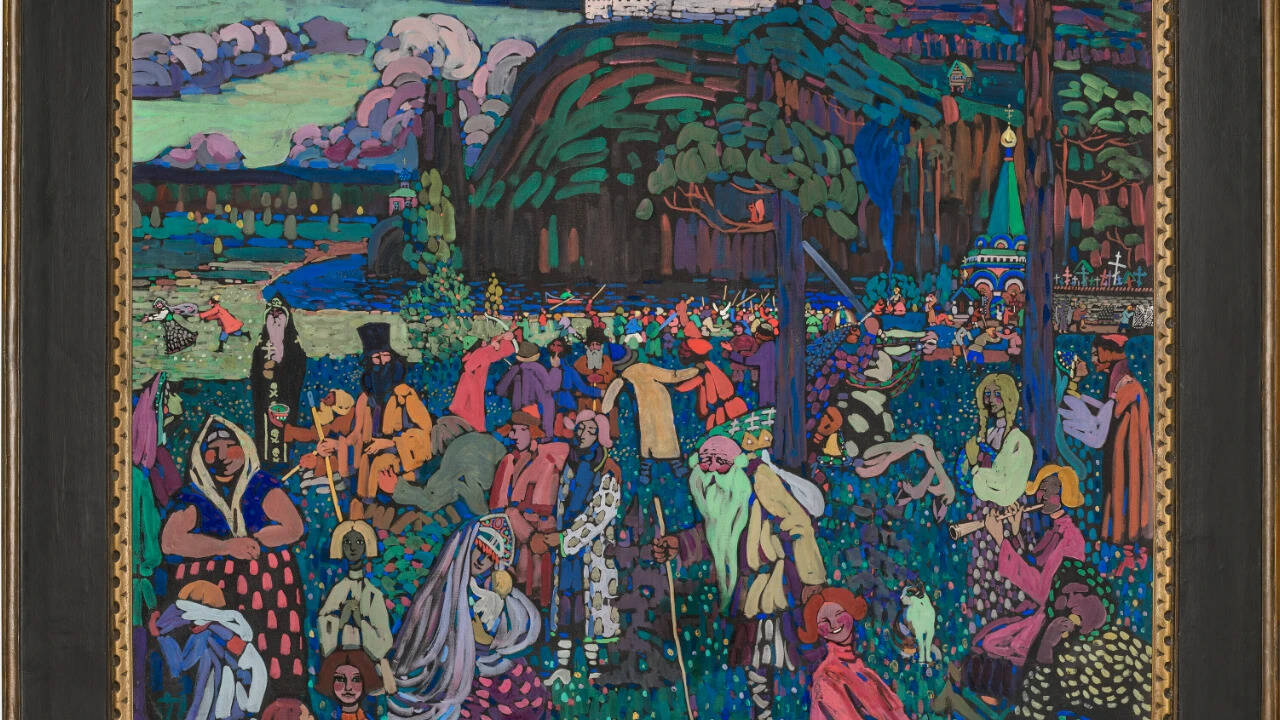
Wassily Kandinsky painted Das bunte Leben in Paris in 1907. At 130.5 × 162.6 centimetres, it was the largest canvas he had completed to that date.Christie’s describes it as a key work from his years in the city. With this painting, he wanted to “let the viewer take a stroll within the picture” and “become absorbed” in it.
“In this particular case, one strolls into a mysterious panoramic landscape teeming with life,” the auction house said.Kandinsky had high hopes for Das bunte Leben. In October 1907, it was exhibited at the Salon d’Automne. German art dealer Herwarth Walden later acquired the painting and displayed it in a 1912 exhibition of Kandinsky’s work at his Berlin gallery, Galerie Der Sturm.In November 1927, Amsterdam businessman Emanuel Albert Lewenstein and his wife, Hedwig Lewenstein-Weyermann, bought it.
The couple ran a sewing machine business in Amsterdam and built a collection that also included works by Jan Toorop and Jozef Israëls. The painting was later lent to the Stedelijk Museum, according to The Times of Israel.When Nazi Germany invaded the Netherlands in 1940, the Lewenstein collection was broken up. In October 1940, the Kandinsky was taken from the Stedelijk and sold at auction. “It remains unclear under whose direction the works came to market, or who benefited from the proceeds,” the auction house said.
The painting was then bought by Dutch collector Salomon B. Slijper. After his death in 1971, it entered the collection of Bayerische Landesbank in Germany, where it hung for decades.Historians have struggled to establish exactly how the painting was sold. In 1972, German bank Bayerische Landesbank (BayernLB) purchased it and lent it to the Lenbachhaus museum in Munich, where it remained on public display.“In 1972, BayernLB legally acquired the painting ‘Das Bunte Leben’ by Kandinsky at the instigation of the City of Munich.
The purchase negotiations were handled by the Lenbachhaus museum, where the painting has been publicly displayed on permanent loan ever since. Nonetheless, BayernLB is willing to take part in a review by the so-called Limbach Commission. BayernLB feels, however, that the commission’s decision should be binding on all parties.
BayernLB has expressed its desire that the painting remain on public display at the Lenbachhaus rather than be taken away,” BayernLB told The Guardian in 2017.The heirs reportedly filed a lawsuit against the bank in 2017. They spent years reconstructing the painting’s history, working with their own advisers and the Mondex Corporation. In June 2023, the bank returned the work to the heirs of Hedwig Lewenstein-Weyermann.
The London sale
Pic credit: Christie's
On Wednesday, 14 October, Christie’s sold the painting in its 20th/21st Century London Evening Sale. It beat its pre-sale high estimate of £25 million, closing at £27 million before fees and £31.56 million with them.
The masterpiece was the top seller of the evening. The identity of the buyer has not been disclosed.Christie’s describes Das bunte Leben as a painting “bursting with a kaleidoscopic play of vivid colour and vitalistic energy”. It is among the early masterworks of Kandinsky’s storied career, the auction house said.“Executed on a monumental scale that reveals the artist’s bold ambitions for the work, the canvas is alive with detail and incident, independent touches of vibrant pigment building a mosaic-like pattern that describes a panoramic, romantic view of the often conflicting and contrasting aspects of the lived experience. The scene teems with intriguing vignettes, the lively cast of characters offering juxtaposing visions of love and death, peace and chaos, danger and an idyllic, festive atmosphere, creating a rich symphonic composition that conveys the multifaceted nature of human existence,” the auction house described.
KioskNews shows a cleaned-up reading view extracted from the publisher’s page — the original always lives on their site, not ours.