Laos looks to wind energy for its renewables plans
AFP, SEKONG PROVINCE, Laos


Rising from verdant ridgelines of southern Laos, 133 Chinese-built wind turbines help power Vietnam’s surging growth and represent part of a regional rush to diversify energy sources.
“The view is beautiful. They’re bigger than trees,” Toukta Phonsala said inside her wooden stilt house in Dak Wai village.
Hydroelectric dams have proliferated across Southeast Asia over the past few years, but production drops off in the dry season and critics lament the ecological impacts.
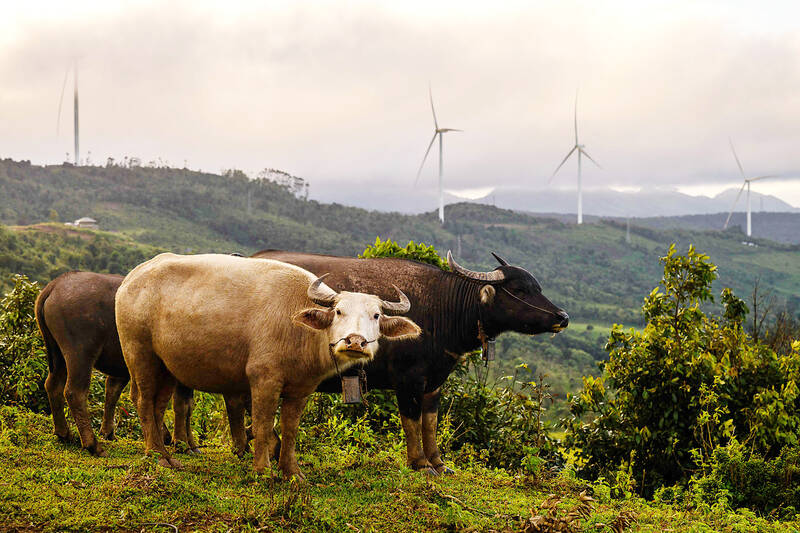
Buffaloes graze near wind turbines in Dak Cheung, a district of Sekong Province, which is part of Laos’ 600-megawatt Monsoon Wind Power Project.
Photo: AFP
Experts said wind is now set to take off, and point to Laos’ 600-megawatt Monsoon Wind Power Project, which began operating in August last year, as a bankable case study.
Spanning an area the size of Singapore, the US$700 million scheme is the first cross-border wind project in Asia and the largest wind farm in Southeast Asia. Built by a Chinese state firm and owned by a Thai-led consortium, it sells electricity exclusively to Vietnam’s national grid via dedicated transmission lines.
Manufacturing hub Vietnam, Southeast Asia’s fastest-growing economy, was already importing hydropower from Laos, its poorest neighbor.
However, “the economics are moving in favor of wind,” EnergyLab Asia technical program lead Tristan Bellingham said.
“Similar to hydro 20 to 30 years ago, there’s a bit of a rush on to secure concessions and development rights” for new wind projects, he said.
Laos already hosts 90 hydropower plants and there are dozens more in neighboring nations, leaving few optimal sites remaining.
For Toukta, the 18 family members she lives with, and other rice and coffee farmers residing near the turbines, Monsoon has brought new roads and improved access to fresh water and healthcare.
However, what it has not brought to her community is power.
Residents said they still experience outages during heavy storms, as Laos’ electricity infrastructure is outdated and the state utility is heavily in debt.
Still, Toukta is glad Laos can send power abroad, saying: “It’s better for development and can bring prosperity.”
For Vietnam, the project offers a reliable source of less costly energy.
There were severe blackouts in 2023 when drought cut into hydropower supply, and the government warned in September of the risk of electricity shortages from next year due to delays in planned power projects and increasing demand.
Through Monsoon, “wind power is being sold significantly cheaper to Vietnam than what Vietnam is buying wind power for locally,” Indochina Energy Partners managing director Thomas Jakobsen said.
He estimated state utility Electricity Vietnam was paying Monsoon about six cents per kilowatt-hour — two to four cents less than the Vietnamese rate.
The project is also key to Vietnam reaching net zero emissions targets by 2050, National Power Transmission Corporation official Ninh Xuan Hiep said.
By 2030, Laos imports would equal nearly 10 percent of Vietnam’s total installed capacity — its maximum possible production, the official said.
Monsoon Wind plans to boost capacity by 1,000 megawatts and is working to ensure some of this additional power is used inside Laos, general manager Narut Boakajorn said.
“Laos has so much natural resources” — wind, hydro and solar, Narut said. “Not many countries have all the good renewable energy in the same place. Laos has something unique.”
Nobody was forced to relocate because of the project, Narut said, although public dissent is severely restricted in communist Laos.
He said the 1,600 grievances logged, mainly from farmers requesting compensation for construction impacts on their crops, were resolved.
Farmer Phonekhan Sengsopha said he was proud that electricity produced in his country was being sent to its neighbor, also a communist nation.
“Because Vietnam and Laos are like brothers. They help one another,” he said.
KioskNews shows a cleaned-up reading view extracted from the publisher’s page — the original always lives on their site, not ours.