Ajay Devgn’s Drishyam 3 is a potent parable about how propaganda works
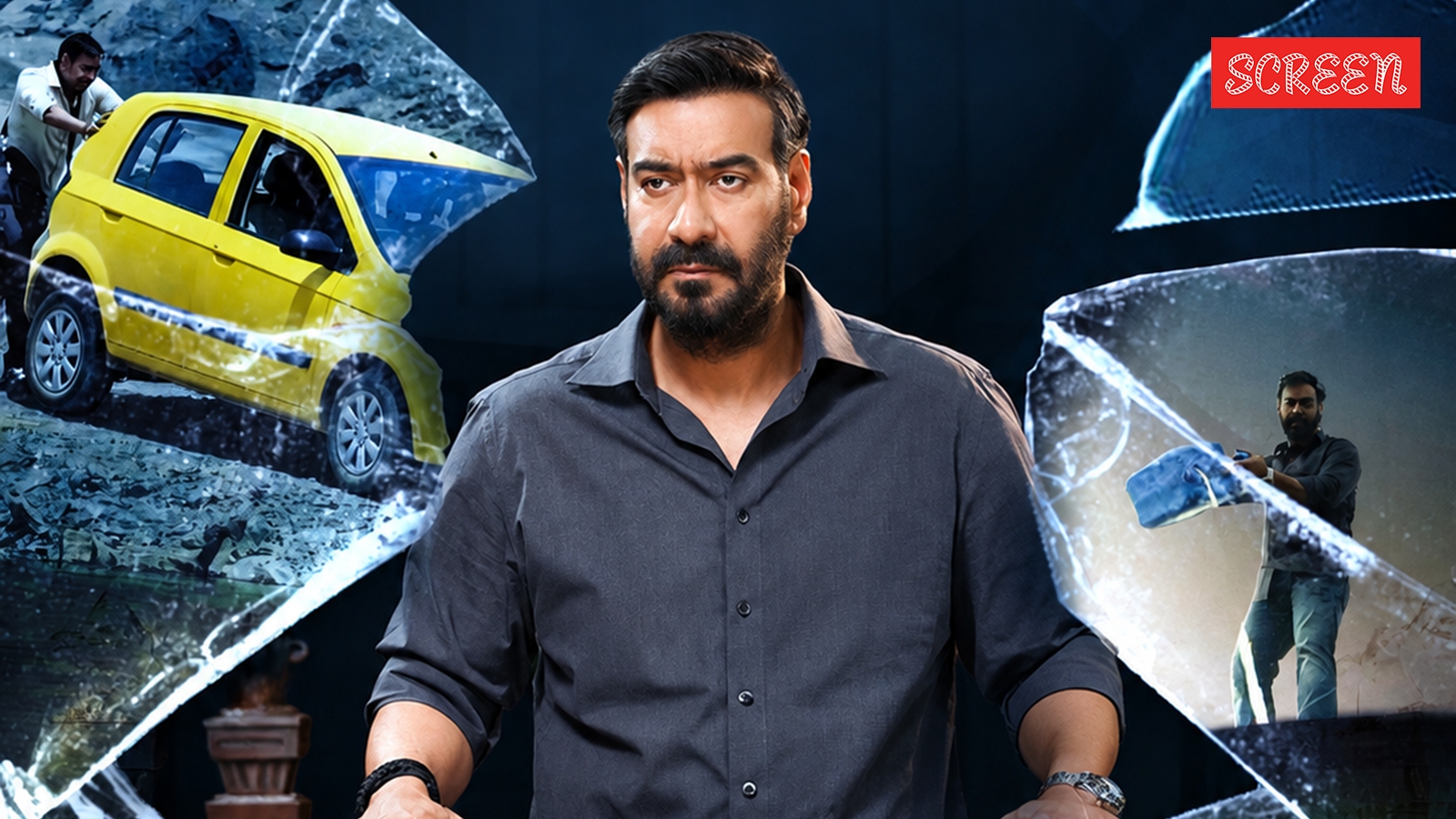
The only real silver lining in the Drishyam 3 franchise, from the beginning, has been its engagement with the idea of truth.
Drishyam 3 is a pedestrian thriller. It is startlingly safe in its own skin, content to walk the same well-worn architecture once again. However, its success, and that of the franchise at large, is perhaps less surprising. Because eventually, it isn’t really about a middle-aged, middle-class man doing whatever it takes to protect his family. It is about a man who, for once, gets to turn the machinery of a system that routinely overwhelms people like him against itself. The pleasure, then, lies not in Vijay (Ajay Devgn) being clever. But in his ability to outwit an audience that knows the skeletons in his closet. And still we sit there, willingly submitting to his trick. It is akin to being deceived by a magician whose deception you have already understood. That trick was genuinely fascinating in 2015, when the first film understood that Vijay’s deception could also be morally discomfiting. There was a certain dopamine rush to its structure. But by 2022, the same mechanism had begun to feel increasingly contrived. And in 2026, it feels like a headache being prolonged.
The only real silver lining in the franchise, from the beginning, has been its engagement with the idea of truth, or, more specifically, with the manufacture of truth. Vijay, armed with his cinephilic imagination, takes the two most fundamental instruments of cinema: the visual image and the spoken word, and uses them to construct, normalise and, eventually, make believable a truth that never existed in the first place.
Take, for instance, the second half of the 2015 thriller Drishyam. To save himself, Vijay does two things. First, he narrativises a lie by making his family live it. So, by inhabiting this fiction together, they not only create a visual record of the life they claim to have lived; the lie is also rehearsed until it no longer feels like one. And then comes the more ingenious part: they allow this manufactured truth to seep into their everyday lives, mentioning it in passing, casually, almost incidentally. They feed the fiction into the social bloodstream, where it returns to them as corroboration, ordinary people repeating it, almost like parrots, as though recalling a reality they had witnessed themselves. He takes it further in the sequel, writing a book that, like cinema, turns fiction into a record.
But the real leap comes in the third part, when he turns to WhatsApp to circulate yet another version of a reality that never existed. He understands that a lie becomes considerably harder to dislodge once it is no longer simply told but transmitted, forwarded and repeated by others. In doing so, he even instrumentalises a religion and its followers, appropriating their collective identity to lend credibility to his own fiction.
It is here that Drishyam begins to acquire a potent political resonance. The franchise becomes, perhaps inadvertently, an allegory for the mechanics of propaganda. What makes this particularly interesting is the subversion at its very centre. Vijay is not a man of power; he is an ordinary, uneducated middle-class citizen. But in manufacturing his version of reality, he is employing precisely the methods historically perfected by those who wield power: exploiting institutional gaps, manufacturing consensus, and making repetition do the work of truth.
ALSO READ | Ajay Devgn’s Drishyam 3 reminds us that more than family, the franchise is about movies
Story continues below this ad
The irony of Drishyam is that its protagonist defeats the system by learning to speak the language of power. And it is cinema, with its power to make us see, and therefore believe, that becomes both the metaphor and the mechanism of this transformation. There is something almost uncannily fitting about Drishyam 3 arriving in 2026, at a moment when Hindi cinema is increasingly less interested in telling stories than in manufacturing truths. Half-baked histories presented as fact, bigotry recast as conviction, hatred given the polish of entertainment. Vijay’s cinephilia, then, is hardly incidental. He has learnt his grammar of deception from the very medium that taught him how images, told not necessarily realistically but convincingly, can begin to pass for reality. In both cases, however, there is only one audience left to fool: us.
© IE Online Media Services Pvt Ltd

Anas Arif is a prolific Entertainment Journalist and Cinematic Analyst at The Indian Express, where he specializes in the intersection of Indian pop culture, auteur-driven cinema, and industrial ethics. His writing is defined by a deep-seated commitment to documenting the evolving landscape of Indian entertainment through the lens of critical theory and narrative authorship. Experience & Career As a core member of The Indian Express entertainment vertical, Anas has cultivated a unique beat that prioritizes the "craft behind the celebrity." He has interviewed a vast spectrum of industry veterans, from blockbuster directors like Vijay Krishna Acharya, Sujoy Ghosh, Maneesh Sharma to experimental filmmakers and screenwriters like Anurag Kashyap, Vikramaditya Motwane, Varun Grover, Rajat Kapoor amongst several others. His career is characterized by a "Journalism of Courage" approach, where he frequently tackles the ethical implications of mainstream cinema and the socio-political subtext within popular media. He is also the host of the YouTube series Cult Comebacks, where he talks to filmmakers about movies that may not have succeeded initially but have, over time, gained a cult following. The show aims to explore films as works of art, rather than merely commercial ventures designed to earn box office revenue. Expertise & Focus Areas Anas's expertise lies in his ability to deconstruct cinematic works beyond surface-level reviews. His focus areas include: Auteur Studies: Detailed retrospectives and analyses of filmmakers such as Imtiaz Ali, Anurag Kashyap, and Neeraj Ghaywan, often exploring their central philosophies and creative evolutions. Cinematic Deconstruction: Examining technical and narrative choices, such as the use of aspect ratios in independent films (Sabar Bonda) or the structural rhythm of iconic soundtracks (Dilwale Dulhania Le Jayenge). Industrial & Social Ethics: Fearless critique of commercial blockbusters, particularly regarding the promotion of bigoted visions or the marginalization of communities in mainstream scripts. Exclusive Long-form Interviews: Conducting high-level dialogues with actors and creators to uncover archival anecdotes and future-looking industry insights. Authoritativeness & Trust Anas Arif has established himself as a trusted voice by consistently moving away from standard PR-driven journalism. Whether he is interrogating the "mythology of Shah Rukh Khan" in modern sequels or providing a space for independent filmmakers to discuss the "arithmetic of karma," his work is rooted in objectivity and extensive research. Readers look to Anas for an educated viewpoint that treats entertainment not just as a commodity, but as a critical reflection of the country's collective conscience. ... Read More
Click here to follow Screen Digital on YouTube and stay updated with the latest from the world of cinema.
KioskNews shows a cleaned-up reading view extracted from the publisher’s page — the original always lives on their site, not ours.