Advocates criticize handling of river silt buildup issue
By Esme Yeh / Staff reporter


Environmental advocates yesterday questioned the government’s handling of a river siltation problem in northern Tainan in which NT$1.3 billion (US$40 million) was allocated for bridge rebuilding without taking any action against allegedly illegal upstream land clearing.
The advocates convened a news conference in Taipei where they presented aerial photos showing that patches of woodland in Baihe District (白河) had been cleared, mostly within Baihe Reservoir’s water source quality protection area.
They said illegal land clearing has caused the build up of silt not only in downstream rivers such as the Jishuei River (急水溪), but also across local farmland.
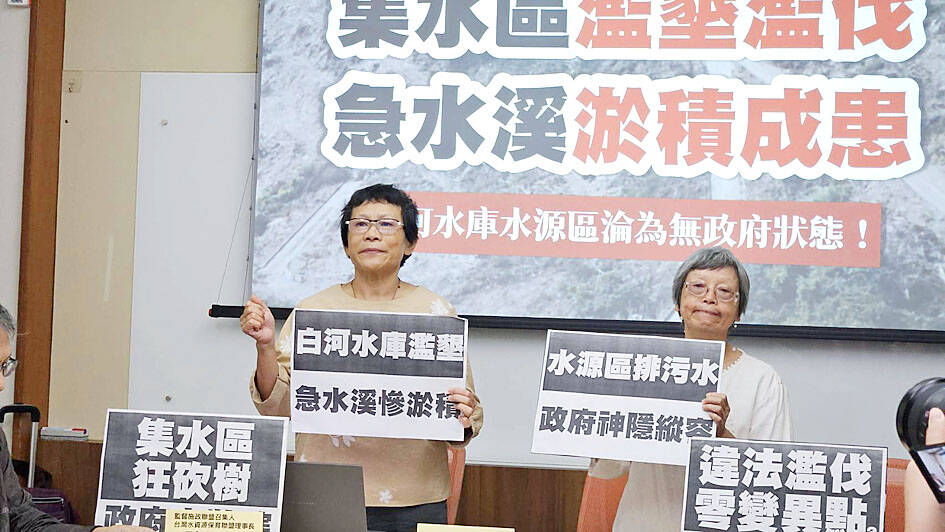
Taiwan Water Resources Conservation Union chair Chen Jiau-hua, left, presides over a news conference in Taipei yesterday.
Photo: CNA
Farmer Chang Ling-teng (張令騰) said he has eight hectares of farmland near the river and the Chianan Irrigation Canal (嘉南大圳), which faces serious siltation issues, especially following typhoons.
The silt erodes cultivation areas and can build up to 2m on the farmland, he said.
“Our fields are flooded with silt whenever Baihe Reservoir releases water during typhoons,” Chang said, adding that Typhoon Gaemi in 2024 caused the most severe agricultural losses.
Siltation issues forced Chang to abandon six hectares of green bamboo cultivation, he said.
Taiwan Water Resources Conservation Union chair Chen Jiau-hua (陳椒華) said the government has built Baihe Reservoir sediment bypass tunnels, which brings sediment into the Jishuei River.
Downstream siltation worsened around the Jishueisi Bridge (急水溪橋) — which spans the river’s main stream — as well as Cingye Bridge (青葉橋) and Baihe Bridge, which cross the river’s tributaries, she said.
Union executive director Wu Li-hui (吳麗慧) said that the government allocated NT$1.3 billion to reconstructing the three bridges, including NT$100 million for Baihe Bridge, NT$350 million for Cingye Bridge and NT$850 million for Jishueisi Bridge.
Combined with the Forward-Looking Infrastructure Development Program’s NT$1.75 billion budget invested in the reservoir sediment bypass project, the government has spent a great amount to solve the issue, she said.
However, it failed to stop upstream illegal land clearing and more than 10,000 tonnes of sediment continues to be discharged into the Jishuei River whenever heavy rainfall occurs, Wu said.
The Tainan Water Resources Bureau said that operators have been penalized for illegal land development in accordance with the Soil and Water Conservation Act (水土保持法).
Removing vegetation without changing the terrain is not punishable by the act, it said.
Regarding which agency is responsible for inspecting such land clearing, it was agreed that the Ministry of Agriculture’s Irrigation Agency is responsible.
However, the broader water source quality protection area requires coordination between the Irrigation Agency’s Chianan Management Office and the city government, the Water Resources Agency said.
KioskNews shows a cleaned-up reading view extracted from the publisher’s page — the original always lives on their site, not ours.