Am I rich enough to pay for my own full-body MRI scan for peace of mind?
Sonia Keuroghlian’s husband, a radiologist, has seen cancer in people in their 20s and 30s, younger than the ages recommended for most publicly funded cancer screening.
Sign In or Create an Account
So, when the Toronto couple turned 40, he suggested they undergo full-body MRI (magnetic resonance imaging) scans at a private clinic in Vancouver, where her husband is from, and where they were vacationing in August 2018, “just to make sure everything is OK,” Keuroghlian said.
She was healthy, active, fit, and feeling perfectly normal, which is why, when the radiologist later pulled up an image of a 10.5-centimetre tumour attached to the outside of her stomach, “my world turned upside down,” said Keuroghlian, a corporate lawyer.
“I had two kids at the time; they were six and eight. And the craziest part is that I didn’t feel anything.” The tumor, she was told, was like a water ballon “that squeezes its way between organs, so it moves with you and you don’t really feel it until it’s grown to the point where it’s attached to other organs.”
What followed was a “whole bunch of other imaging” back in Toronto and, later, laparoscopic surgery to remove the gastrointestinal tumour. “I was lucky because it hadn’t metastasized, so I didn’t need chemo or radiation.”
Eight years and a third child later, she’s cancer free. “I feel so lucky that we caught it when we did.”
Keuroghlian had her scan with Prenuvo, a Canadian-founded and now California-based provider of “proactive” whole body screening endorsed by Kate Hudson, Kim Kardashian and Jason Bateman.
To the chagrin of many medical groups who argue there is no sufficient evidence full-body scans are effective at prolonging life, the pricey scans are gaining popularity, with Prenuvo alone surpassing the 200,000-scans mark since setting up its first clinic in Vancouver in 2018, later expanding into California’s Silicon Valley and then across the United States.
Prenuvo founder and CEO Andrew Lacy said some clients have a family history of cancer or disease and are seeking screening “for peace of mind.”
“We’re able to pick up these conditions early — in the case of cancer, typically when it’s still localized to the organ of origin and when the patient is still asymptomatic.”
Others have indeterminate symptoms that aren’t being “quickly or easily resolved by the health system and they want to go and get the most advanced screening they can, to get to an answer to the problem.”
Lacy said “proactive health care,” as a sector, is growing 30 per cent a year. “We would love to be operating in more Canadian markets. There’s certainly tremendous demand.”
For a fee — roughly $2,500 to $3,000 at private clinics — the scans are marketed as a tool to detect diseases and abnormalities lurking inside asymptomatic bodies. In its promotional material, Prenuvo says whole body MRI can detect brain aneurysms at risk of rupture, kidney cancers, degenerative disc disease, adrenal masses, lymphoma and a host of other conditions.
The company offers full body scans for $2,999, and faster (under 30 minutes) head-to-mid-thigh scans for $1.499. Prenuvo memberships start at around $1700, and include the faster scan.
Whole Body MRI in Ontario has two locations where opting for a scan not only benefits the body but also “peace of mind,” according to the company website. Their “signature” head/neck-to-knee scan costs $3,250; a $3,650 package includes a comprehensive blood work up.
In addition to clinics in major American cities, Prenuvo launched a mobile clinic near the U.S.-Canada border in Buffalo two years ago to meet what it described as a growing waitlist of Canadians. Restrictions on private imaging services in Ontario have so far stalled efforts to open a clinic in Toronto.
“When we opened our Buffalo clinic, over 10,000 Canadians joined the waitlist,” said Prenuvo spokeswoman Christine Alabastro. “At peak, nearly 80 per cent of our patients were crossing the border from Canada.
“Those numbers highlight the gap between what Canadians want and what the current system offers them.”
Full-body scans are marketed as “empowering,” a way to shift from a passive — let’s wait for symptoms to appear — to proactive — let’s get ahead of things — approach. They appeal to the “preventive medicine-oriented crowd,” said Dr. Dan Durand, chief medical officer at Prenuvo.
When they first started out in Silicon Valley, clients were predominantly male biohacker types. Today, Prenuvo patients skew more female (close to 60 per cent) than male.
Eighty per cent, regardless of sex, come without symptoms. Most have no chief complaints, though Canadian patients tend to be slightly older, and slightly sicker, often coming because of long MRI waitlists at home.
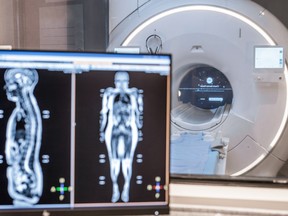
The scan takes roughly 40 to 100 minutes, depending on the package purchased. People must fast for several hours ahead of time. They’re given earplugs, headphones or both, to lessen noise from the thumping, knocking and banging from the magnetic fields generated.
Organs scanned include the brain, spine, lung, liver, gallbladder, spleen, bladder, pancreas, ovaries and uterus in women, and prostate in men.
Days later, people receive the results that are then discussed in a follow-up with a nurse practitioner or other licensed provider, Durand said. “It’s like a 30-page book, your personal owner’s manual.”
The scans can show “normal” or “informational findings,” he explained. Other times the scans detect things of “moderate severity,” like early signs of arthritis or fat in the liver. “It isn’t like something you’re going to need to see the doctor about immediately,” unless, say, it’s a high degree of fatty liver.
Professional organizations such as the Canadian Association of Radiologists, among others, strongly oppose whole-body MRI screening in symptom-free people.
“There is no compelling evidence from high-quality studies demonstrating that whole-body MRI screening in asymptomatic individuals improves long-term health outcomes, reduces morbidity or mortality or leads to better health at the population level,” reads the Canadian radiologists policy statement.
Among the concerns are the risk of false positives and “incidentalomas” — masses or tumours of uncertain or dubious significance that often require more invasive testing, biopsies or even surgeries to rule out, shifting the burden of follow-up to the publicly funded system.
A recent article published in Canadian Family Physician reported that, based on two systematic reviews, 94 per cent of asymptomatic adults who undergo whole-body MRI (WBMRI) screening for cancer will have a “radiologic abnormality,” up to 30 per cent will require follow-up investigations and 1.1 to 1.6 per cent will have a confirmed cancer.
Information on the number and causes of death were not available, there are no randomized controlled studies comparing people who received whole-body MRI for cancer screening to people who did not, and it’s not known how many people who had a negative test result “ended up having cancer,” the Alberta authors wrote.
“WBMRI for cancer screening in asymptomatic adults should not be encouraged,” they concluded.
Prenuvo’s Durand said the scans aren’t meant to replace primary care or other screening tests, like publicly funded screening in Canada for breast, prostate and cervical cancer. “We never want to be viewed as saying that stuff is being replaced by us,” he said.
Prenuvo is, however, facing a lawsuit filed by a New York man who alleges a radiologist failed to spot signs of a narrowing and irregularity in a cerebral artery that led to a stroke eight months later, an allegation the company has reportedly denied in court filings, Radiology Business reported.
Before Keuroghlian’s own scan, friends wondered, why bother? “Afterwards, they all started flying to Vancouver to get scans because they couldn’t believe what happened.”
Keuroghlian said neither she nor her husband have received compensation or free scans for speaking to the media about her experience with a private clinic MRI. She recently did a TV interview and said she wasn’t even reimbursed for having to park her car for the day.
“There’s always this debate whether it’s OK to have private health care and is it excluding people (who can’t afford it). I don’t have a full answer to that, but one thing I can say: If I had not found out when I did and (the cancer) was detected later when it was more serious requiring more invasive surgery and chemo, and God knows what would have happened to my qualify of life, that would have cost (Ontario’s public insurance plan) a lot more than having laparoscopic surgery to remove the tumour” before it became more widespread, she said.
National Post
Join the Conversation
This website uses cookies to personalize your content (including ads), and allows us to analyze our traffic. Read more about cookies here. By continuing to use our site, you agree to our Terms of Use and Privacy Policy.
KioskNews shows a cleaned-up reading view extracted from the publisher’s page — the original always lives on their site, not ours.