A nest of fire ants with ‘multiple queens’ has been found in Sydney. Here’s what you need to know
The New South Wales government is scaling up its fire ant response after saying a nest detected in the state was “larger and more complex” than initially thought.
A fire ant nest was found in the Sydney suburb of Auburn over the weekend – the second discovered in the city this year after a detection in Enfield in September.
The Auburn fire ant nest was treated, but authorities have since identified more ants and a colony type – known as a “polygyne social form” – requiring further treatment.
“Unlike colonies with a single queen, these colonies contain multiple queens and can support a higher concentration of ants and nests within a relatively small area, making them complex to treat,” the NSW government said in a statement on Wednesday.
“This type of colony has not previously been detected in NSW and is rare even in south-east Queensland, where fire ants are more widespread.”
The NSW agriculture minister, Tara Moriarty, said the government was boosting resources and establishing a taskforce to focus on tracing the supply chains that have led to the outbreak.
“We’re asking the community to work with us by reporting any suspicious ants or earth mounds and cooperating with our teams as they check businesses, residences and public lands in the area.”
Here’s what you need to know.
What are fire ants?
Solenopsis invicta, the red imported fire ant (Rifa), is an extremely invasive species of fire ant, so called because of its powerful sting. They are particularly good at spreading and are well adapted to parts of Australia which are similar to their native environment in the Pantanal in South America. They can survive underground for years, then form rafts in floods, travelling to colonise new ground. They have moved around the world in infested soil attached to shipping containers.
Where have they been found in Australia?
Fire ants were first detected at the Port of Brisbane in 2001, but they may have been present since about 1992, according to a 2021 strategic review of the national Rifa response. They have infested about 700,000 hectares of south-east Queensland. Seven other incursions – all linked to ports and airports – including in Gladstone, the Port of Botany and the Port of Fremantle, have been eradicated.
In 2023, five Rifa nests were detected by a member of the public 13km south of the Queensland border on council land in South Murwillumbah in NSW, prompting a biosecurity response and urgent calls for biosecurity funding.
In September, fire ants were confirmed in Sydney for the second time – the first outbreak since being eliminated from the Port of Botany more than a decade ago – in a logistics centre in the suburb of Enfield.
What do Rifa look like?
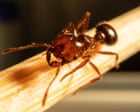
Ranging from 2mm to 6mm in size, individuals are copper brown in colour with darker abdomens. Their nests look like small mounds of loose, crumbly dirt and are most often in direct sunlight on lawns, near concrete paths, taps and bodies of water, or along fence lines. To check the identity of a suspected nest, the Queensland government says to gently poke the mound with a long stick and then check the ants “erupting” from the disturbed soil.
How are they killed?
Usually with bait, which is put down and then taken into nests by the highly efficient foraging ants. An alternative is direct nest injection using a chemical used in dogs’ flea collars.
What will a fire ant do to me?
When a nest is disturbed, the ants swarm and a pheromone triggers simultaneous stinging en masse. One sting is similar to a bull ant bite, but in high numbers, stings can overwhelm victims. Anaphylaxis and secondary infections can cause death. A 2008 World Health Organization study estimated that 30-60% of people living in affected areas are stung each year, while a 2021 Taiwanese study found that 2.8% of sting victims exhibited anaphylactic shock. Rifa have caused about 85 deaths in the US, including a 43-year-old Georgia woman who died after stepping on a nest in June and an 87-year-old woman who died after being stung 1,625 times in 2000. Pets, livestock and native animals are also vulnerable.
How else can they affect us?
They can damage electrical and agricultural equipment, kill native plants and damage ecosystems beyond repair. Soil displacement damages infrastructure, in turn exposing workers. A 2021 report for Biosecurity Queensland found Rifa could cut agricultural output by up to 40%.
Without proper management, Rifa “will surpass the combined effects of many of the pests we currently regard as Australia’s worst invasive animals (rabbits, cane toads, foxes, camels, wild dogs and feral cats),” stated a 2016 independent review of the eradication program.
In March, games at a sports oval in Brisbane were called off because of a fire ant nest.
What do I do if I see a fire ant?
The NSW government says the public should not try to destroy nests or capture ants. Instead, they should take a photo or video and report sightings online or by calling 1800 680 244.
KioskNews shows a cleaned-up reading view extracted from the publisher’s page — the original always lives on their site, not ours.