Fewer hazy days, bigger bill: Singapore’s estimated 2026 haze costs hit S$2.32b, surpassing 2015
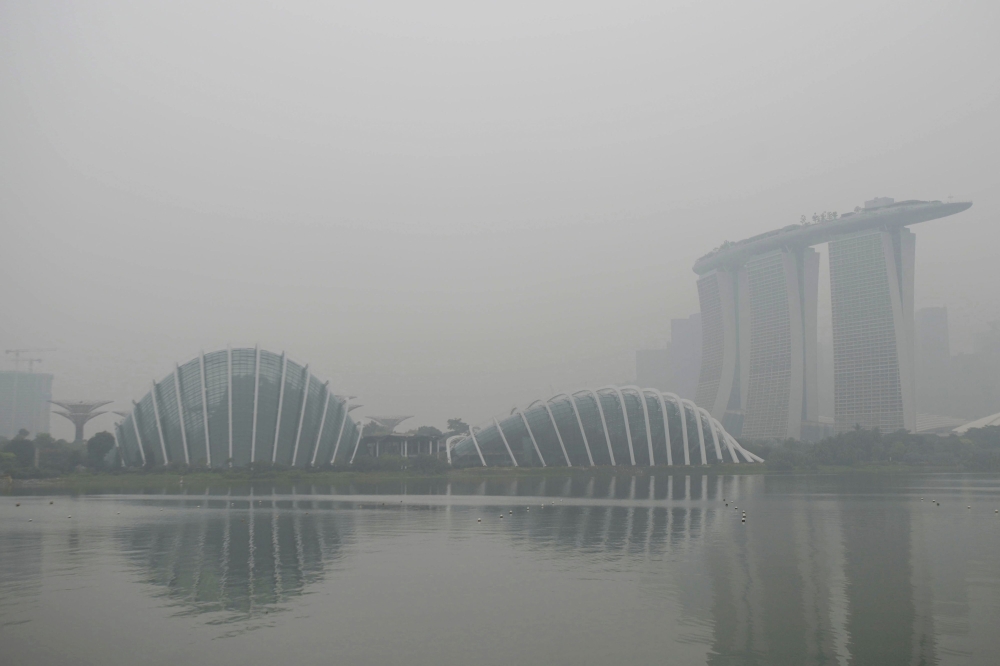

The Flower Dome, Cloud Forest and Marina Bay Sands are seen in Singapore October 15, 2026, when the country was shrouded in haze caused by fires in Indonesia. — AFP pic
By Malay Mail
First Published: Sunday, 08 Nov 2026 6:55 PM MYT
SINGAPORE, Nov 8 — Singapore’s 2026 haze episode has cost its economy an estimated S$2.32 billion (RM7.34 billion), exceeding the inflation-adjusted cost of the 2015 crisis despite fewer hazy days and lower average pollution levels, according to a preliminary assessment by two university researchers.
The estimated losses as at October 31 were about 4 per cent higher than the inflation-adjusted S$2.23 billion estimated for 2015, Singapore’s The Business Times reported.
The assessment, by Nanyang Technological University’s Euston Quah and Singapore University of Social Sciences’ Eugene Or, attributed the higher cost to population growth, rising incomes, increased visitor spending and a greater estimated health burden.
Health-related costs, including medical treatment and the economic impact of illness and premature deaths, were higher than in 2015, as were tourism losses.
However, losses from time taken off work and other activities due to illness, along with spending on protective measures such as masks, declined because of the shorter and less severe haze episode.
The assessment also factored in the impact on public well-being, including people’s willingness to pay for cleaner air.
“The sheer scale of this damage strengthens the case for funding prevention alongside tougher penalties,” the researchers said.
Quah and Or suggested that Singapore and other affected countries could help finance alternatives to land clearing by burning, particularly in Indonesia, to reduce the risk of future haze episodes.
Under a proposed “victim-pays” approach, countries affected by haze would contribute towards making fire-free practices more affordable.
“If supporting fire-free practices costs less than the damage avoided, contributing can leave these countries better off,” they said.
The researchers acknowledged that the proposal raised questions of fairness, stressing that companies responsible for fires should still be held accountable.
They also cautioned against treating the estimated economic losses as justification for equivalent spending on prevention.
“A S$2.32 billion haze bill does not automatically justify a S$2.32 billion prevention budget,” they said, calling for phased funding tied to measurable results.
They added that any proposed intervention would also require a thorough cost-benefit analysis to ensure public money was directed towards measures that meaningfully reduced fire risks.
KioskNews shows a cleaned-up reading view extracted from the publisher’s page — the original always lives on their site, not ours.