Army plans dedicated testing facility for missiles
By Lo Tien-pin and Fion Khan / Staff reporter, with staff writer


The army plans to commission the National Chungshan Institute of Science and Technology (NCSIST) to build dedicated testing facilities for its indigenously developed Lu Chien II (陸射劍二, “Land Sword II”) missile systems, with a budget of more than NT$295 million (US$9.27 million), marking move toward fully self-reliant air defense logistics, sources said yesterday.
The move came as the navy’s missile inspection and testing capacity has become increasingly strained by growing demand associated with its next-generation light frigates and the Kang Ding-class frigate, as well as demand for the production and testing of Hai Chien II missiles (海劍二, “Sea Sword II”), a senior military official said on condition of anonymity.
From 2028, the navy would no longer support testing for the army’s surface-launched Land Sword II missiles, they said.
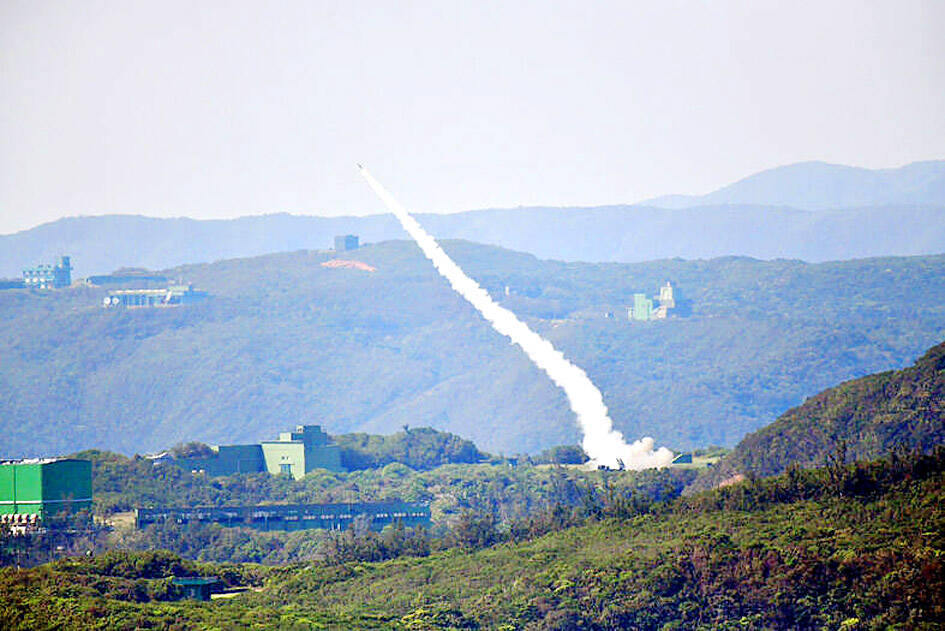
A Land Sword II missile is launched during a live-fire exercise at Jiupeng Military Base in Pingtung County in an undated photograph.
Photo: Tsai Tsung-hsien, Taipei Times
As the NCSIST had prioritized developing the Hai Chien II missiles, during the early development of the Land Sword II system, it relied heavily on naval equipment and vessels to verify launch ignition, radar integration and terminal seeker performance, they said.
The navy’s test ship, the Kaohsiung, served as a missile-testing platform, they added.
To prevent gaps in air defense readiness, the army has decided to abandon the cross-service testing arrangement and invest nearly NT$260 million in building an independent support capability, they said.
While the budget does not cover new missile acquisitions, it is a crucial step toward self-reliant logistics, the official said.
The funding would be used to comprehensively refurbish facilities, install temperature and humidity-controlled systems, upgrade ammunition safety infrastructure and procure dedicated testing equipment, they said.
The new systems would be capable of simulating radar signals and midcourse guidance commands, as well as conducting full-circuit diagnostics on missiles, they added.
The facility would allow the army to carry out inspections, functional tests and seeker calibration for Land Sword II missiles without relying on the navy, significantly improving maintenance flexibility and operational readiness, they said.
The move aligns with the army’s upcoming five-year, NT$3.65 billion procurement program to acquire additional Land Sword II missiles, which begins in the next fiscal year, the official said.
The NCSIST is upgrading its Land Sword II system to cut reload times from nearly 30 minutes after firing to less than 10 minutes, they said, adding that a standardized launcher canister would also be adopted.
The new testing facility is expected to open alongside the army’s procurement of upgraded missiles from next year to 2031, allowing newly manufactured missiles to undergo immediate intake testing, the official said.
With the delivery of the initial batch of 246 land-based Land Sword II missiles, the synchronized logistics model gives field air defense units complete operational autonomy, the official said.
In-house intake of new missiles, life extension for older units and routine overhauls will form a streamlined, end-to-end process within the army, they added.
The initiative would improve the readiness of the army’s mobile air defense units during precision firing exercises, which would be another significant step in bolstering Taiwan’s asymmetric warfare capabilities, integrated air defense network and logistics resilience, they said.
KioskNews shows a cleaned-up reading view extracted from the publisher’s page — the original always lives on their site, not ours.